

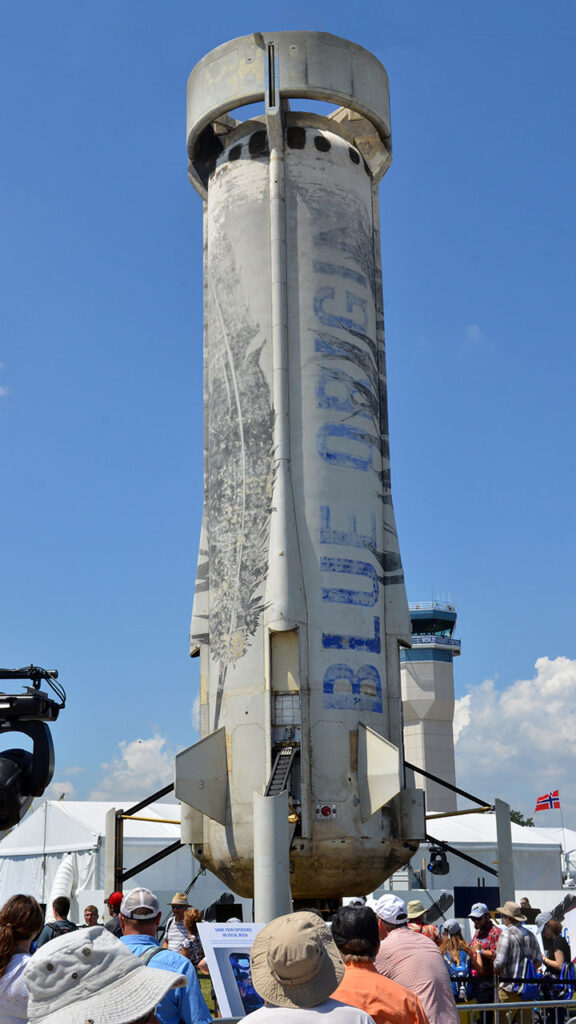
When SpaceX blasts off a Falcon 9 rocket with a payload of supplies for the International Space Station, a piece of Northeast Wisconsin goes with it.
Actually, several pieces. And it’s more than just SpaceX.
With the growth of commercial spaceflight in the past decade, Northeast Wisconsin has tapped its aviation and aerospace roots and its manufacturing excellence to create growth opportunities within this newest frontier.
“We do space,” says Paul Knoll, chief executive officer of Shawano‑based JR Machine, which produces components for commercial payload rockets from nickel‑based, high‑temperature alloys. “We are doing all of the major launch companies. Demand is high. Space is an ascending market sector for us.”
JR Machine is not alone.
Wisconsin Aluminum Foundry has also found growth in the aerospace sector, also with the launch companies, particularly within the past five to six years, says Sachin Shivaram, chief executive officer of the Manitowoc‑based company.
“The launch companies are buying a lot of components, and when they are buying, we get to participate in that sector,” Shivaram says, describing recent launch components that included polished brass disks for a flywheel assembly in a satellite as well as a highly polished aluminum dish with extremely tight tolerances.
WAF also produces drone components for the defense industry.
“This region has a lot of capabilities,” he says.
Those capabilities have empowered companies to tap into a rapidly growing market and have regional economic leaders studying how a coordinated effort could yield further growth.
Global economic activity in the commercial space sector has doubled in the past decade, growing to $626 billion from roughly $310 billion. Private commercial launch companies such as SpaceX, Blue Origin and United Launch Alliance have driven down the per‑launch cost of lifting payloads into space, driving additional launch activity, according to PricewaterhouseCoopers’ Next in Space 2025 report.
But there is more to aerospace than launching rockets. In fact, there is more to it than things that fly. Aerospace as an economic sector generates more than $1 trillion in annual economic activity, according to the Aerospace Industries Association, almost evenly split between commercial aerospace and defense and national security.
The industry is further broken down into sectors including original equipment manufacturers; parts and supply chain; and maintenance, repair and overhaul. There are companies in Northeast Wisconsin that have found opportunities — some quite significant — in all of those aspects of the broader aerospace category.
It’s more than regional manufacturers’ ability to make things, though that helps. Northeast Wisconsin has both a broad reach and a long history with the sector, notes Barb LaMue, president and founder of Pebble Rock Partners, an economic development consulting firm.
“Clearly the decision for Gulfstream to locate a major operation next to [Appleton International Airport] points to the strength of the region in this space,” LaMue says. “Besides the heavy manufacturing for aerospace products, the region has business aviation, general aviation and aviation education. Along with [Experimental Aircraft Association], the educational ecosystem gives the region assets for developing aviation talent.”
A broad ecosystem
Plexus Corp. engineers and produces electrical systems and components used in a variety of applications for aviation and space. Gulfstream Aerospace operates a major maintenance and cabin completion facility at Appleton International Airport. The airports in Oshkosh, Appleton and Green Bay all have fixed base operators and aviation services companies, as well as airlines at ATW and GRB.
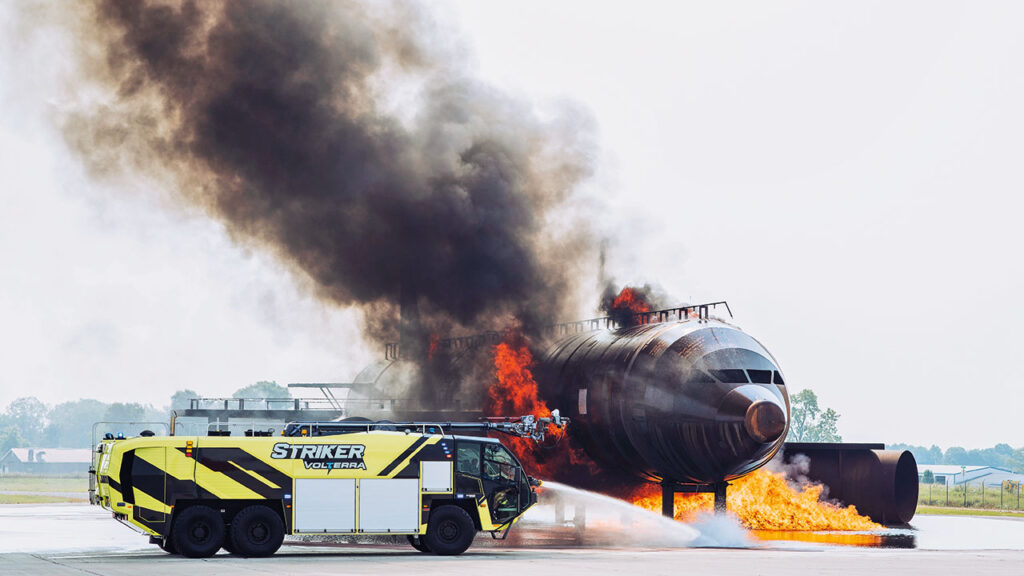
Oshkosh Corp. may not make aerospace products that fly, but airports around the world would not be able to operate as they do without the firefighting equipment manufactured by Oshkosh Airport Products or the ground and gate equipment produced by Oshkosh Aerotek.
Aerotek’s products are designed in Northeast Wisconsin, though largely manufactured in other locations. The ARFF firefighting vehicle is manufactured in Neenah, with a supply chain that draws heavily from smaller manufacturers in Northeast Wisconsin.
“That vehicle has a supply chain of more than 4,400 parts,” says Andy Mathes, general manager and business unit director for Oshkosh Airport Products. “About 50% of those parts are local to Northeast Wisconsin. That supply base is here. We have a lot of small shops in this region that can produce high precision parts.”
While better known for its wood product and paper industries, Northeast Wisconsin has a long history with aviation and aerospace.
Air racer, aviation pioneer and self‑taught aerospace engineer Sylvester Joseph “Steve” Wittman managed the Oshkosh airport from 1931 to 1969 while designing and building his own air racing planes. He held several patents in his lifetime, and one of his aircraft designs hangs in the National Smithsonian Air and Space Museum.
Wittman was a key player in the effort to attract the EAA to the region. EAA’s annual AirVenture event attracts thousands of aviation and aerospace enthusiasts, manufacturers and regulators to Oshkosh each year. While not a direct player in economic development activities, EAA does play a role in facilitating connections between players interested in growing the industry in the region.
Growing the region’s share of the aerospace sector has been part of several efforts during the past few decades.
The defense cuts of the early 2010s had the region staring at a nearly 4% reduction in its manufacturing base. Rather than lose that capacity, state and regional planners used a federal grant to research and recommend related economic sectors where those labor and manufacturing skills would be transferable.
One of the primary recommendations from that work was the development of aerospace industry clusters. LaMue, who was with the Wisconsin Economic Development Corp. when the initial studies were done, says the information may be a bit dated, but it is still valid. There are aerospace companies already in place, and the skilled manufacturing is still in the region.
The Fox Cities Chamber is currently planning a study trip to gauge how the region can further foster growth in the aerospace sector.
Growing the aerospace industry
Those already in the industry have related but divergent perspectives on what it will take to expand the industry in Northeast Wisconsin.
In Mathes’ view, it might take some patience for the industry to mature and some heavy recruiting to convince the talent to relocate itself to the Midwest and Wisconsin.
“If you look at the business right now, a lot of these companies are startups and that activity is concentrated on the coasts,” Mathes says. “If you look at the companies we have here, they are established. We have talented engineers. We have talented manufacturers. We take pride in what we produce. The challenge is getting companies to migrate here, or companies here to start up in aerospace.”
Startup capital is a challenge in the Midwest compared to the coasts. The standards and certifications for aerospace are much higher than many regional manufacturers currently meet.
But they can be met, Knoll says.
JR Machine holds certifications for the highest ISO9001 standards required for aerospace and can meet the incredibly tight tolerances demanded by the industry. JR Machine is now part of Schneider Elite Machining Group, a holding company specifically created for high‑end precision manufacturing.
Investment capital and labor could be the restrictive barriers the region has to overcome, Knoll says.
“The machines to meet these tolerances are expensive,” he says. “You also need the highest skilled programmers and machinists.”
There just might not be enough around. While 15 to 20 years ago, the challenge may have been not enough young people going into manufacturing, now there is a challenge of young workers skipping the tech schools and going directly to a shop where they learn on the job. While they are needed on the shop floor, that might not be giving them the needed skills to meet the demands of the aerospace sector.
Tradition might also be a barrier the region has to overcome, Shivaram says.
Northeast Wisconsin is dotted with smaller, family‑owned manufacturing firms. While they have a tradition of doing great work, that might also prevent them from being able to work at the scale required to be a major player in the aerospace industry, he says.
“We just don’t have those great scale manufacturers that you see in the industry,” Shivaram says. “What we do have is a lot of lower volume, high‑precision manufacturers.”
Northeast Wisconsin could grow its role as a components supplier — a reliable part of the supply chain, supplying components to other manufacturers that then supply completed assemblies to the major aerospace companies for the final product.
“We make components, and that really is where the most value is added,” Shivaram says.
But he also has a word of caution. At one time, WAF had a similar role as a component supplier for Tesla, until CEO Elon Musk came up with the idea of creating the Gigafoundry, where it now casts the frame of its cars in one piece.
Still, there are great opportunities for the region, Knoll says.
“We’ve got a lot of companies that have been involved in traditional defense work,” he says. “If they can retool and step up, there are opportunities.”
Aerospace on the rise
The Fox Cities Chamber of Commerce has organized a Leadership Exchange and benchmarking visit to Huntsville, Alabama next February. Alabama has leveraged aerospace as one of its key economic drivers as it has transformed into a high‑tech manufacturing hub. It offers powerful lessons in economic growth, talent attraction and regional success. Fox Cities business leaders will make the trip Feb. 16-18, 2027. Learn more at foxcitieschamber.com/leadership-exchange-visits