
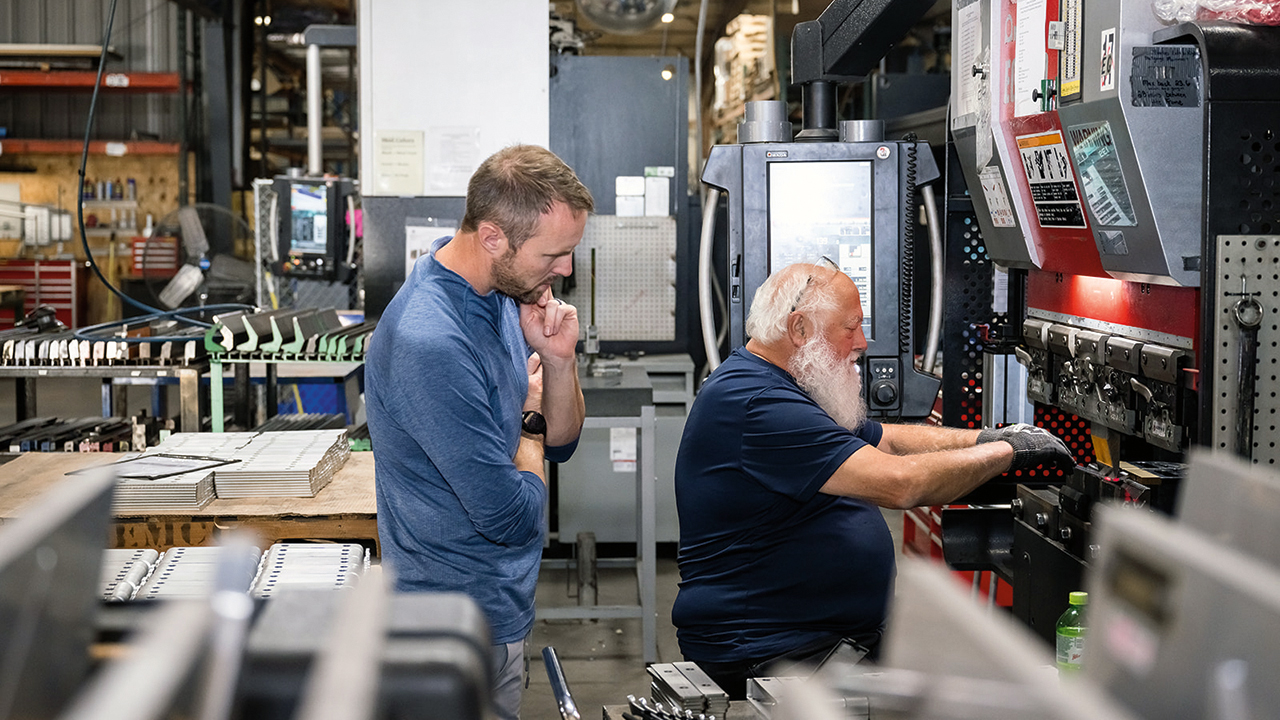

If sitting is the new smoking, the appeal of active jobs should theoretically be on the rise. But the paradox is real: For years, physical activity in leisure time has been scientifically associated with positive health outcomes, while physical activity at work is exactly the opposite — even adjusted for other factors.
Bryan Schwebke, owner of Paramount Physical Therapy & Training in Suamico, says there’s an opportunity for manufacturing to flip the script by integrating wellness and physical therapy into an industry that has been striving to shed its stigma as “dark, dirty and dangerous” and create healthier, more resilient workers on the other side who enjoy their jobs — and even embrace the benefits of being active.
Insight recently sat down with Schwebke, who holds a doctorate in physical therapy from UW‑Madison and has worked for more than a decade with both star athletes and everyday Wisconsinites, to talk about the tradeoffs between desk work and physical work and how employers can better train and protect what he calls “industrial athletes.”
Insight: Just because some of these industrial athletes have physically demanding jobs, that doesn’t mean they’re getting quality exercise, right?
Schwebke: You can work at a job all day long and get really strong in specific types of movement patterns, but typically the foundation is not addressed — and that’s what we’ll try to get people to see. You see people doing those jobs who say, “Well, I exercise all day long.” But do they, really? You have to get them to understand the idea behind intention and purposefulness.
What are the most common physical issues you see with manufacturing workers?
It’s a lot of shoulders — whether they’re working overhead or they’re just kind of reaching, pushing, pulling. They develop the big muscle strength, but they don’t develop the endurance in the shoulder. So we see a lot of either rotator cuff strains or tears. [Also a] lot of low back [issues], typically from either standing for too long with their weight shifted to one side or constant rotating to one side and not to the other side — or just lifting … We [also] see a lot of feet, because people are standing typically in steel toe shoes and their calves get super tight.
How are workers getting hurt?
Most injuries are actually happening outside of work [and] it’s affecting them at work. So I think companies don’t always understand the impact of non‑work‑related injuries and how much that really is hurting [productivity] — not to mention just culture and employee satisfaction, because if they’re injured all the time, or if they’re worried they’re going to be injured, that makes it a less happy place to be.
You started Paramount 10 years ago, and in the last three you have been strategic about working directly with employers, including Wisconsin manufacturers such as Trek, Professional Fabrications and Nature’s Way. How are you helping those companies redesign jobs and factory floors?
When I talk to companies about workplace setups, the first conversation we have is about building resilience in their employees. Typically what they’re going to do is some kind of stretching program that probably doesn’t catch on, or they’re going to do a bunch of ergonomic stuff to a machine. And ergonomic adjustments are great, but they’re kind of one size fits one, because you can have it set up perfectly for one individual, but the next person that comes on it, it doesn’t [work]. There’s so many limitations with machines, so rotating jobs is big, even if it’s just two different jobs — being able to have something that you can step away from and change how you’re moving.
You can be intentional about putting together a good warm‑up program that they actually use and understand. Something we’re doing with Nature’s Way is — they’ve tried warm‑up programs in the past, and we’ve put a new one in at one of their plants that’s been super successful — is allowing time [every morning] for those exercises. They’re becoming part of their culture. Those can be used throughout the day now for the individual employees to step away and be like, “OK, I just need to do this for a couple minutes and come back to work.” It’s building culture around the idea of taking care of themselves.
Is it safe to say some manufacturing workers, particularly older men, are skeptical about preventative health care and training?
Absolutely. It’s a culture thing. When we go in there and start working with people, the first push is not to install a program; it’s to build relationships with people and get them comfortable having that conversation. This is a typical conversation when someone comes to see us: “Hey, how’s it going? Do you have any issues?” “Nope, not at all.” Then we talk a couple more minutes and they’re like, “Well, actually my knee does bother me and my back’s been hurting for about 10 years or so.”
[The Transtheoretical Model of Change] shows people think about exercise as a thought continuum. There’s readiness, contemplation, pre‑contemplation … Pre‑contemplation means you’re thinking about thinking about starting to do it, and that’s where many of those people are. Once they start buying in, you can meet them where they’re at. They might not be willing to do an hourlong workout, but maybe you can get them to be OK with putting their phone away 30 minutes before bed so they get a little bit better sleep at night and feel more recovered.
What do you see as the impact of rising automation on worker health?
On the “pro” side, it reduces a lot of repetitive stuff, reduces a lot of heavy lifting. Even things like cranes are really helpful when used purposefully and intentionally. You just have to consider what are the side effects to it now? Those people who were really physical, even if it wasn’t great [for their health], are now less physical. They’re probably monitoring screens. And even if they’re standing, moving around, it almost becomes like a desktop, because they’re doing less than they were before.
And what are the health tradeoffs associated with switching to a more sedentary or technology‑based job?
From a musculoskeletal standpoint, [factory workers] are lifting and moving and doing stuff all day long, so you’re challenging the muscles. You are typically doing jobs that, even if they’re repetitive, are multi joint, multiplane … you’re rotating, you’re bending, a lot of different stuff, so that’s all good in just building muscle strength and endurance, whereas obviously sitting you’re getting almost none of that.
Sedentary people are going to have musculoskeletal issues that tend to come from lack of usage and from tightness. Welders can also get what they call, I think, cell phone neck — this kink in the back of their neck. But besides musculoskeletal stuff, you’ll see a lot more migraines and headaches because the muscles in the back of your head are big pain generators. You’ll have employees that are dealing with headaches, and they think it has nothing to do with their job, but it can actually have quite a bit to do with it.
What does a good manufacturing wellness program look like, in your experience?
Finding engagement is priority number one. You have to find someone that’s going to work a program in that is going to be successful, and that has everyone bought into it. Putting [health professionals] on site is huge, because it reduces the barriers. Even if people have insurance and they hurt their knee, they can walk in the door and see us for free, right when we’re on site. [The alternative is] to call, wait online, wait for an appointment that’s probably a couple weeks out, see a doctor, then go see a physical therapist. There’s just so many barriers, so you can sidetrack all that by having someone on site who can really help.
This is probably obvious, but what is the upside for the employer?
If the employees are healthy, you reduce missed days. You reduce the likelihood of workers’ comp, which is huge … Culture is probably the other big one. If you are offering [a program] and it’s not being presented as, “Here’s a wellness program I want you to do so you don’t get hurt because it affects my company,” [versus] “I really want you to take care of yourselves” … the employees can feel that, and they know that, and it makes them happier. It makes them move better, helps them think more clearly.
What have you liked most about Paramount’s foray into industrial partnerships?
As a physical therapist, I like the relationship part. I’ll see people [in the clinic], but eventually the goal is for them to stop coming back. [At a company], I know I’m gonna see people for an extended period of time and get to know them. And selfishly, I love working with companies I love. Because they’re successful, I take so much from them that I implement into Paramount.