
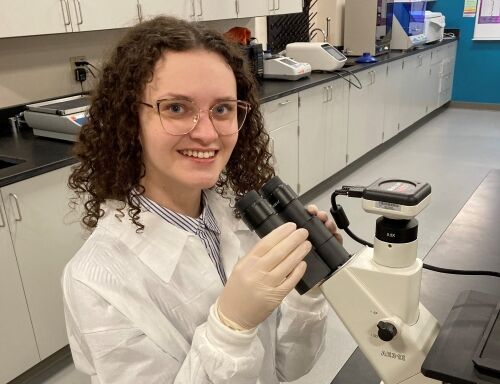

For the first time in NWTC’s history, technical college students are publishing their work in a peer reviewed scientific journal.
Two microbiology students, Justyna Kakol and Mainor Vang, have received multiple micropublications indexed in the National Library of Medicine for their work categorizing the antimicrobial activity or the bacterium species paenarthrobacter nicotinovorans. For non-scientists, that means that Kakol and Vang have been working to understand the characteristics of a bacteria, specifically for use in antibiotics.
Part of the Tiny Earth project – a global network of instructors and students focused on discovering novel antibiotics from soil microorganisms – the research Kakol and Vang conducted is helping address one of the most pressing healthcare threats of the 21st century, the diminishing supply of effective antibiotics.
Soil is a rich source of microbial activity, and many common antibiotics used today (like penicillin) were derived from soil bacteria or fungi. The Tiny Earth project represents a collaboration between education, research, and global medicine to address the challenge of antibiotic resistance. Kakol and Vang’s publications contribute to the growing body of research on developing new antibiotics.
What does publishing as an undergraduate mean?
Publishing as an undergraduate is no small feat.
“While it is rare at the undergraduate level for students to be published for scientific work at a four-year institution, it is virtually unheard of at community or technical colleges,” said NWTC Biology Program Director Dr. Angelo Kolokithas. “Being a published author in a peer reviewed journal opens many doors to future employment and graduate work.”
Undergraduate research has many benefits, including increased employability, the development of multiple skills – critical thinking, data analysis, and scientific methodology, and a head start on their future careers. Research and publication at this level simulates the rigor of what a bachelor or master’s capstone project might look like – setting Kakol and Vang up for success long after they finish at NWTC.
Use the links below to see Kakol and Vang’s methodology and conclusions:
Antimicrobial activity of Paenarthrobacter nicotinovorans
Time course study of Paenarthrobacter nicotinovorans secondary metabolite toxicity profile
Toxicity of secondary metabolites of Paenarthrobacter nicotinovorans