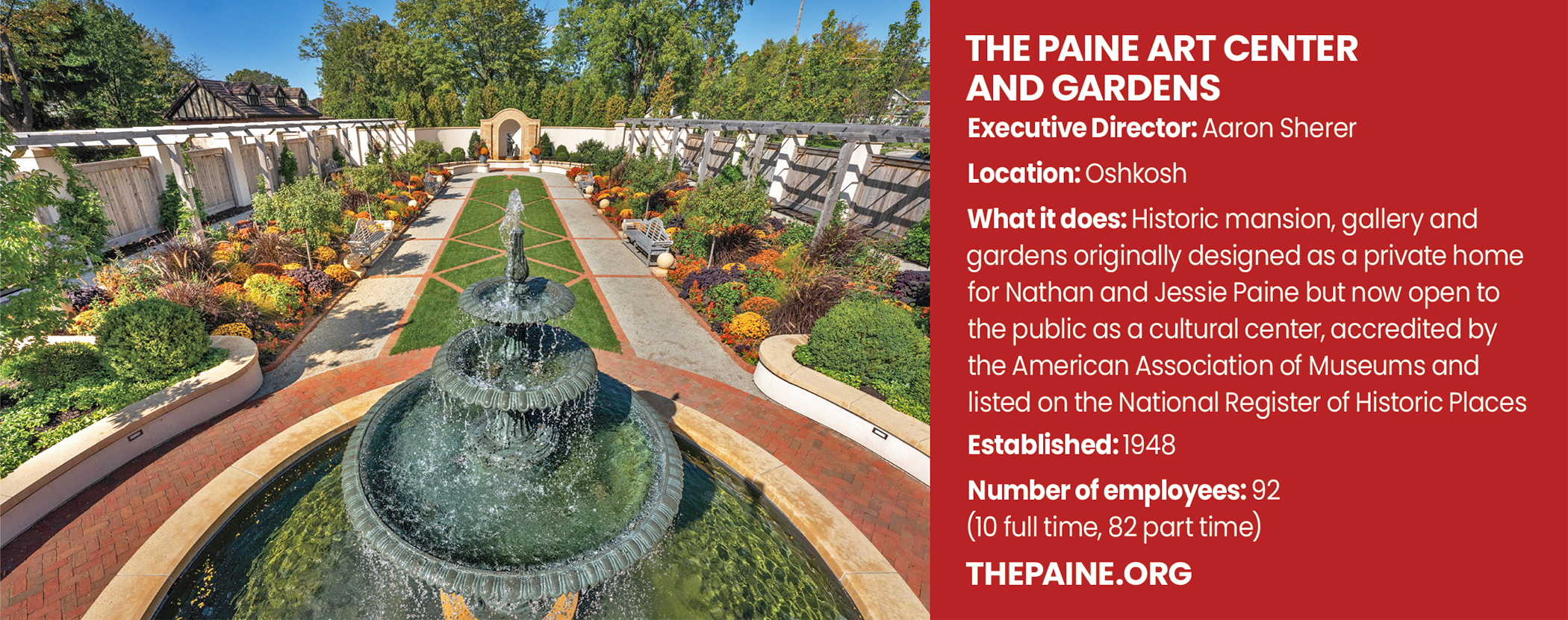

The story of the Paine Art Center and Gardens in many ways reads like a leather-bound fairy tale.
In Oshkosh there stands a castle, decorated with enchanting works of art, surrounded by intricate, otherworldly gardens. This castle is sometimes inhabited by whimsical, dancing fairies or tea parties fit for royalty.
There’s even a giant. For the Paine’s current caretaker, Aaron Sherer, the castle itself was a sleeping giant whose awakening is a tale of triumph he once penned in a short-story tribute.
As you can imagine, it was quite a remarkable thing for the village to have a sleeping giant. As more and more people came to see him, and as the villagers continued to take care of him, something began to happen that no one ever dreamed was possible. The giant started to wake up!
Sherer’s “The Story of the Sleeping Giant” of course has a happily ever after.
I’ve heard that the giant is still alive and awake, and he’s telling stories, singing songs and dancing, and the villagers are still taking good care of him and loving him as much as ever, generation after generation. The End.
Indeed, Oshkosh’s premier art center is a place to escape into another world. But it’s also a centerpiece of education and economic development that anchored the community’s growth and put it on the map, just as its creators envisioned a century ago.
Long ago, in a land not far away…
Two of the Fox Valley’s wealthiest families came together in 1896 when Jessie Kimberly, daughter of Kimberly-Clark Company co-founder John Alfred Kimberly, married Nathan Paine, heir to the Paine Lumber Company fortune. In 1925, the Paines set out to build their dream home when they commissioned noted architect Bryant Fleming to design a Tudor-revival country estate for them on the family’s cow pasture along Algoma Boulevard, with a look and feel inspired by their shared English heritage and their shared love of art.
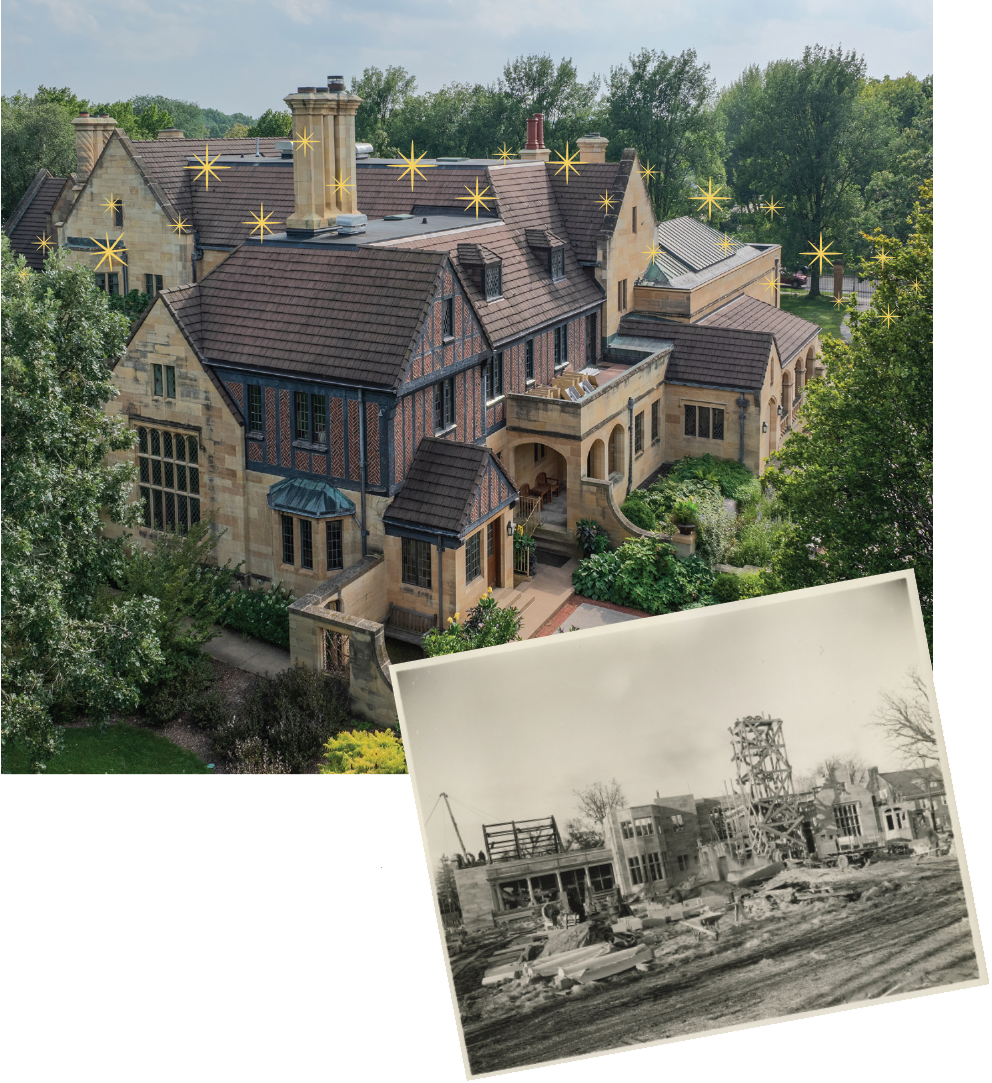
As the 1920s roared, Nathan Paine helped build Paine Lumber into the world’s largest manufacturer of doors and windows and bolstered Oshkosh’s reputation as “Sawdust City.” But in 1929, just as construction of the mansion’s exterior was reaching a crescendo, the world turned upside down with a legendary crash.
Throughout the ensuing Great Depression and crisis of World War II, the project sat untouched. Its façade had been created using the finest materials — including steel, limestone and poured concrete — but the interior spaces were unfinished. After all that had been endured in the two-decade period, including the devastation of Paine Lumber’s workforce, Nathan would go on to write that “occupancy of the new home would give no pleasure.” So in 1946, the Paines finalized plans to finish the project, turn it into a museum and establish a nonprofit for the “highest educational and cultural advancement of the greatest number of people possible.”
Bill Wyman, who grew up in Oshkosh and is today president of the city’s community foundation, remembers growing up in the shadows of the Paine, where his mother served on the board of directors in the 1960s and ’70s. But childhood memories of the Paine aren’t part of the equation for Wyman; back then, he says, children weren’t allowed inside. It was not until he moved back to Oshkosh as an adult with his wife Beth in 1988 that the sleeping giant first enchanted him with a wink.
Beth Wyman joined the Paine board in the 1990s. To see it become what it is today, she says — a place of community gathering and pride where all ages are most definitely welcome — has been one of her great joys.
“I think for greater Oshkosh it’s definitely a quality of life issue, and when I look around Oshkosh we continue to make things better,” she says. “I love to see the changes; I love to see the enthusiasm and you see more young people getting involved, bringing their young families, enjoying the life that Oshkosh has. Any time you have an organization like the Paine, it sets a tone that we have culture in our community and that culture will continue to grow.”
Setting the tone
In 2002, Beth Wyman helped make a decision that has certainly helped set the tone for the Paine’s development and the city of Oshkosh’s growth. When the board selected an up-and-coming young museum professional to lead the Paine, Beth hoped but never dreamed Sherer’s tenure would last more than two decades.
“Aaron is respected by so, so many. I would say he’s met the challenges of the board, but he’s really the one who challenges himself and the community for their support and patronage,” she says. “He’s just done a phenomenal job.”
And while Beth Wyman remembers Sherer as a young, hungry talent who was an easy “yes” to hire, Sherer has a different perspective on the interview process that brought him to Oshkosh from Boston’s Institute of Contemporary Art just four years after completing his master’s degree in arts administration.
“I’m a Midwesterner at heart,” says Sherer, a native Iowan. “I’ve always liked historic homes, and the garden… I was really interested in that combination of things.
But honestly, I was not nervous at all, because I never thought I was getting this job in a million years. I had never managed an institution, and I’d actually never managed more than a half-time person.”
But Sherer’s growth mindset and the Paine’s slumbering potential were a perfect match, and today he has not just helped awaken the sleeping giant but grown strong roots in the community. His husband, Paul, is a special education teacher and together the couple has adopted four boys from the foster care system.
“I didn’t think he would ever stay here,” Bill Wyman says of Sherer. “But he has been a big asset for the whole community; his partner is very involved in the school district, and they have adopted four children. They really have helped the whole community grow.”
Sherer says his work as the Paine’s executive director is diverse and engaging enough to keep it fresh, even after 22 years.
“We’re a really eclectic institution, and that’s kind of what makes this job so fun and interesting,” he says. “And the thing that really makes me happy is when I see it being used, activity happening. There’s just a huge amount of satisfaction.”
‘The whole package’
Sherer chuckles when he recalls the times he has been shushed in the Paine by well-meaning guests.
The mansion is itself a showcase of architecture, woodwork and one-of-a-kind furnishings, but Nathan and Jessie Paine also designed the estate with the intention of displaying their late 19th and early 20th-century French Barbizon and American landscape paintings in both dedicated galleries and everyday living spaces.
Therefore, in many traditional respects, the Paine is a “shush-worthy” museum that has added to its permanent collection as well as hosted sought-after traveling art exhibits, perhaps most notably its 2023 exhibition of Auguste Rodin sculptures, “Rodin: Contemplation and Dreams.”
“We’ve done Ansel Adams in here, Norman Rockwell, [Dale] Chihuly,” Sherer says. “We love exhibitions that look great in the space, so we’re trying to not just put art in the room but also make the whole package look good.”
But while Sherer is passionate about the art, he is even more passionate about the shared experiences museums help facilitate.
“People always come in groups, and they’re talking the whole time, like ‘see how these flowers match the artwork?’ and ‘oh, did you see this?’” Sherer says. “It’s this really engaged, dynamic experience. It’s not people standing quietly looking at art.”
And under Sherer’s leadership, the Paine has attracted countless exhibits that have gotten people talking. In 2006, it hosted the largest-ever exhibition of Tiffany lamps outside of New York City.
“We had 20,000 people go through, and we had never seen anything like that before,” Sherer says. “That was kind of this ‘a-ha’ moment for me, that maybe there’s more potential here than we realize … to go from ‘a hidden gem’ to a premier cultural destination. Like, what would that journey look like?”
A Christmas story
One year after the Tiffany lamps exhibition, Sherer put forth another vision aimed at attracting new audiences to the Paine: taking its annual holiday decorations to the next level.
The mansion and gardens would help tell the story of “The Nutcracker,” Sherer says, complete with dancers, storytellers and illustrators. Putting on the first “Nutcracker in the Castle” was a heavy lift, so to make the investment worthwhile he envisioned it as a five-year project.
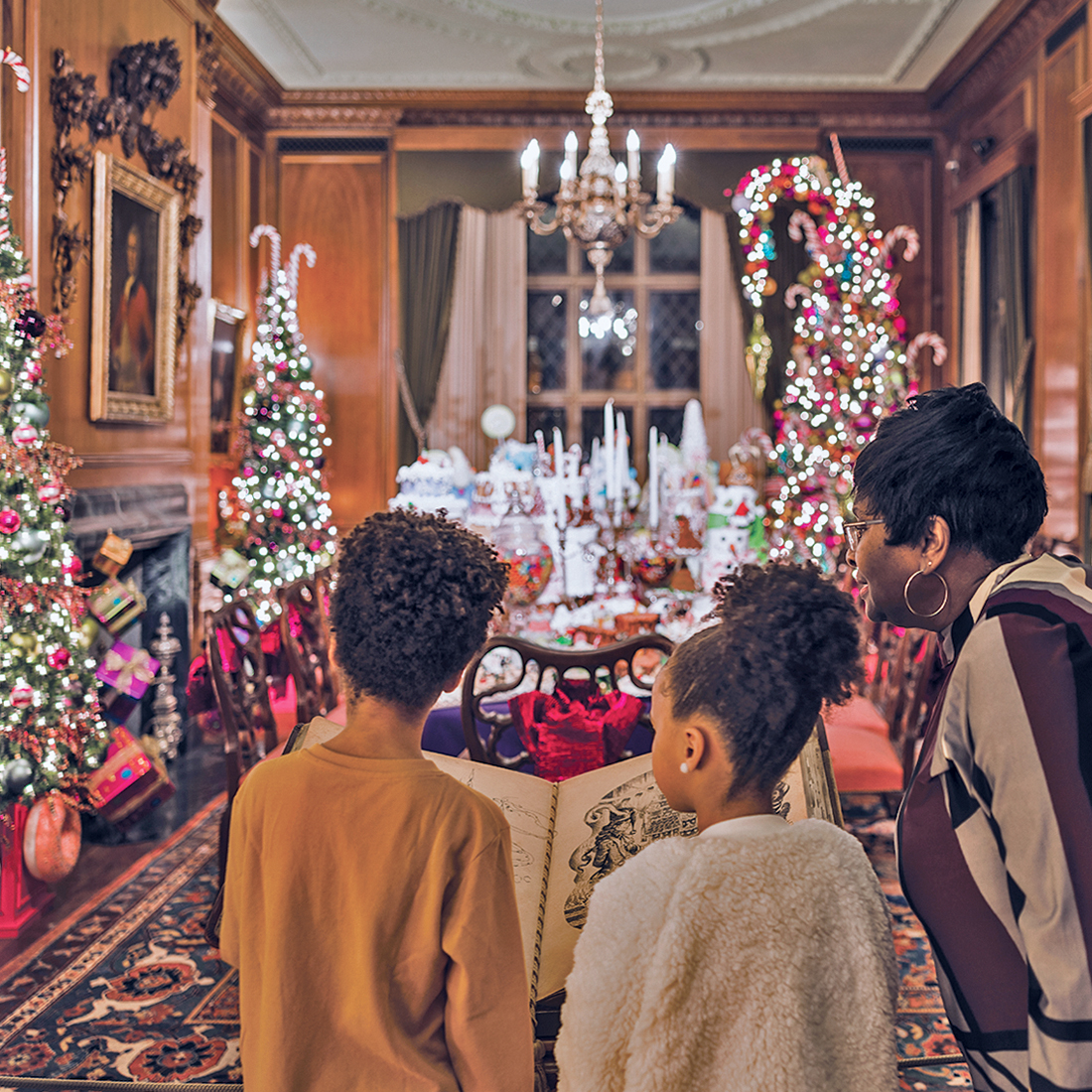
Seventeen years later, in 2023, the event saw the highest attendance ever at 26,000. People who saw “Nutcracker in the Castle” as children are now creating their own family traditions and bringing their kids.
“We just laugh because it gets bigger and bigger every year,” Beth Wyman says. “Like, aren’t people tired of this? But it’s just amazing how many families have created a tradition out of it. It’s just truly magical, and it really has made a difference as far as exposure to kids and families.”
It is Sheila Glaske, the Paine’s curator of horticulture, who has been tasked with bringing “Nutcracker in the Castle” to life since the beginning. The exhibition, for the most part, has remained the same every year. Dancers and actors are now only part of the guided tours, which Sherer says typically sell out ahead of “Nutcracker”’s Thanksgiving-week opening. Enhancements over the years have included the “Cupcake Café,” candlelight tours and a “mouse hunt” designed to engage children. And repeat visitors just keep coming back. The beauty and whimsy of the displays captivate all ages.
“I think we’ve seen people come through as adults and leave as children,” Glaske says.
Glaske, who has been the Paine’s chief horticulturist for more than a quarter-century, now adds elf duties every October. She says it takes about four weeks to put “Nutcracker in the Castle” together, including decorating more than 70 Christmas trees; it takes two weeks to tear down. A storage facility adjacent to the property is piled with carefully-labeled plastic tubs of decorations, and Glaske’s long-tenured garden crew executes the vision each year.
Glaske says her work at the Paine, whether it’s planting 12,000 tulip bulbs or erecting a pair of 26-foot nutcracker statues, is a crowd-pleasing creative outlet that is hard to find in any other job. She also credits Sherer as a visionary leader who doesn’t micromanage.
“He has visions, and things come to him really fast … really great ideas,” Glaske says. “I think I learned from Aaron that we’re gonna do it, and we’re gonna do it well.”
Doing it well
Whether it was the 2015 exhibition of “Downton Abbey” costumes that drew 30,000 visitors, the Paine’s innovative early adoption of social media, or the reservation system implemented to control crowds during COVID that has remained in use to improve the visitor experience, Sherer is constantly thinking about the next big thing. Membership has quintupled during Sherer’s tenure, and Bill Wyman says that, in recent years, a significant portion of estate giving to the community foundation has been designated for the Paine.
Some of Sherer’s biggest wins as executive director, he says, are things the public may not care about or even notice, like the recent installation of a new HVAC system or the relocation of a neighboring historic home to make room for a new parking lot. Restoration projects are frequent and expensive.
“It’s definitely a high-maintenance house,” he says.
Extending the mission of the Paine to benefit the broader community is also an accomplishment of which Sherer is proud. In 2015, the Paine partnered with the University of Wisconsin Oshkosh and local schools to create ArtsCore, a nine-day professional development program teaching concepts of arts integration to a cohort of about three dozen teachers each year.
Krista Frenz is an ArtsCore alumna and advocate who serves as the full-time arts integration coach at Oshkosh’s Vel Phillips Middle School. She says the Paine’s participation in ArtsCore not only provides a stunning, peaceful backdrop for the education sessions but engages and elevates the teaching community.
“They (the Paine staff) listen to what the community wants. They are so great at welcoming everybody and really tailoring it to you and your students,” says Frenz, who adds that arts integration is utilized to enhance student learning in all academic disciplines — yes, even mathematics — and that ArtsCore has begun attracting participants from as far as California.
“We’re really lucky that we get to engage our students in this way and have the funding for it,” Frenz says.
New audiences, new opportunities
Another way the Paine is attracting new audiences is through Wisconsin Art Destinations, a collective established to promote the state’s 16 distinct art museums for tourism. As the soon-to-be dean of Wisconsin’s museum directors, Sherer led the charge to launch the program last fall and secure funding through a state destination marketing grant. The collaboration encourages people to visit the museums and to enjoy each of their surrounding communities by suggesting itineraries with dining, lodging and shopping options on the website wisconsinartdestinations.com.
Amy Moorefield, executive director of the nearby Bergstrom-Mahler Museum of Glass in Neenah, says her museum’s attendance has doubled in the past year. She credits the marketing muscle the institutions are able to flex as a united front. The concept isn’t itself novel; in her past museum leadership roles in other states, there have been similar efforts — but she says this one has “powerful oomph.”
“This particular endeavor has a lot more steam because it’s got so many more institutions involved and the support of state tourism, so I think it has a lot more teeth to it,” Moorefield says. “And whether he likes it or not, [Sherer] is the Gorilla Glue that holds us all together.”
Any visit to the Paine, or any other Wisconsin museum, is a feather in Sherer’s cap. His love of the arts keeps him prodding at the giant and anticipating the next chapter in the Paine’s fairy tale.
For Sherer, preserving the Paine for future generations means preserving gifts of beauty, nature and wonder.
“When people visit, I don’t want them to think they should have to have a big, huge house like the Paine, but you want them to have an encounter with inspiration and creativity and beauty, which is kind of a fantasy experience,” Sherer says. “If that inspires you to have a little more joy in your life, that’s great.”