
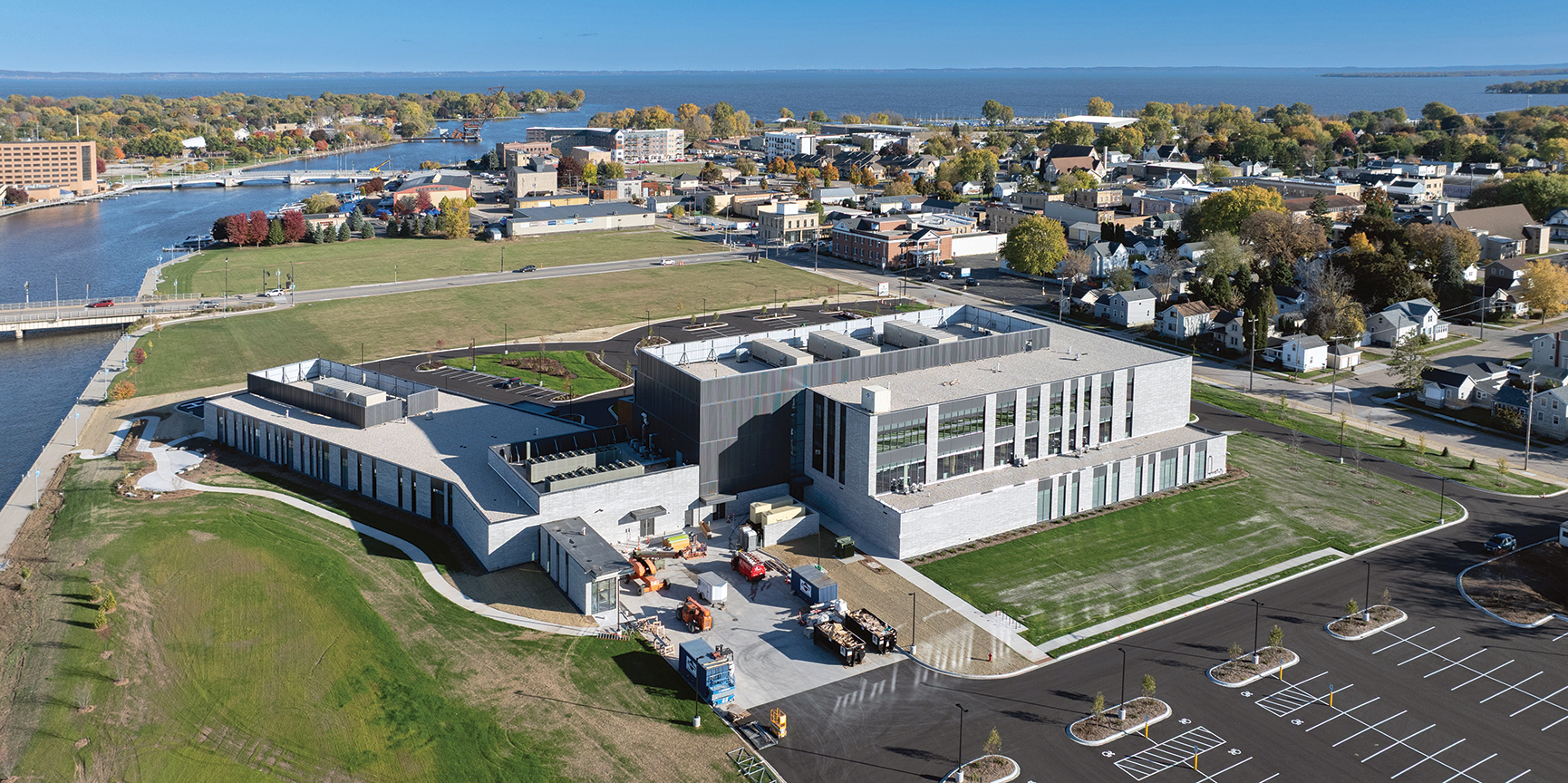

A new $84 million health care facility opens this month near downtown Oshkosh.
The 114,000–square–foot ThedaCare Medical Center‑Oshkosh, located at 250 W. 6th Ave., includes 24/7 emergency care, inpatient care, an ambulatory surgery center, primary care, pediatrics, specialty care, a drive-thru retail pharmacy, imaging services, MRI and nuclear medicine, and lab services. More services may be added depending on community needs, says Jenny Nikolai, vice president of ThedaCare Medical Centers–Fond du Lac and Oshkosh.
“Our goal is to meet patients where they are — providing the right care, in the right place, at the right time. When designing ThedaCare Medical Center–Oshkosh, our patients and families were at the forefront of our planning to develop services around them,” she says. “Our health system is committed to ensuring patients receive the care they expect and deserve.”
Nikolai says building the new medical center east of U.S. 41 was important because the city’s other main health care facilities are west of the highway. She says 73% of Oshkosh residents live east of the interstate, meaning they are more than 15 minutes away from a hospital or emergency room.
The medical center will create about 60 new jobs.
“The project is especially valuable because it transformed a site that previously faced environmental challenges into a modern medical facility that supports residents who most often face barriers to care, including low- to moderate-income households,” says Hannah Schueler, an economic development specialist with the city of Oshkosh.
Building for the future
The Greater Oshkosh Economic Development Corp. recently completed its Future in Focus campaign, raising $3,276,663 to bolster economic growth and innovation in the region for the next five years.
GOEDC President and CEO Tricia Rathermel says longtime partners and 20 first-time investors participated in the campaign, which was a shift for the organization, supplanting annual fundraising.
“We wanted to create a five-year strategic plan and secure our funding to carry out that plan so we can focus on long-term goals,” she says.
Those long-term goals include developing housing, reinvigorating the relationship between area businesses and the University of Wisconsin Oshkosh, and making the community more business-friendly.
When it comes to housing, Rathermel says businesses are aware their employees are having trouble finding places to live locally.
“Our focus is to work with developers on projects to create more housing. We are also working with the county to create a revolving loan fund to help fund some of these projects,” she says.
Businesses benefit a lot from a connection with UW Oshkosh, Rathermel says. “With COVID, a lot of things stopped happening and we know there are a lot of resources available at the university that businesses can take advantage of, and we want to open that up again,” she says.
GOEDC is also conducting a survey to identify key factors that make the Oshkosh area a good place to do business, as well as what could be done to make it an even better place to expand or locate a business, Rathermel says.
Residential growth
There are three new residential projects that will bring more housing to Oshkosh, Schueler says.
The Corridor is a housing and mixed‑use project located on the west side of Jefferson Street. The proposal includes a 17,648-square-foot, three-story, mixed commercial/residential building along North Main Street and two 4,659-square-foot townhome buildings along Jefferson Street.
The Corridor’s ground floor will be used as a two-shift day care center, with 39 apartment units on the upper floors. The townhomes will each consist of eight units per building, providing additional modern housing options.
“This project brings meaningful community benefits — not only by expanding child care capacity, but by helping address the housing gap for low- to moderate-income families and individuals,” Schueler says. “This is one of the groups most in need of housing, yet their needs are often overlooked because these developments are not always as profitable as traditional market-rate projects.”
The city of Oshkosh platted the former Washington School site into 18 residential lots for redevelopment. Habitat for Humanity purchased four of the lots to construct new single-family homes, with the potential to purchase and develop up to five additional lots in the future. The remaining nine lots will be made available through a competitive RFP process, with the goal of creating high-quality workforce housing.
In the Sawdust District, Mill on Main is an upcoming mixed-use redevelopment. Schueler says the project will feature 191 multifamily units and approximately 21,800 square feet of commercial space. There are also plans for a private clubhouse, pickleball courts, an amphitheater and riverwalk improvements.
“Mill on Main is expected to be a major anchor for the district and a significant draw for both residents and visitors,” Schueler says. “It also supports closing the housing gap and bringing new life and activity back to this part of the city.”

