


The year 2025 has arrived, and with it comes the beginning of a new era for U.S. higher education: the enrollment cliff, a phenomenon referring to sharp and continually sharpening national declines in college attendance due to decreasing birth rates and COVID-19’s impact on educational attainment.
According to Statista, the total enrollment for the 2017 fall term in the United States was 19.9 million students; that figure dropped to 18.2 million in 2022. Nationwide trust in higher education has dropped to just 36%, according to Gallup.
Wisconsin is not immune to these enrollment declines and issues of broken trust. In 2022, the UW System recorded its lowest head count enrollment (160,782) since 2000, falling 20,187 students in a 10‑year period. And while enrollment made some small gains system-wide this year, the macro trend is declining enrollment for the foreseeable future.
Shifting programs and strategies to serve more students has made UW‑Green Bay an outlier in the UW System. Chancellor Michael Alexander says UWGB has grown 19.8% in the last five years, thanks in large part to its focus on dual enrollment and its embrace of nontraditional and first-generation students, which make up more than half of UWGB’s student population. Today the campus enrolls a full one-third of all continuing education learners in Wisconsin.
Elsewhere in the New North region, UW Oshkosh’s enrollment has declined annually since 2018 when it was 16,416; the institution reported a fall 2024 head count of just 12,964. In June, the system announced plans to close UWO’s two‑year Fox Cities campus in Menasha, marking the sixth two-year UW campus to be flagged for closure since November 2022.
Access to affordable, high quality higher education close to home has been a guiding principle of the UW System since it was founded by the legislature in 1971 with 13 campuses — the flagship in Madison, plus four-year comprehensive institutions in Milwaukee, Oshkosh, Whitewater, La Crosse, Eau Claire, Green Bay, Stevens Point, Stout, Platteville, River Falls, Parkside and Superior. Today Wisconsin is home to one of the largest public university systems in the country, and, officials say, regional access remains of critical importance despite population decline and the increased prevalence of online learning. Statistics show students who attend one of the state’s 12 regional comprehensive campuses are more likely than UW-Madison grads to remain in that area for employment, helping fill critical labor shortages in more rural parts of the state.
In short, the “Wisconsin Idea,” which dates back to 1905, is still as relevant today as when UW President Charles Van Hise famously said, “I shall never be content until the beneficent influence of the university reaches every family of the state.”
Having the hard conversation
Last summer, the nonpartisan Wisconsin Legislative Council convened the Legislative Council Study Committee on the Future of the University of Wisconsin System, made up of 18 members charged with examining demographic trends affecting the system; evaluating institutional infrastructure needs; reviewing the system’s governance; and making recommendations for shaping the system’s future, including through policy.
Rep. Amanda Nedweski (R-Pleasant Prairie) chaired the committee, which included both elected officials and public members such as business leaders, former regents and state officials, as well as current faculty members. Current students were not represented.

One of the public members lending faculty perspective to the committee was UW‑Green Bay Associate Teaching Professor Shauna Froelich, who said she valued the experience but ultimately felt like the group’s work produced more questions than answers. Following five lengthy meetings packed with presentations from both state and national experts, members voted in person on Oct. 24 and through mail ballot on Nov. 20 to ultimately green light the following 12 recommendations, expected to be further considered by the legislature this year:
- Explore the creation of a dedicated governing board for UW-Madison that is separate from the Board of Regents for the Universities of Wisconsin, who will then oversee and support the work of the 12 universities outside of UW-Madison.
- Create a Wisconsin Higher Education Coordinating Council, appointed by the governor and subject to senate confirmation, to advise both the UW System and Wisconsin Technical College System (WTCS).
- Explore reforming how members of a dedicated board to UW-Madison and a board for the Universities of Wisconsin (the rest of the 12 universities outside Madison) are selected, ensuring key stakeholders are represented effectively through the membership of political leaders, university donors, students and business leaders.
- Explore granting some level of bonding authority to UW-Madison.
- Set guardrails relating to bonding authority, such as limiting bonding authority to projects within a designated cost range, requiring financial projections and showing the Joint Finance Committee and/or the Board of Regents a demonstrated need for the project, subject to their approval.
- Eliminate artificial price ceilings and allow more flexibility at the institution level to set differential tuition by program based on factors such as cost and demand.
- Devise and implement a formalized process for gathering information about why students do not complete their degrees, perhaps through exit interviews, voluntarily taken up by the Board of Regents with UW policy.
- Regionalize UW System program offerings to reduce duplication in programming at campuses that are geographically near to each other; move toward a model of specializations for programming at each campus.
- Continue discussions on creating results-oriented metrics by university leadership that incentivize leadership to find ways to improve educational outcomes and campus success in a way that is measurable and transparent to the public.
- Create a universal pipeline and early college credit programs for the UW System, WTCS and secondary schools.
- Create a new state appropriation to provide general purpose revenue (GPR) funding specific to UW-Madison and maintain a separate, singular GPR appropriation for the other comprehensive universities in the UW System combined.
- Require the Board of Regents to publish the formula or methodology it utilizes to allocate state GPR to each of the UW campuses and require the board to review this formula or methodology on a regular basis, such as every two to five years.
Funding conundrum
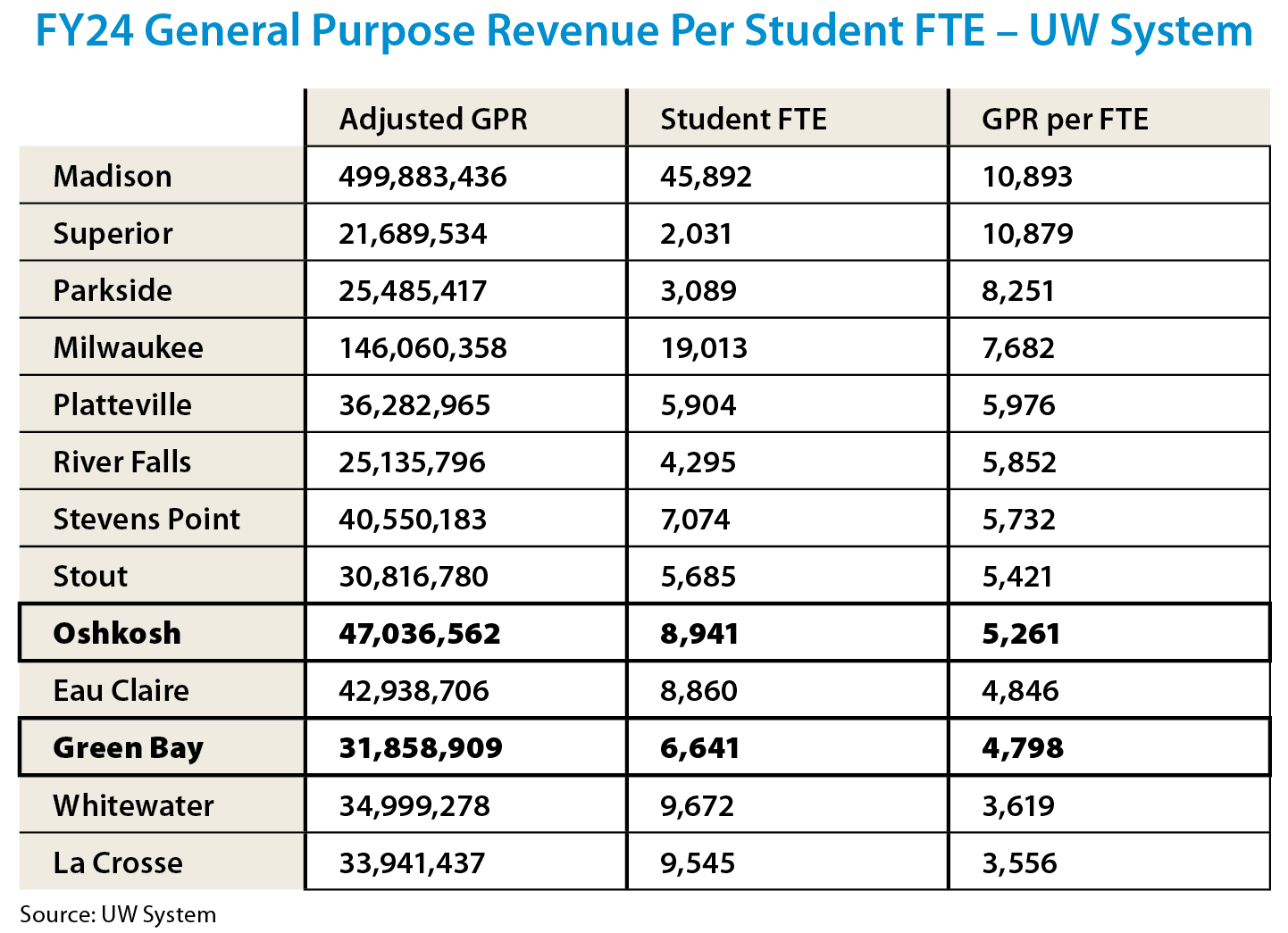
The distribution of general purpose revenue funding was a key topic of conversation around the committee’s work, which attempted to dissect the sometimes stark inequality between institutions. UW-Superior received the most — $10,679 in GPR per full-time equivalent student — funding in FY24, while UW-La Crosse ranked last, receiving just $3,556. Among the 12 comprehensive campuses, Northeast Wisconsin entities Oshkosh (8th, $5,261) and Green Bay (10th, $4,798) both ranked in the bottom half.
Members of the legislative study committee described the formula used by the Board of Regents for calculating allocations as overly complex and not appropriately transparent, leading to the ultimate calls for more transparency and regular review.
“It has been an interesting experience in this committee trying to get information,” Nedweski remarked at the Oct. 24 meeting. “We have discussed at length that the legislature and the Universities of Wisconsin have a trust issue. We don’t always trust them, and they don’t always trust us and we need to work on that.”
Committee member James Langdon, former VP of administration for the UW System, spoke out in favor of reform and oversight.
“There’s been a stunning lack of transparency when it comes to the GPR allocation,” he said Oct. 24, “and this committee has suffered from it, the regents have suffered from it, the campuses have suffered from it over the years. This allocation formula is very much a black box … I have so little faith in the university and the system specifically to follow through on this that I think there needs to be some enforcement mechanism to make sure that it happens.”
Mark Pitsch, a spokesperson for the UW System, says the allocation methodology is complex “because the universities, and the costs and services they provide, are very different.” He adds that GPR allocations follow the “base plus” methodology utilized by all state agencies and that the bigger issue is lack of funding from the state.
“Since President [Jay] Rothman took office, his focus has been addressing the urgent fiscal issues facing our universities and advocating for state funding of our universities that would move us out of the bottom 10 nationally,” Pitsch says. “Helping Wisconsin win the war for talent by developing and retaining talent, for the benefit of all Wisconsinites, is a top priority for the UWs. We cannot do that when Wisconsin ranks 43rd out of 50 states in public funding for our universities, while all our neighboring states are in the top 10.”
Froelich says it’s frustrating to see UWGB funded at a lower level than most other campuses given that it’s actually growing, serving new constituencies and infusing Northeast Wisconsin with much-needed talent.
“Some universities are finding a way to succeed, while there are others where enrollment has dropped significantly,” she says. “No one wants a school to close, and no one is going to say on the record that they want a school to close, but everyone can agree this can’t stay afloat and function the way it’s currently working.”
Can campuses like UWGB continue to grow in the current funding environment? If so, Froelich says, it will likely be at the cost of faculty and student turnover. As an open access institution, committed and qualified faculty are essential to providing services and education at UWGB, particularly to students who may face other barriers.
“I feel for our faculty and staff who are doing this on their backs in many ways, and that’s hard for me as a chancellor to watch,” Alexander says. “I think we do it because we believe very strongly in our mission, and I’m incredibly proud to work at a place that our faculty and staff feel so committed to our mission to our students.”
Appetite for disruption
Among the ideas discussed by the study committee that did not receive enough support to become official recommendation were the concept of formally separating UW-Madison from the rest of the UW System — an idea first proposed by then-Gov. Scott Walker in 2011; raising tuition; centralizing UW‑Madison and UW System administration; and creating a streamlined three-year arts and sciences degree option.
With demographic challenges now a reality rather than a prediction, Froelich says putting more disruptive solutions on the table may be the only way to shake up an unsustainable system.
“I think because of the enrollment cliff, disruption is occurring and people are afraid to create more disruption by changing the model,” Froelich says. “But more disruption might actually help move us through this specific time.”