
After much anticipation and a year-long pandemic delay, the Ryder Cup at Whistling Straits finally came to pass. It delivered on all expectations, including welcoming tens of thousands of fans each day of the event, raising Sheboygan County’s profile and providing an estimated $135 million economic impact to the region. To top it all off, Team USA brought home the win.
Brian Doudna, executive director of the Sheboygan County Economic Development Corp., says the region showed well both in person and on television, and he expects the exposure to drive traffic to the county for years to come.
“From a tourism (perspective) and putting Wisconsin and Destination Kohler and Whistling Straits on the map, you couldn’t have asked for a better weekend or better environment,” he says.
Amidst the fun and festivities of the Ryder Cup, Sheboygan County communities have remained focused on one of their most pressing issues: housing.
The City of Sheboygan completed an affordable housing study in 2021. It found that while the city has added nearly 950 multifamily units since 2015, the need is still great, with another 1,000 units needed within the next five years.
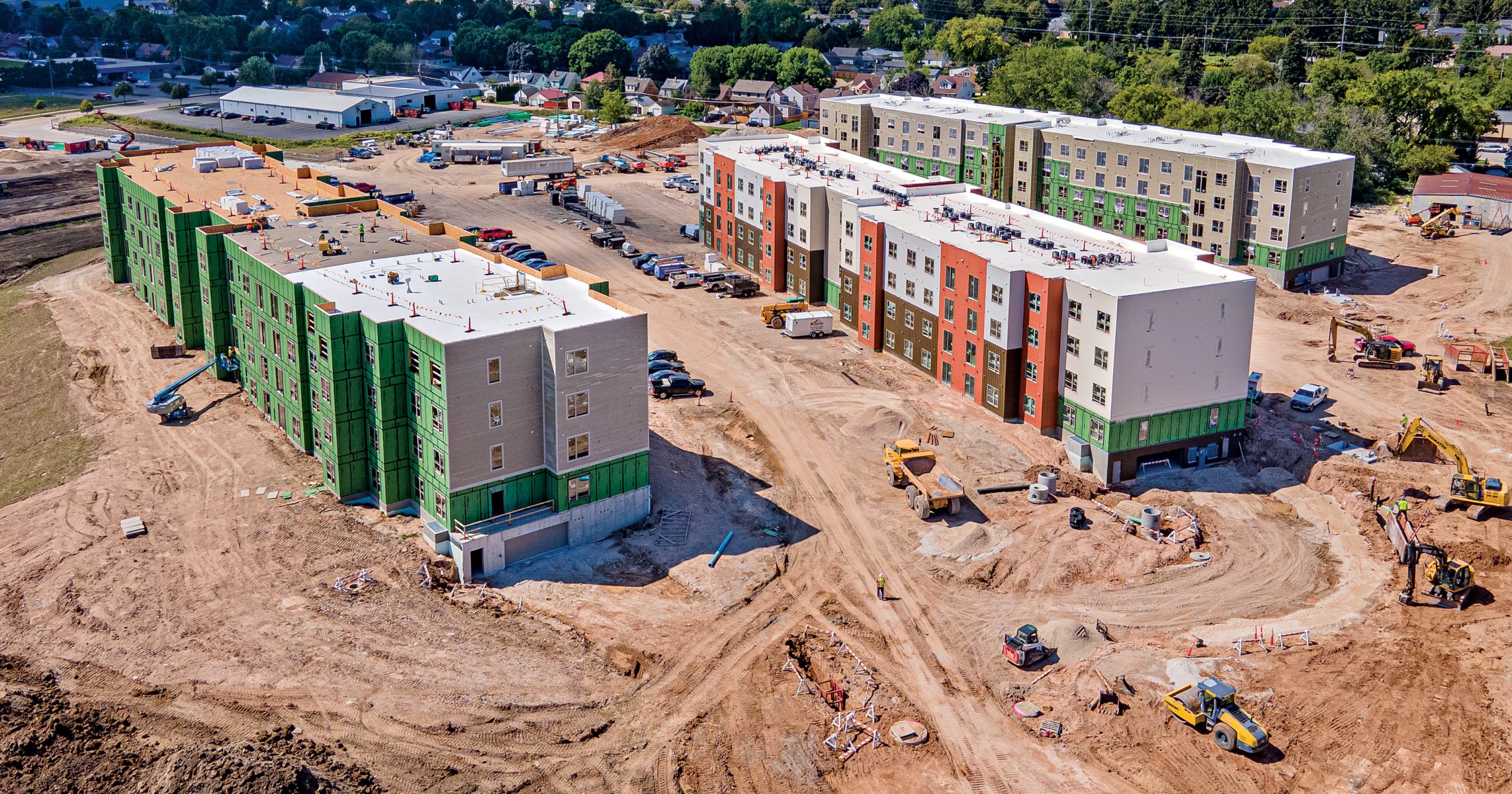
When The Oscar in Sheboygan opens fully this fall, it will help meet some of the housing need with its 240 units that include one- and two-bedroom options. It’s the largest housing project in the city’s history and offers amenities including a fitness center, barbecue stations and an outdoor firepit with lounge area.
Badger State Lofts, another recently completed multifamily housing project, delivered 118 units. Before construction was even complete, all units were fully leased, with a waiting list of 50 people.
“The demand continues to be there for affordable housing, as well as more middle-range and luxury housing,” says Chad Pelishek, director of planning and development for the City of Sheboygan.
The city is working on adding Section 42 affordable family housing units. A parcel of land off South 14th Street and Illinois Avenue recently got rezoned for building 48 units of affordable housing, with Commonwealth Development leading the project. The redevelopment authority also approved a project on Indiana Avenue near the riverfront that will bring 96 units of senior affordable housing and 18 units of live-work housing.
Adding single-family housing options remains a challenge. “We know we need to build more single family, but we just don’t have the land to do it,” Pelishek says, adding that the city is bound by Kohler on one side and Lake Michigan on the other.
The city is negotiating to purchase some farmland on its outskirts to line it up for a 260-acre single-family housing development that would need to be annexed into the city. In addition, Stonebrook Crossing, a 134-lot single-family subdivision through Werner Homes, is underway and recently began pulling housing permits.
Elsewhere in the county, single-family developments are underway in Random Lake, Elkhart Lake, Kohler and Sheboygan Falls. The Tannery Falls apartments complex in Sheboygan Falls is complete and fully leased or nearly so, Doudna says.
The Town of Sheboygan recently reached an agreement for a $60 million development with Van Horn Development LLC for a project located on the I-43 and Highway 42 interchange. It will include office and retail space as well as multi- and single-family homes and townhomes, with open spaces for recreational facilities. The town is contributing roughly $12.4 million for the project, while Van Horn will contribute the remaining $48 million.
Businesses need people to live in the community, Pelishek says, noting that the county of about 115,000 people has 3,000 to 4,000 open jobs at any given time and unemployment of less than 2 percent. Doudna agrees and says the SCEDC plans to announce workforce housing strategies in the coming months, including options that would have the private sector partner with municipalities to create solutions.
On the business development front, one major project could boost Sheboygan’s tax base, bring jobs and create housing solutions. In July, the City of Sheboygan agreed to sell 40 acres of land located at the SouthPointe Enterprise Campus to S2A Modular, a California-based manufacturer of the world’s first self-sustaining, custom, luxury modular smart homes.
The S2A project would bring a 125,000-square-foot facility for manufacturing modular homes. The city is still finalizing and negotiating the development agreement.
“That’s the real reason why the city was so aggressive in trying to land them here, because we know we have an immediate housing need here in the county, but also the fact that their goal is to be shipping these modular housing pieces (to locations) within two hours. They can hit the north side of Chicago, all the way to Madison and the Fox Valley and Door County,” Pelishek says.
Within SouthPointe, the city also is working with a local broker to develop a 100,000-square-foot spec building for industrial use, taking up 13 acres and leaving about 50 to 60 acres within the park. With warehousing and industrial space remaining in short supply and high demand, Pelishek expects the building won’t sit empty for long. Still, the city must subsidize the project because rents in the market aren’t keeping up with construction costs.
“We’re trying to build a new park and build a new tax base. I think in the end it will be beneficial for the developer and the community, but it’s a risk going into it with the current market values,” Pelishek says.

