
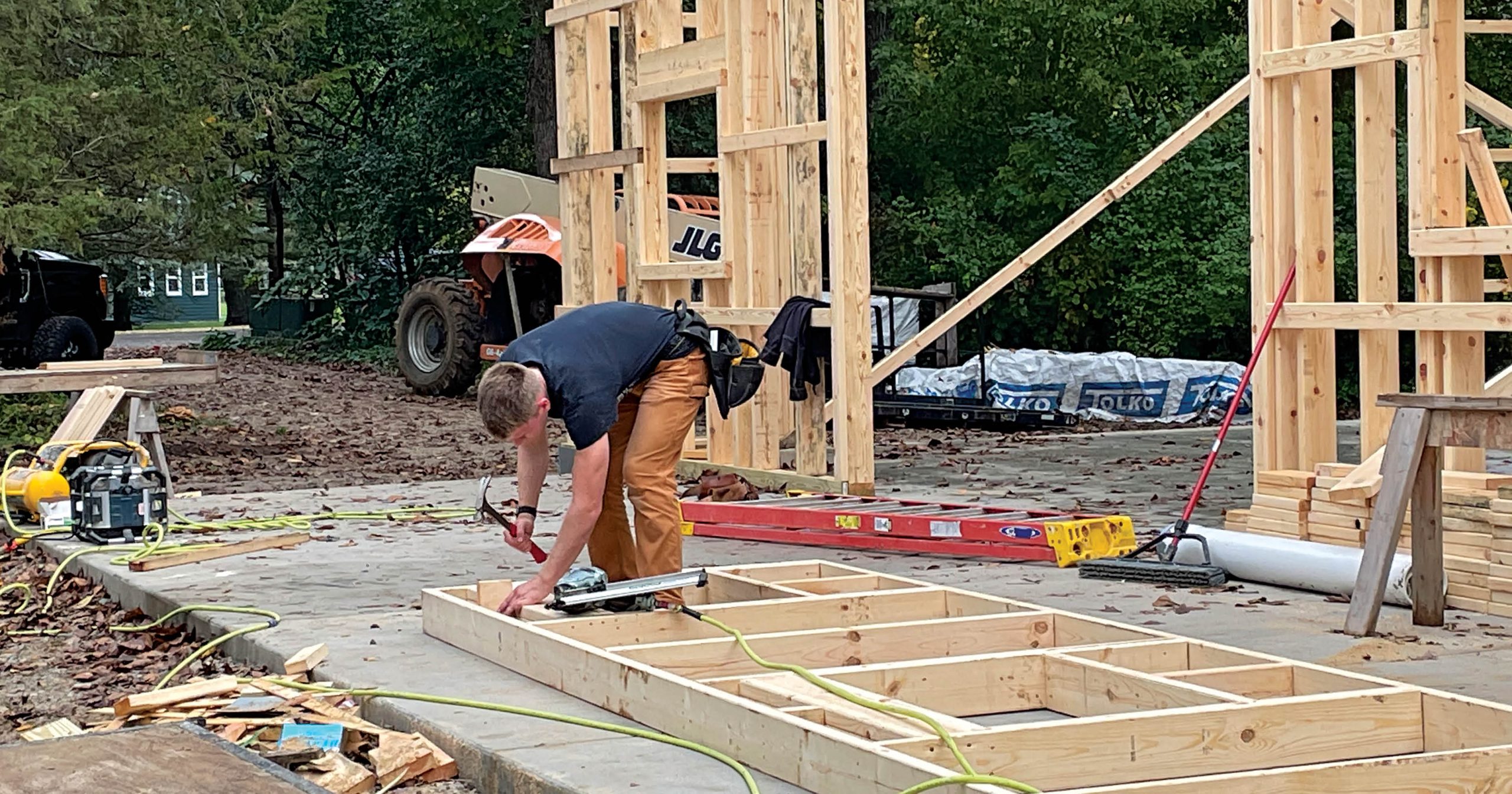
For a youth apprenticeship participant, the experience can look like it did for Braden, Holly and Isaac, three area high school students who worked for local employers gaining hard and soft skills and earning money while also refining their career aspirations.
It can also be a more deliberate pathway, like one provided through the national nonprofit organization Jobs for the Future, which aims to take students from certified pre-apprentice or youth apprentice to registered apprentice.
Either way, organizations and schools are spreading the message that YA is for everyone and offers many pathways.
Braden Lefeber, a senior at Little Chute High School, began his YA with Fox Valley Tool & Die the summer before his junior year. Through his flexible schedule, he goes to work at 6 a.m. each day before heading to school later in the morning. In the summers and during breaks, he can take on more hours.
The experience has allowed him to explore machining, and he’s learned that he’s more interested in becoming a mechanical engineer, a path he’ll pursue next fall at the University of Wisconsin-Stout. “Having the youth apprenticeship job definitely helped me decide because, before that, I was kind of confused about what I wanted to do,” he says.
Isaac Whitrock, a senior at Ripon High School, had a similar experience. He’s completing a YA at Alliance Laundry Systems in Ripon, where he works with engineers and quality team members to improve quality and manufacturing processes and standards.
“After working at Alliance, I realized how much more I enjoy working with people than machines all day. Going into the future, I want to look for a job that not only has the engineering aspect of problem-solving and design but also being able to work directly face to face with people,” he says, adding that he plans to study engineering at UW-Oshkosh next fall.
When Holly Perks, a senior at Notre Dame Academy, saw an email about an opportunity with Prevea Health, she knew she had found the ideal fit. She wanted to explore a medical career but didn’t hold a certified nursing assistant license. In her role, she works in the provider relations department and helps with the physician credentialing process.
“There are so many different benefits to this job. I’ve learned a lot about organization and time management and working in an office environment,” she says.
Perks hasn’t settled on a school yet but plans to study biology and go on to medical school and then go into research or work with patients. She says her experience has helped her understand what goes on behind the scenes in the medical field.
Amy Powalisz, a parent who had all three of her children participate in YA through Manitowoc Lincoln High School, says the experience benefited her two sons and daughter in multiple ways and set them up for success.
Powalisz’ son, Joe, worked on a farm for his YA and now works as a field mechanic for Lakeside Foods. Her other son, Peter, worked with the line crew of Manitowoc Public Utilities for his YA. He graduated from the lineman program at Northeast Wisconsin Technical College and is now an apprentice with MPU who will become a journeyman next year.
Clara, Powalisz’ youngest, graduated in 2021 and completed a YA with Shady Lane Nursing Home. Through the experience, she got her CNA licensure, as well as many other health care classes, paid for. She recently graduated from the Lakeshore Technical College emergency medical technician program and has started her paramedic training at the school.
“My kids were made to feel welcome; they were made to feel like they could ask questions; they were rewarded with opportunity, and they knew it. They were made a part of a program that they liked. They were treated like people and not kids who were just getting out of a school day. They felt valued every day because of YA,” Powalisz says.
It’s not just students but also employers who benefit. Jennifer Stencil, human resources manager for Fox Valley Tool & Die, says the company has 15 to 20 employees on its team who have come through a YA experience. “This is going to be the route that we put all our resources toward,” she says.
Jessie Pondell, manager of talent strategy for Prevea Health, says the organization has offered several YAs in various roles over the past few years. These include work within clinical departments, medical laboratories and administrative departments, like the experience Perks is completing.
“We hope that when students complete the program, they have a stronger connection to their career goals. That could be a clearer picture of a post-high school academic program they want to apply to or the decision to take on another work experience to explore a different area of career interest. It could also be a direct pathway into a post-high school career at Prevea such as a lab assistant or patient service representative,” she says.
Proven results
These experiences all speak to the value of YA, says Tania Kilpatrick, director of the College & Career Readiness Center for CESA 6, the cooperative education service agency that works with around 70 schools statewide, including many in the New North. Whether students learn they like the paths they’re on or that they want to pursue different ones, they are building skills and gaining invaluable insight.
“What we’re doing at CESA 6 obviously is having a huge impact benefiting employers but also supporting students with their career goals moving forward,” she says. “If we don’t let kids see it, they’ll never aspire to be it, so we have to open up the doors so they can see what the opportunities are locally.”
Doug Olig, principal of New Holstein High School, says his community’s YA program, which runs with the help of CESA 6, has grown tremendously in the past several years. When he began in his role six years ago, just one student was in the program, and that has increased to 18 students working in fields ranging from agriculture to manufacturing to health care to finance.
The school continues to work with employers to meet their needs. “As much as they want our students, they want us to also provide some of the basic skills training,” Olig says. “They want kids who are going to come in and be accountable. They can collaborate, they can communicate, and they can work on their feet.”
The success of YA led to a new partnership between the Greater Green Bay Chamber, CESA 7 and the Ahnapee Youth Apprenticeship Consortium. The Northeastern Wisconsin Youth Apprenticeship consortium creates an academic and career planning program customizable to individual school districts and a streamlined process for students to connect with workforce experience as YAs.
Colleen Timm, director of learning services for CESA 7, says she’s seen the life-changing outcomes of YA throughout her career. “I’m really excited about it because I think it’s a model that, to my knowledge, isn’t replicated anywhere else,” she says of the program. “Helping kids leave high school with a diploma by design is critically important.”
For its part, Ahnapee brings a strong track record of results. The consortium, which includes Luxemburg-Casco, Kewaunee and all of the Door County high schools, has seen 600% growth in YA participation, even through the pandemic. At Luxemburg-Casco High School, over 40% of juniors and seniors take part in a YA work-based experience.
“We ultimately want to keep kids in northeastern Wisconsin, and so this is a great opportunity for us to showcase our students and partner them with employers who are willing to train that future workforce and create that pipeline for their needs,” says Jennifer Johnson, regional youth apprenticeship director for Ahnapee.
Marcia Waldron-Kuhn, readiness specialist for CESA 7, says the organization aims to make YA a universal program that’s promoted to all students. Organizers also are encouraging employers to advertise all the options available under their roof. So, for example, a manufacturer may want to attract welders but could also bring in those interested in marketing, IT, human resources or finance.
“With youth apprenticeship, there is some rebranding that has to be done. Youth apprenticeship has stereotypically been seen as for the trades as opposed to looking at all 16 career clusters,” she says.
Path to prosperity
In his role as director of Jobs for the Future’s National Innovation Hub for Diversity, Equity, Inclusion & Accessibility in Registered Apprenticeship, Joshua Johnson strives to make YA more accessible to minority and female students.
JFF is a national nonprofit that’s been around for nearly four decades, and the hub Johnson leads was created through a cooperative agreement with the U.S. Department of Labor focused on helping employers and the system to create more inclusive registered apprenticeship programs across the country.
Apprenticeship boasts impressive stats, including 90% of people completing apprenticeships remaining with their employer after that experience. But Johnson says there’s still ground to gain. “That long way to go is toward advancing equity in apprenticeship participation,” he says.
Johnson speaks from personal experience. He has spent 17 years connected to apprenticeship, first as a construction apprentice himself and then in several previous apprenticeship leadership roles, including serving as state director of apprenticeship standards for the Wisconsin Department of Workforce Development.
“It was me and there may be one other Black person on the jobsite. Or on most of the jobsites, it was me and I was the quota,” he says of his experience as an apprentice.
Johnson’s goal now is to ensure that all individuals can tap into the promise of apprenticeship, not just white males. That’s why Wisconsin apprenticeship commercials that run during Milwaukee Bucks games exclusively feature minority and female apprentices.
While some YA programs focus on exploration, Johnson emphasizes the importance of the YA to registered apprenticeship path. He says apprenticeship has the potential to both address workforce challenges and positively impact individuals’ lives. After all, the average Wisconsin apprentice makes $70,000.
Johnson points to himself as an example. He never went on to higher education and came to his apprenticeship after being a convicted felon.
“I can’t think of any other workforce program that you can walk into with limited to no experience and walk out a skilled worker in that occupation,” he says. “If you get those individuals to come out and become skilled workers, that’s how you attack the gap to getting people to the middle class. That’s how you eradicate poverty.”
On the Web
cesa6.org
cesa7.org
jff.org