
Life as a safety professional can sometimes feel like being “on an island,” says Samuel Engineered Systems Group Environmental Health and Safety Manager Mike Winkler. Winkler has been in his role with the Marinette-based global manufacturing firm for 16 years, he says, making him something of an anomaly in the high-burnout profession.
“When everything goes right, it’s a team effort. Everything that goes wrong is the safety guy’s fault,” Winkler says. “If [a] safety person doesn’t have the support, they tend to burn out. Most safety professionals make it at a company two or three years.”
It’s a phenomenon that has a trickle-down effect within companies and across the industry — with ramifications not only in the health and safety realm, leaders say, but also in talent recruitment and retention.
For Ann Franz, executive director of the Northeast Wisconsin Manufacturing Alliance, debunking the stigma of the manufacturing profession as “dirty and dangerous” is central to her organization’s mission of ensuring all manufacturers in the region can find the talent they need. So when Winkler’s colleague, Mark Callow, approached her about creating a NEWMA task force focused on the topic of safety, it was easy to say yes.
“We know that the image of manufacturing sometimes is that it’s unsafe,” Franz says. “And by us having a special emphasis on safety, that will help us with talent recruitment, show that this is an important topic, and our companies in turn will be safer.”
And after just two meetings, the task force’s membership has already climbed to more than 40. Extra chairs were shuffled into a Green Bay Startup Hub conference room on the February morning of the group’s second meeting: “If everyone shows up, we’re going to need the stadium,” Winkler quipped, nodding toward Lambeau Field.
Working together
Callow, Samuel Pressure Vessel Group’s Marinette operations manager and co-chair with Winkler of the task force, says the new group will get people off their islands and sharing a vision.
“Instead of tackling this problem individually, the task force for me is a focus on how we work together to number one, understand what the issues are, and number two, put together programs that help better prepare people who are coming into industry and support manufacturing growth more sustainably,” Callow says, adding that there is a cornucopia of topics on the table for the group to address.
Among the hottest topics are the impact of electronic medical records, the transition from hard hats to safety helmets, improving workplace ergonomics, the role of AI and automation on safety, behavior-based training strategies, return to work policies, and keeping up with changes to Occupational Health and Safety Administration (OSHA) rules and reporting systems. But the most important topic, Callow and Winkler agree, is how to achieve company-wide buy-in to safety culture.
“For someone like me, it’s having bosses that actually truly care,” Winkler says. “If it doesn’t start at the top, then it stalls out. You want me to change the safety culture here, but it doesn’t change without you.”
Winkler says he is encouraged by the industry representation, which hasn’t just been limited to company safety directors, at the task force’s meetings. Seeing vice presidents of operations and other leaders at the table, he says, sends a strong message.
And when it comes to making the case for safety initiatives, Winkler says, you can start with HR.
“Most employees do not want to work at a place that is unsafe. In today’s hiring market, it’s hard enough to find qualified people as it is,” Winkler says. “They find out that you don’t have a safe shop, they’ll just go down the street.”
And of course safety can bring direct financial benefits, including lower insurance premiums and reduction of time loss. But while there are plenty of business cases to be made for safety, Callow says, striking a delicate balance is important.
“How many companies offer a productivity bonus? We put a high dollar value on being productive, but we don’t necessarily put a high dollar value on being safe,” he says. “Something our group [at Samuel] has been trying to work through is ‘how do you reward safety?’ You have to be very careful with a rewards-based safety system — that you’re not creating [a system in which] it’s a good thing not to report accidents, incidents or hazards. If you do that, you’re on the wrong path.”
A winding path
Safety is a rapidly evolving topic, Callow says, adding that he thinks the COVID-19 pandemic was a pivotal moment of change — in attitudes about health and safety, in regulation, in the labor landscape, and in technology.
“It’s a whole new set of challenges and rules being written today,” Callow says. “And the lack of employment is forcing a lot of companies to really dive very quickly into Industry 4.0.”
That includes robots, which can and should be leveraged to perform the most dangerous tasks first, Winkler says, adding that artificial intelligence is being implemented to study what those are. At the same time, automation can introduce new hazards that need to be addressed, such as a robot arm swinging around on the manufacturing floor.
The rise of youth apprenticeships, changes in child labor laws and work permitting, and baby boomers remaining longer in the workforce all present new safety challenges related to workforce age. Sixty percent of injuries come from employees with less than a year of experience, and those injuries also tend to be more severe. And new workers are getting younger and younger, Callow adds.
“The recruiting process has changed,” he explains. “We were recruiting 18- to 20-year-olds three years ago, and now we’re recruiting 16-, 17-, 18-year-olds. Ultimately, we have to be proactive about it, because we know that there’s risks coming into the business. How do we keep them safe?”
Winkler says concerns about age and safety are likely to persist for manufacturers.
But engaging with a younger workforce can mean seeing the shop floor through fresh eyes, Winkler says. “You get an honesty you might not be used to,” he says. “They might see something we’ve walked by for six months, a year, and we’re used to it. And to them, it’s the scariest thing in the world. So we’re listening to that.”

Changing the culture
The NEWMA Safety Task Force has already hosted discussions about improving communications with OSHA and navigating the insurance landscape, and given its newness Callow says the group is starting off by “triaging” the topics members have identified as most pressing — many of them OSHA-related. But in the long term, he sees the group as an opportunity to educate and influence, engaging everyone from K-12 students to CEOs in the task force mission.
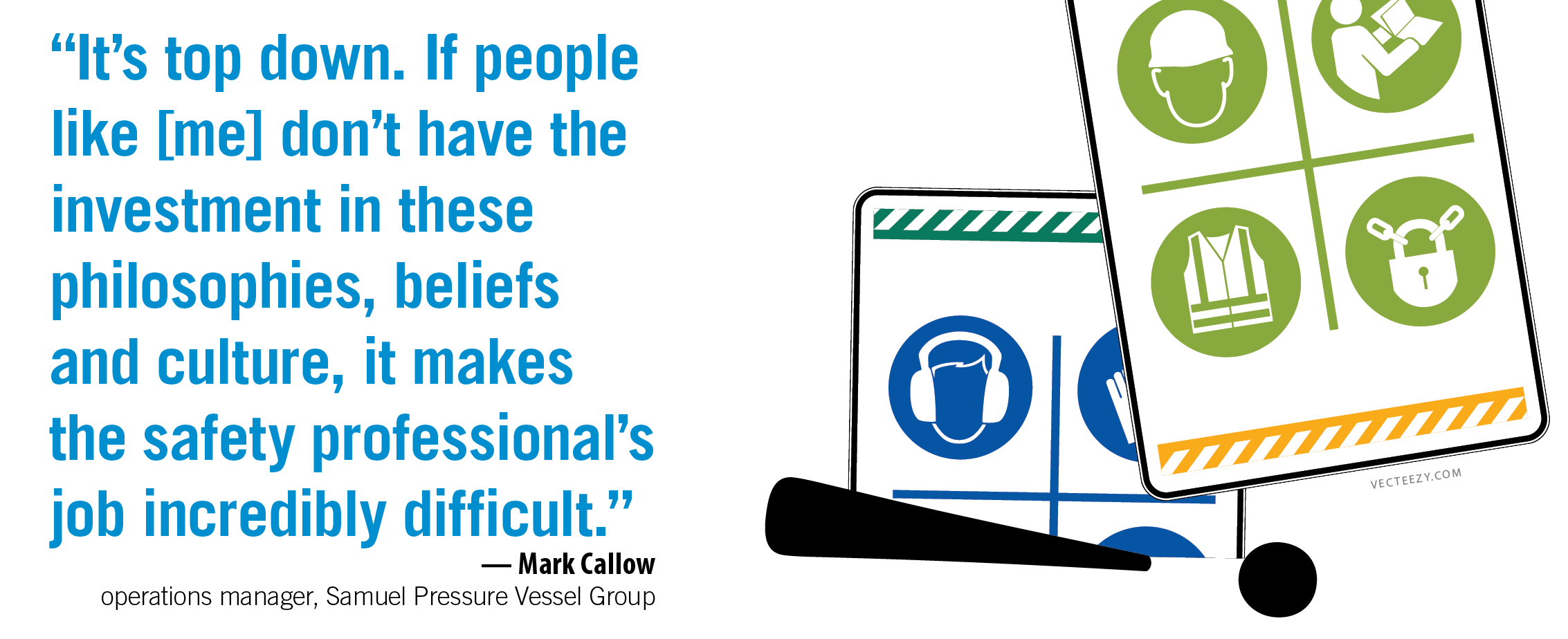
“It’s top down,” he says. “If people like [me] don’t have the investment in these philosophies, beliefs and culture, it makes the safety professional’s job incredibly difficult.”
Winkler says he welcomes engagement from all NEWMA members in the work that should ultimately be everyone’s first priority.
“Most manufacturers in this area, and probably across the country, want to do the right thing,” Winkler says. “But we run into roadblocks. What we found out in the first meeting was, there’s a lot of similarities between the issues that we have. And the goal for all of us is that our employees, who are the most important assets our companies have, go home safe. So it’s about sharing information. Who else needs to know what we can do?”
To join the NEWMA Safety Task Force, contact Ann Franz at ann.franz@nwtc.edu

