


In January, the U.S. Department of Labor (DOL) published a new final rule on the classification of independent contractors under the Fair Labor Standards Act (FLSA).
The implications are that many workers could now be classified as employees — rather than independent contractors — and be eligible for FLSA rights and protections like minimum wage requirements and overtime pay.
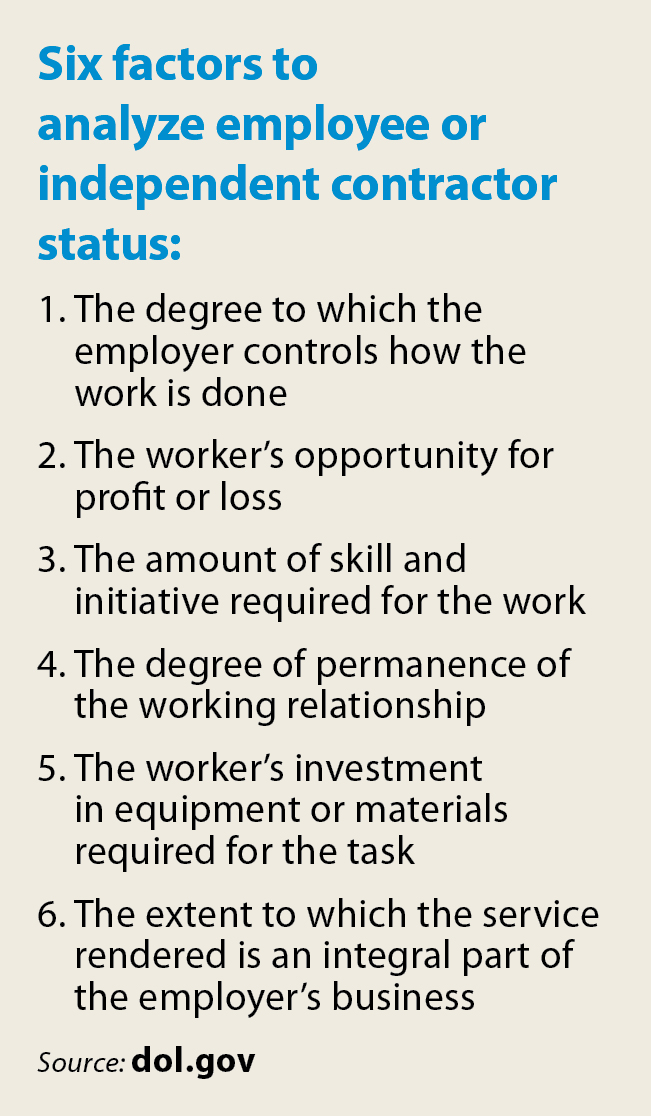
This new rule rescinds the 2021 Independent Contractor Rule that made it easier for employers to classify workers as independent contractors and introduces a six-factor test to determine a worker’s classification.
“What changed are some fairly significant pieces,” says Jim Macy, attorney with von Briesen & Roper, S.C. “It went from five criteria with two core standards to six criteria, but it’s the totality of the circumstances. In other words, no particular factor gets greater weight; you figure it all as a whole.
“The cautious employer is going to work through these criteria, and they should line up the facts that support one position or the other to make sure that they have a solid argument for categorizing people as an independent contractor or employee,” Macy adds.
The new rule, which went into effect March 11, has big implications for the gig economy and businesses like Uber, Lyft and DoorDash that hire droves of independent contractors. But any business that hires independent contractors will be affected — one New North business is facing the reality that 350 contractors could in fact be employees, causing its employee count to jump from 40 to almost 400 overnight.
“Any business owner out there that uses independent contractors, or is thinking about using independent contractors, needs to be aware of all of these rules, because it is not one size fits all,” says Steve DiTullio, attorney with DeWitt LLP Law Firm.

Industries that rely heavily on independent contractors, such as financial services, construction, transportation and media, could feel the impact of the changes most strongly. For example, an accounting firm that hires independent accountants to supplement its workforce during the busy tax preparation period may now need to treat those contractors as employees under the new rule.
Businesses that misclassify employees as independent contractors could face significant overtime liability risk.
“With the DOL new rule, the biggest risk is in overtime pay,” DiTullio says. “Under the new rule, if those [misclassified] independent contractors were working more than 40 hours a week, you’re going to owe them back overtime. It’s not as significant if it’s just one or two folks, but if it’s even 10 people who were misclassified for a couple of years, that’s going to add up.”
In addition to seeking legal counsel, employers should make sure they establish a well-written, comprehensive independent contractor agreement. But simply having a contract isn’t enough, DiTullio says.
“You have to have the contract, but how that contract is actually administered with the contractors needs to be lined up and fully consistent with that,” he says. “You can’t have a contract that looks wonderful, but then the actual day-to-day implementation is not followed. That’s a big mistake.”
DiTullio urges employers to “proceed with caution” and consider their motivations for hiring independent contractors rather than employees. “You really have to look at what you want to accomplish with your workforce and why you want to have [workers] as independent contractors,” he says. “That’s a key question for a business to answer.”
While legal experts expect challenges to the new rule, the changing landscape of employment, particularly post‑COVID, has brought the issue to the forefront where it likely will remain — so preparation is key.
“Good planning, good forefront analysis and good contracts will really make the day for employers,” Macy says.

