


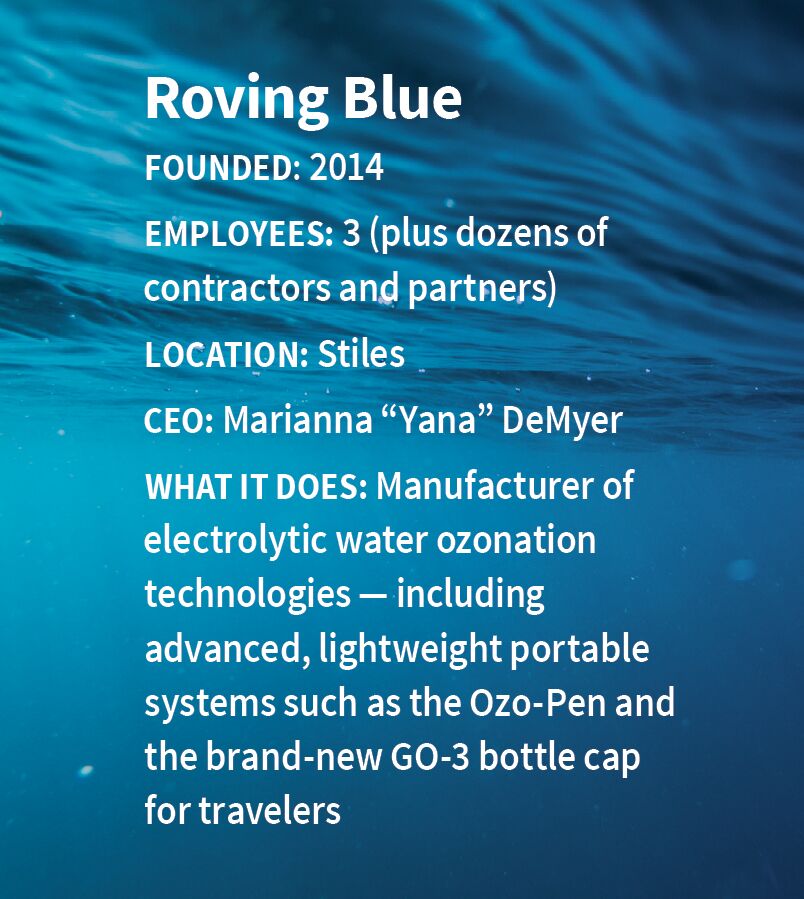
Marianna “Yana” DeMyer is an inventor, artist and advocate who says entrepreneurship isn’t easy — but her passion for Roving Blue’s innovative water purification technology keeps her on a clear path.
Photographs by Shane Van Boxtel, Image Studios
Styling by Shalene Enz
“If there is magic on this planet, it is contained in water.”
So goes the wisdom of American writer and anthropologist Loren Eiseley. All her life, Marianna “Yana” DeMyer says she has felt a pull toward the magical powers of water. But when it comes to her water purification and sanitation business, Roving Blue, there’s no magic required. Just science.
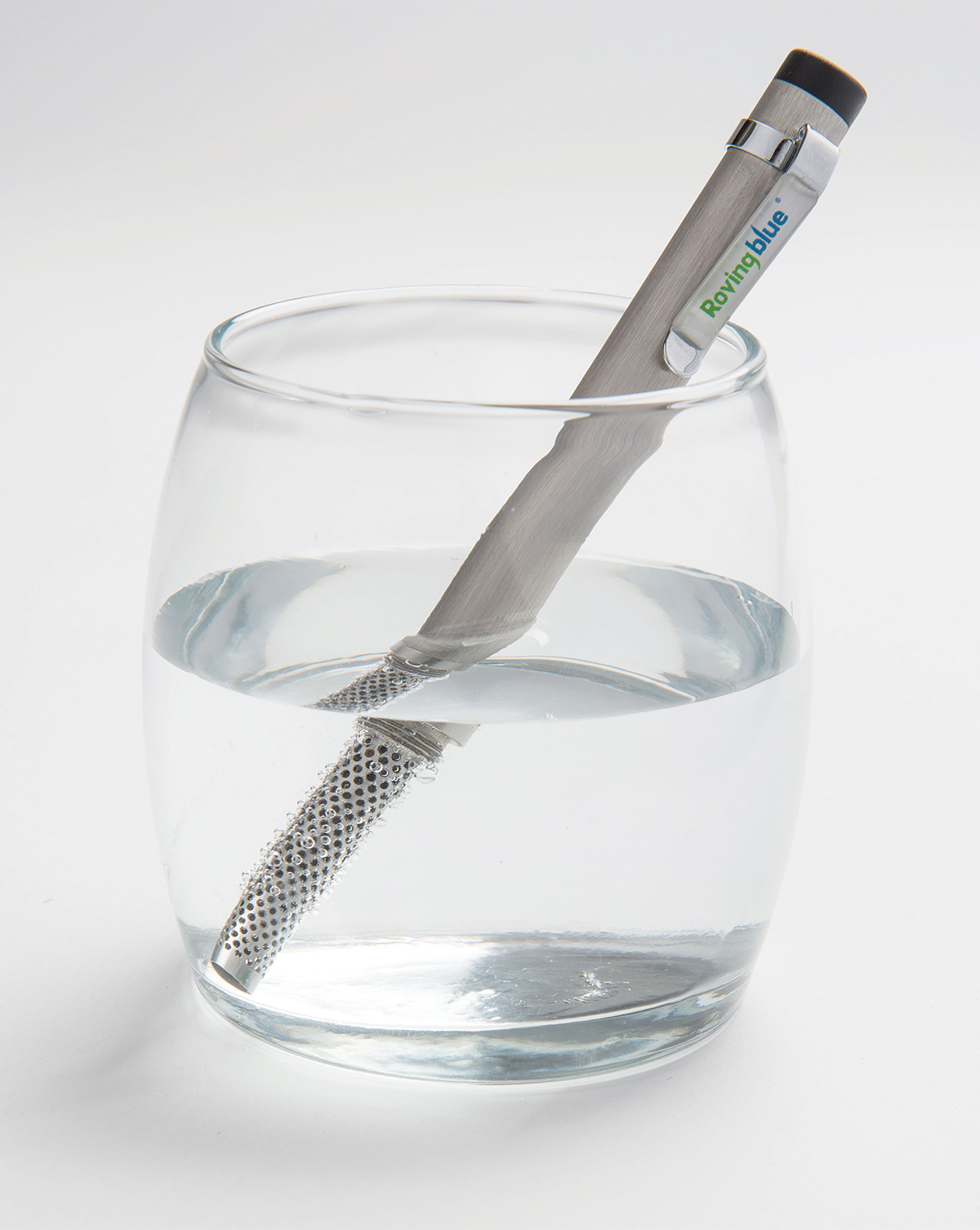
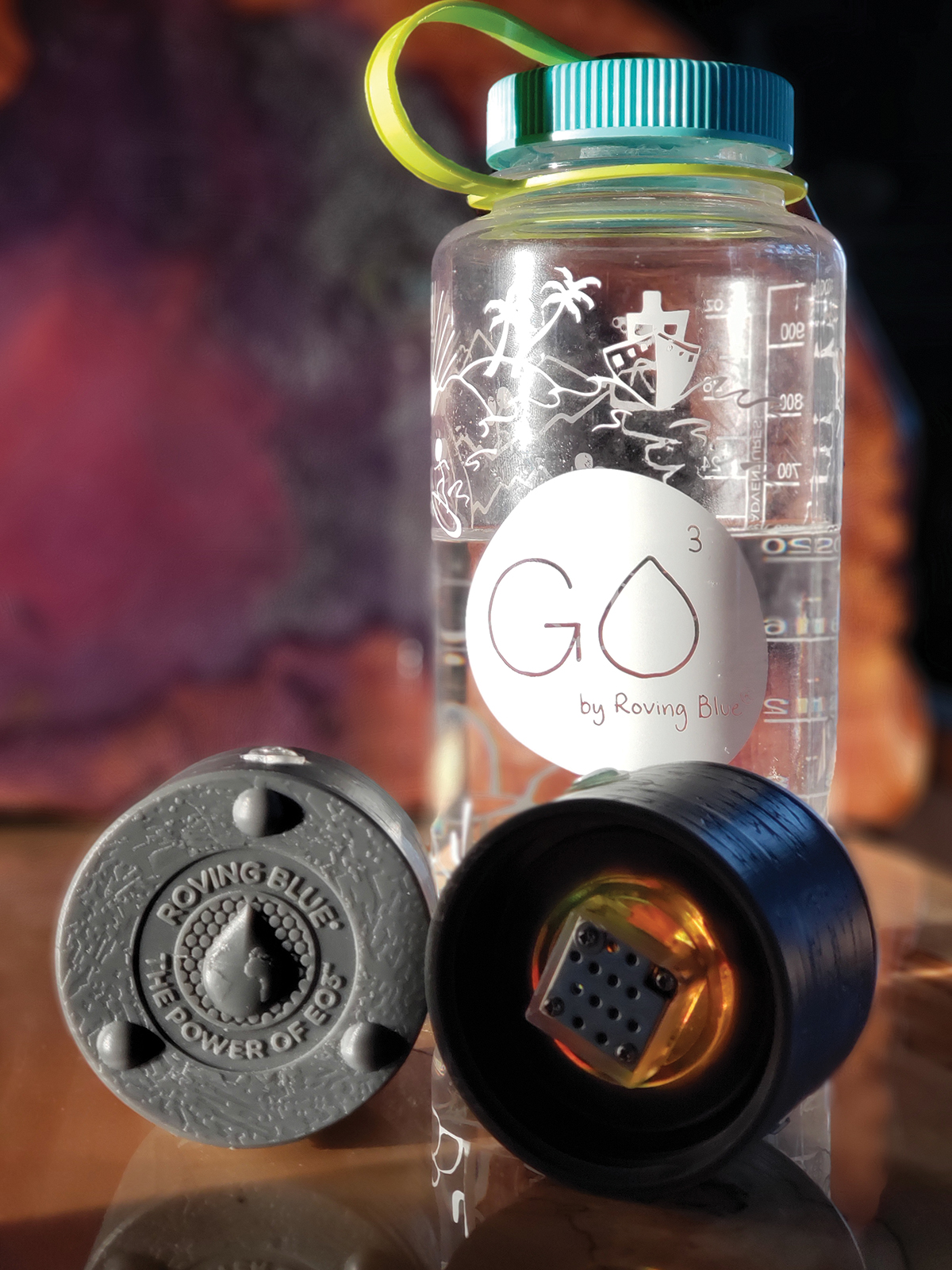
DeMyer has been inventing all her life, she says, but never did anything with her inventions until Roving Blue. Created out of her home in rural Oconto County, the company offers a range of personal, portable products that use ozone to kill bacteria and viruses in water. These include the Ozo-Pen, which is as small as it sounds, and the new GO-3 water bottle cap — a purifier for a Nalgene water bottle that sold out of its first major run for Christmas 2022.
The portable devices allow people to make their own safe drinking water from any freshwater source — wherever they may rove, eliminating the need to worry about carrying heavy water bottles when traveling. An avid water drinker, traveler and outdoor enthusiast, DeMyer is her own customer. (“I carried a water bottle before it was cool,” she says.)
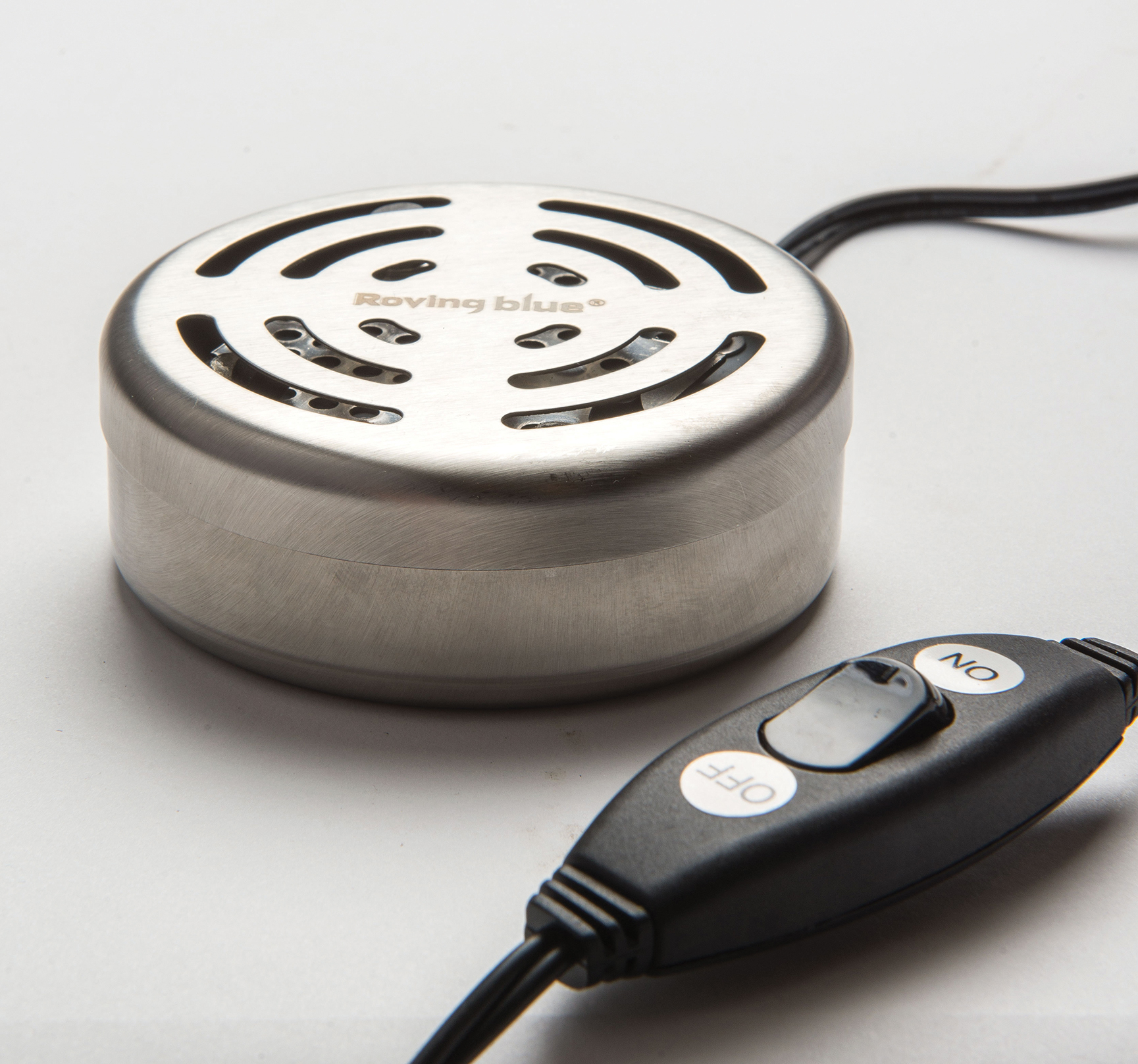
But the technology isn’t only for rovers. The Ozo-Pod is a small household appliance that generates ozone for home disinfecting tasks, and the technology has drawn interest from more than just personal-use customers — major multinational companies, NGOs and the U.S. military.
“There’s a world of possibility,” DeMyer says.
Finding blue horizons
DeMyer’s home in Stiles is surrounded by towering trees and a large pond with an artesian well that she has used to raise, sell and create art of Japanese koi — a nod to the country where she was born to a Filipino mother and a white American father.
Because her father was a career U.S. diplomat, DeMyer grew up traveling and living all over the world. She describes her life and career as a “series of little coincidences.” Middle-school-aged DeMyer and her family were living in Tehran, Iran when the city received a distinguished visitor who would become a family friend: University of Wisconsin-Green Bay Chancellor Ed Weidner. A few years later, DeMyer would enroll at UWGB and discover the place what would become her forever home along the Fox River.
A UWGB science communications graduate, DeMyer began her career in media and communications. But a passion for water has always figured large. In the mid-1980s she became part of the DNR’s Lower Green Bay and Fox River Area of Concern — the “Clean Bay Backers,” who successfully campaigned to clean up the river. After that, DeMyer would go on to make water her full-time job; she held roles managing marinas, selling yachts and growing Skippers Choice Marine Supply into the Green Bay area’s top marine retail store before the entrepreneurship bug bit her hard.
DeMyer and her now-husband, Jim, started the business White Knight Commercial Funding in 2007 to help connect companies with bridge financing in the wake of the Great Recession. She was consulting with a client when another of life’s little coincidences steered her back toward water.
The client was using ozone purification technology for application in medical and dental sinks. Examining the strange-looking box with snaking wires and hoses, DeMyer instantly found herself enthralled.
“I asked the company president, ‘Why aren’t you making a water purification system out of this?’” she remembers. “And he said, ‘It’s just not our market.’”
But if DeMyer wanted to try and make a splash with her water purification idea, he told her, have at it.
The champagne of ozone
DeMyer admits the word “ozone” doesn’t give everyone the warm fuzzies. When ozone is introduced into the lower atmosphere, explains UWGB Professor Patricia Terry, it’s called photochemical smog and can be a severe respiratory irritant.
But Roving Blue’s technology utilizes the oxygen that already exists in water to create ozone through a process known as electrolytic ozone generation, which is safe, innovative, environmentally friendly — and usually hard for the public to understand.
“My number one hurdle is awareness of this technology,” DeMyer says, adding that it can sometimes take 30 minutes to fully explain the scientific process through which Roving Blue creates O3, with the third oxygen atom of ozone being extremely reactive and able to change the chemical structure of viruses and bacteria it encounters. Furthermore, there’s the fact that ozone in water quickly wants to revert back to oxygen after it is used, leaving no trace of chemicals behind.
It’s a technology that can almost sound too good to be true, and DeMyer says it can be easy for people to write her off because she’s a trained science communicator — not technically a scientist. But Roving Blue is regulated by the EPA, and to maintain certification the science behind the products must be rock-solid and independently verified. About three years ago, DeMyer connected with Florida-based BCS Laboratories, which specializes in testing water purification systems, primarily for certifying bodies.
Lab Director George Lukasik says BCS has tested multiple Roving Blue prototypes along the path to development, and they have consistently performed to expectations. And while he hasn’t seen every product on the market, Lukasik says Roving Blue is different from other devices his lab has encountered.
“[Roving Blue products] are unique in that they generate ozone directly in the water, rather than other products we’ve seen out there that generate it as a gas and inject it into the water,” Lukasik says.
And while Roving Blue’s process for creating it is relatively new, ozonated water itself is not. Municipal water utilities and beverage manufacturers have been doing it at large scale for years to improve taste and odor.
“It used to be that the only way to suppress hydrogen sulfide, which causes a lot of taste and odor problems, was the application of another chemical called biocide,” explains Terry, a chemical engineer by trade who serves as UWGB’s chair of engineering and engineering technology and has experience as an external investigator of ozone purification technologies. “It was really expensive, and so the application of ozone allows the improvement in taste and odor at a much lower expense. It also has disinfecting properties, too.”
For DeMyer, the disinfection is the point. Roving Blue creates water that is far more powerful than chlorine at the same concentration. And that’s not its only advantage over the alternative.
“They’re both excellent oxidizers,” Lukasik says. “Ozone might be more potent, but it breaks down into oxygen, which is obviously a natural product, and it off-gasses from the water fairly quickly — so there’s no leftover taste behind that the consumer might find unsatisfactory.”
And then, Terry says, there’s the idea of chlorine gas being introduced into the atmosphere. “That’s infinitely more dangerous to the population,” she says.
With Roving Blue, everything happens underwater, anyway. Attach an Ozo-Pen to your drinking glass, watch the microbubbles swim toward the glowing blue light, and you know it’s working.
“Some call it the champagne of ozone,” DeMyer says.
A freeflowing market
The fact that Roving Blue has so many potential uses is both an opportunity and a challenge, says Mike Mathews of Madison-based Economic Growth Advisors, a business mentor to DeMyer who initially connected with her through his ongoing contract with the Oconto County Economic Development Corporation.
The first product DeMyer patented, the briefcase-sized MVP, was marketed toward the military, disaster relief and other off-grid markets.
Roving Blue spent five years participating in military field trials at Ft. Benning, Georgia, in Thailand, in Hawaii and in Germany. In 2015, DeMyer was a recipient of the Defense Alliance’s Architect of Defense Award for “demonstrating superior tenacity” in responding to military input on Roving Blue. And even though the product received great reviews, the U.S. government wasn’t ready to sign on the dotted line.
Tucker Campion, president of Poseidon Consulting, is a Roving Blue business partner who understands the military market well. The retired commander of SEAL Team 3, Campion today is a Florida-based defense consultant who has helped promote Roving Blue. He says, in his experience, the U.S. military market is especially challenging.
“There was interest, but there wasn’t a whole lot of need,” Campion says of Roving Blue’s military trials. “And if something’s not a top priority in the military, it can take a long time to get through.”
After five years, DeMyer says, “it got to the point where we needed to start selling something. My father always said, ‘When you find yourself in a hole, stop digging.’”
So the company turned its focus to the Ozo-Pen — the personal, portable water purification device that has found a commercial audience among hikers and backpackers, travelers and preppers. It was the company’s top-selling product until COVID hit and the value of Roving Blue’s home-use purifier, the Ozo-Pod, was magnified.
“In the early months, everyone was taking UPS boxes with gloves out to their garage and letting them sit for a few days; they were washing their groceries,” Mathews recalls. “I went down to the basement and grabbed my Ozo-Pod, put it in the sink, plugged it in and we purified our fruits and vegetables to make sure they weren’t a contaminated source.”
DeMyer says she leans on her customer community to share how they use her products, and the uses number in the thousands. She shies away from making any medical claims about Roving Blue, though customers are constantly sharing personal health stories about the water’s ability to clean and heal wounds, as well as its benefits as an oral rinse. “Any time something new comes along, you’ll have alternative health practitioners that jump all over it. People will want to put ozone in places where you probably shouldn’t put anything,” she says. “However, I have heard from real doctors who specialize in integrative medicine. It’s not all bunk; ozone dentistry is a burgeoning area … but for now I have to stay away from it and focus strictly on water purification and sanitation.”
The EPA has published a fact sheet detailing studies it has conducted on the effectiveness of ozone disinfection in wastewater, listing out specific microorganisms it has studied — but testing every ozonation technology and every microorganism is time-consuming and expensive. Like most Oconto County startups and tech businesses, Roving Blue needs capital, Mathews says. DeMyer has explored many avenues, even crowdfunding, to raise money for testing needs.
“Testing is very expensive, and [Yana] doesn’t have deep pockets, so she’s limited,” Lukasik says. “We’ve probably worked more with Yana’s customers than directly with Yana because her customers tend to be bigger companies with deeper pockets.”
And although the road to a big break can feel long, DeMyer is confident in her technology and optimistic about its promise for integration with other manufacturers. She says one global multinational has spent nearly $100,000 testing Roving Blue, and she is hopeful for good news about a new supplier relationship in the near future.
“[Yana has] a really broad platform for this technology, which is great because it provides lots of opportunities into different markets,” Mathews says. “But at the same time, as a small business it’s hard to pursue all those opportunities simultaneously. She’s bright, she’s got a passion, she really knows the value of her product and she’s just wanting to figure out what’s the best way to grow this business.”
A clear view of entrepreneurship
Lukasik admits it’s not common for his lab to work directly with inventors, but there was something about DeMyer that really “struck a chord.” Those who have worked with her point to her passion, diligence and humility.
“She’s a female founder of a technology company, and not only that, she’s doing it in a rural county,” Mathews says. “Plus, she’s so willing to understand and engage, and that’s not typical, either.”
Not only has DeMyer engaged with Mathews and the OCEDC, but she has participated in a wide range of mentorship and startup accelerator programs, including the LG Global Innovation Challenge, the Green Bay Packers Mentor-Protégé Program, gener8tor’s gBETA, the Wisconsin Economic Development Corporation’s ExporTech, the Cleantech Open and Georgia-Pacific and gener8tor’s 1915 Studios. She is also active with New North, Inc.
“It’s amazing how much people are willing to help you,” DeMyer says. “I’m constantly humbled by the fact that people will take time out of their day to make a connection for me.”
Mathews says DeMyer’s entrepreneurship journey is easy to root for. People love to read “rags to riches” and “overnight success” stories, he says, but DeMyer’s story is much more representative of entrepreneurship and what it takes.
“It’s not quick; it’s not easy; it’s not fair, necessarily,” he says. “You just have to keep getting up every day believing [you’re] heading in the right direction, that [you] have a good product and a market out there. That’s what she does. She pursues it faithfully every day.”