
In his previously announced American Families Plan, President Biden proposed an increase to the highest capital gain tax rate for taxpayers whose incomes exceed $1 million. This proposal has many taxpayers rethinking their investment entry and exit strategies, including investments in Qualified Opportunity Zones (QOZs).
While a proposed increase to the capital gain tax rate will certainly have an impact on how capital appreciation is taxed once the proposed rate goes into effect, taxpayers should be aware of both the short-term and long-term tax benefits of the QOZ program.
The tax benefits of investing in QOZs are:
1. Short-term temporary deferral of capital gains invested into QOZs.
2. Permanent exclusion of up to 10 percent of the original capital gain deferred, if the QOZ investment is held for five years before Dec. 31, 2026. Any remaining original gain is recognized on Dec. 31, 2026.
3. Permanent exclusion of all future capital appreciation of the QOZ investment, if the QOZ investment is held for at least 10 years.
It should be noted that the initial temporary deferral is available at the election of the taxpayer making the QOZ investment. However, without the initial deferral election (the first benefit), the taxpayer is unable to take advantage of the second and third benefits.
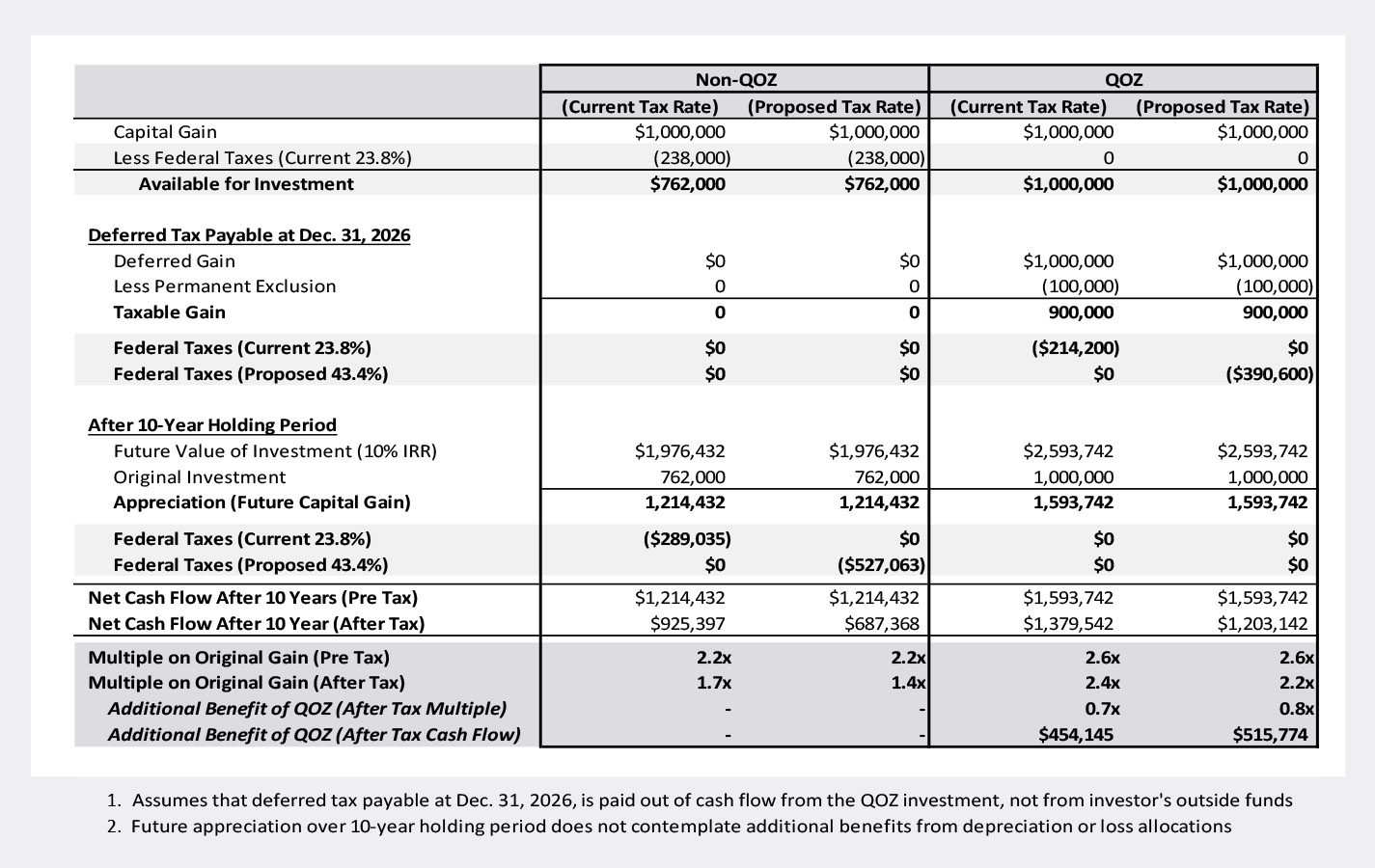
Under Biden’s proposal, capital gains may be taxed at higher rates in the future. Consider the illustration above, where an investment of $1 million made into two identical projects, both of which earn a 10 percent annualized pre-tax internal rate of return. One project is a QOZ (right two columns) and the other project is not (left two columns). Under two possible tax rate environments — one where capital gain rates remain the same and the other where rates increase — four outcomes are possible:
In both tax rate scenarios, a QOZ investment should yield higher after-tax returns than a non-QOZ investment of similar economic performance. This is primarily driven by two factors:
1. Since the tax on the original gain is deferred, the taxpayer can increase the amount of their investment, which will earn an equivalent rate of return from the project. Further, if the taxpayer can use cash flow from the QOZ project to pay the deferred tax when it is due in 2026, without using other sources of liquidity, the earnings on the increased investment amount will compound the taxpayer’s overall rate of return.
2. The tax permanently excluded on a sale after 10 years greatly increases the after-tax performance of the QOZ investment. Notably, in the rising tax rate scenario, the taxpayer is subject to a higher tax rate on the original deferred capital gain when it is recognized in 2026 (less any potential 10 percent permanent exclusion), which may erode the value of the deferral.
However, assuming the higher tax rate is still in effect when the taxpayer disposes of their QOZ investment, the tax permanently excluded would also be the higher rate tax. The ability to permanently exclude future tax at the proposed higher rate outweighs the payment of deferred tax at the higher rate in 2026.

For more information on Qualified Opportunity Zones, contact CLA Signing Director Brian Duren at brian.duren@CLAconnect.com or (612) 397-3159.
The information contained herein is general in nature and is not intended, and should not be construed, as legal, accounting, investment, or tax advice or opinion provided by CliftonLarsonAllen LLP (CliftonLarsonAllen) to the reader. For more information, visit CLAconnect.com.
CLA exists to create opportunities for our clients, our people and our communities through our industry-focused wealth advisory, outsourcing, audit, tax and consulting services. Investment advisory services are offered through CliftonLarsonAllen Wealth Advisors, LLC, an SEC-registered investment adviser.