

When I was a newly minted college graduate, I distinctly remember the moment when it dawned on me that the education I had just worked so hard to obtain (and paid dearly for) was now supposed to sustain me financially for the rest of my life.
This delayed realization occurring to a college graduate may seem a bit alarming, but in my defense there just was not an emphasis on life post-academia in my alma mater’s English department in the early aughts.
I doubt students in Oliver Buechse’s organizational behavior class will have that same deer-in-the-headlights moment of awakening that I did. That’s because the idea of careers after college is baked into the very foundation of the course. In fact, it’s not simply an “idea,” but a very imminent and exciting reality.
The organizational behavior course Buechse is leading will examine motivation, leadership, job satisfaction, learning, group dynamics and stress in the organizational setting. It will also explore how individuals, groups and structures influence behavior within organizations.
If this sounds like a lot to cover, that’s because it is. To help, Buechse, UW-Green Bay’s digital transformation executive in residence, is bringing the business community into the classroom, and I am honored that he is using Insight’s robust issue archive as a means to do so.
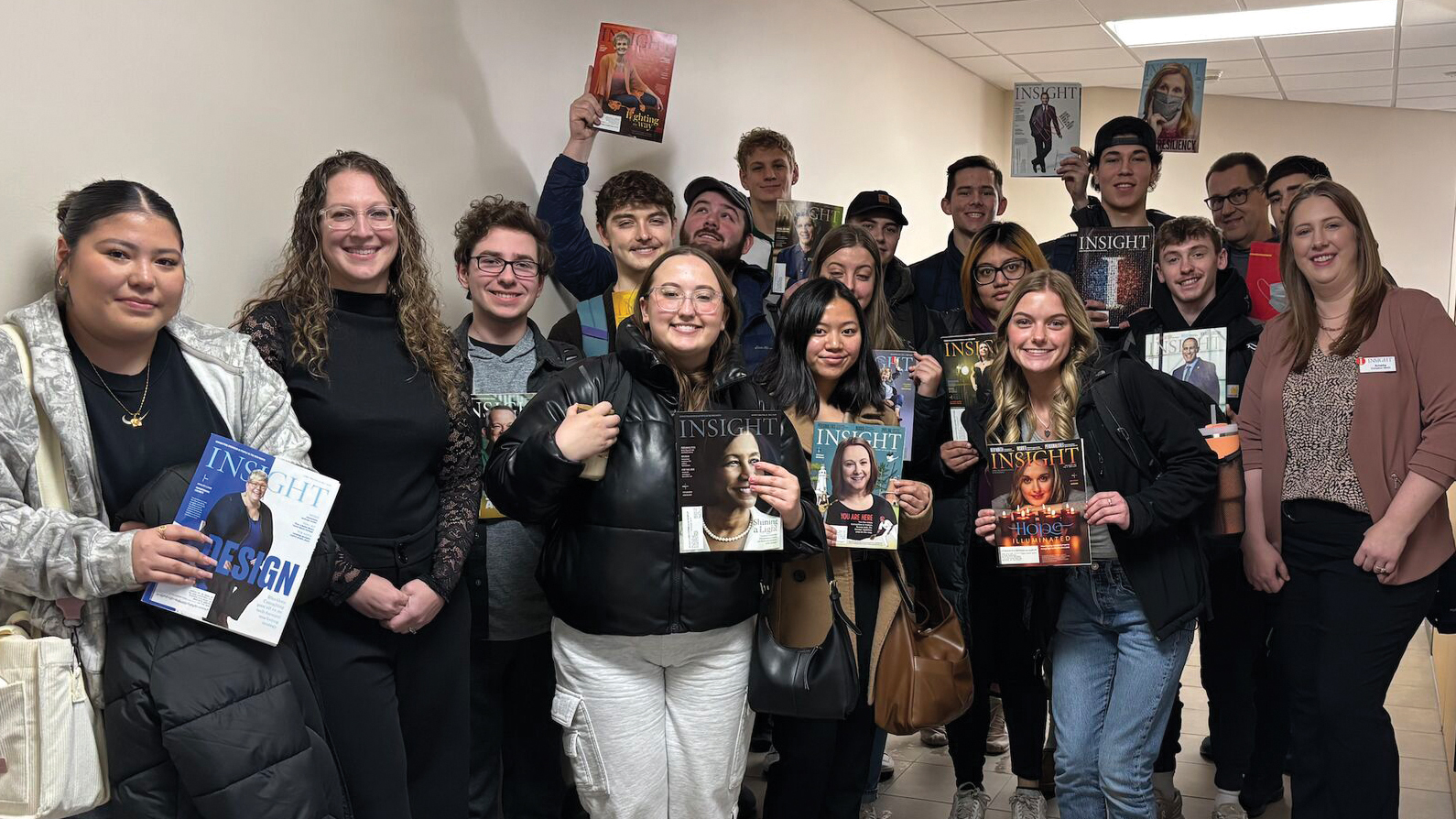
In January, Insight’s General Manager Angela O’Kray and I had the pleasure of joining Buechse’s first class at the UW‑Green Bay Cofrin School of Business. Here we met about 30 students who were asked to select a past issue of Insight on Business and read the cover story. They then introduced the profiled company to their peers and identified aspects of the story that exemplified organizational behavior, whether on an individual, organizational or community level.
It was fascinating to see the students complete this exercise using the real stories of Northeast Wisconsin businesses and leaders. Students discussed how Ashwani Bhatia’s personal experiences as an immigrant has shaped his leadership of BayCare Clinic. They outlined the role strategic risk-taking has played in the success of U.S. Venture. They talked about Larry and Kathy Treankler’s purchase of the Green Bay Blizzard indoor football team and transformation of the game day experience.
One of Buechse’s goals with this is to teach his students “reality vs. textbook knowledge.” The classroom learning is vitally important, to be sure, albeit structured and tidy. The reality of business is a bit messier. Learning to apply the concepts of organizational behavior in the wild is complex and I applaud Buechse’s ambition.
Throughout the semester, students are encouraged to use Insight as a resource to get to know local companies and their leaders. “If they bump into someone at a conference or even in the elevator, they should know the person and be able to start a conversation [with], ‘Hey I read about you in Insight magazine,’” Buechse explains.
In fact, Buechse is so passionate about his students being immersed in the business community that he has offered them an unconventional deal — if at the end of the semester they can identify the business leaders featured on randomly selected past covers of Insight, he will waive their final exam.
This approach to teaching organizational behavior bridges the gap between theory and practice in a way that is both engaging and impactful. By integrating real-world business stories into the classroom, Buechse is equipping students with valuable insights they can carry into their future careers. And if these students take Buechse up on his challenge, they might discover that real‑world insight is the best test of all.

