
By Casey Britten
There’s no way around it; the art of tattooing and body piercing is an up-close-and-personal business.
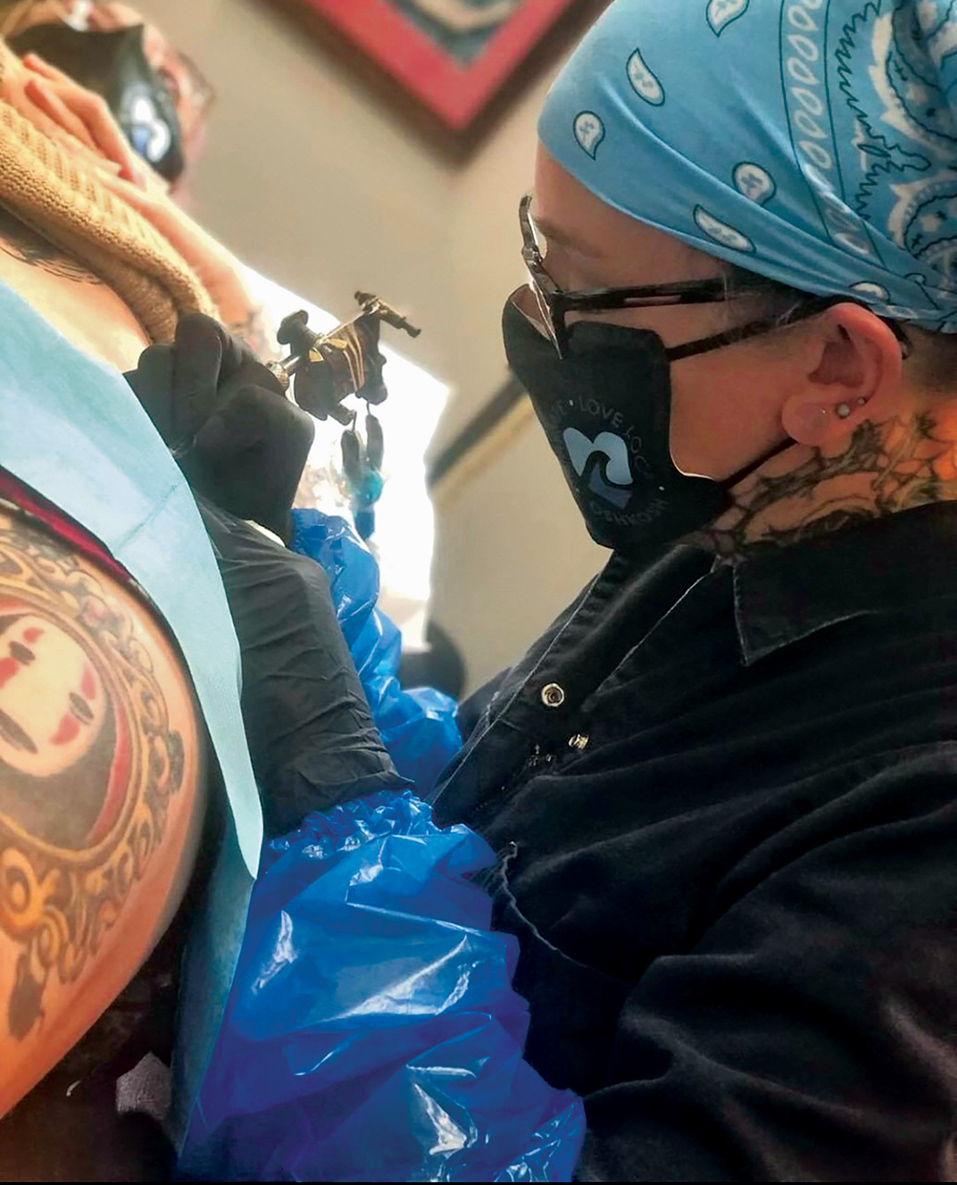
For this reason, the owners of 920 Tattoo Co. have always prioritized safety for both customers and employees. However, at the onset of the pandemic, they got proactive and went above and beyond to ensure safe practices.
“We threw the kitchen sink at it,” says Steve Anderson, who co-owns the studio with his wife Carrie Olson. “We literally did everything we could to keep our clients and ourselves healthy.”
Updates included the addition of UV air filtration to the HVAC unit and in-room mechanical air filtration via HEPA filter units. In addition, they eliminated walk-in traffic, requiring appointments to not only limit contact between clients but also reduce the number of people in the studio. Staff and clients are required to wear masks.
The custom tattoo and piercing studio in downtown Oshkosh has been in business since 2012.
“My wife and I specialize in different styles of tattoo art,” says Anderson, who participated in a New North panel discussion on how businesses are surviving the pandemic. “Carrie focuses on color realism, watercolor work and pointillism, while I specialize in what’s considered ‘traditional’ —western and Japanese styles.”
The studio also employs Molly Moon, a professional body piercer.
How does a business that requires in-person interaction survive a shutdown? That was the challenge Anderson and Olson faced in March 2020, and like many other small businesses, they diversified.
To bring in revenue, 920 Tattoo launched an online store featuring merchandise they had in the studio. The site features original art by Olson, handmade jewelry, apparel and other merchandise.
“It was something we had talked about doing, but just never had the time before,” Olson says.
The online store was met with support from customers, and Anderson and Olson plan to expand offerings and continue to improve the user experience.
“It’s uncommon for a business like ours to have a website with products like ours,” Anderson says. “Most of our income is generated from the service of tattoos and piercings, not from the merchandise. But it was a pretty low cost of entry, so it made sense to try.”
It’s clear Anderson and Olson take pride in what they do and in building a community.
“I’m an artist, so of course I love the art,” Olson says. “But it’s the people, the stories I get to hear that I love the most about what I do. It’s interesting, the way a tattoo can affect someone’s life or their feeling about themselves. To have someone tell me it helped them feel confident or it helped them through a hard time, that means a lot.”
Regarding safety procedures, the duo predicts more of the same going forward.
“With the kind of business we are, we realized that much of what we’ve added just makes sense,” says Olson. “When you’re sitting inches apart from clients for several hours in a row, and there’s open skin, why not have another layer of protection and cleanliness? Some of this will never go away.”
For Anderson, the measures are about leading by example. “We’re part of a community, so how do we act responsibly and hopefully set a better standard?”
The prudent philosophy seems to be working.
“We’ve decided to focus on the third of people who are being cautious. We generate more referrals than we can handle anyway, so we can afford to be cautious,” Anderson says. “If staggering appointments and requiring masks makes my business unappealing to some clients, maybe that’s OK. If we’re appealing to people who are taking similar precautions, that just increases our chances of staying healthy and working with them. We’re hoping that quadrupling down on safety will appeal to enough people to keep the business going.”

