
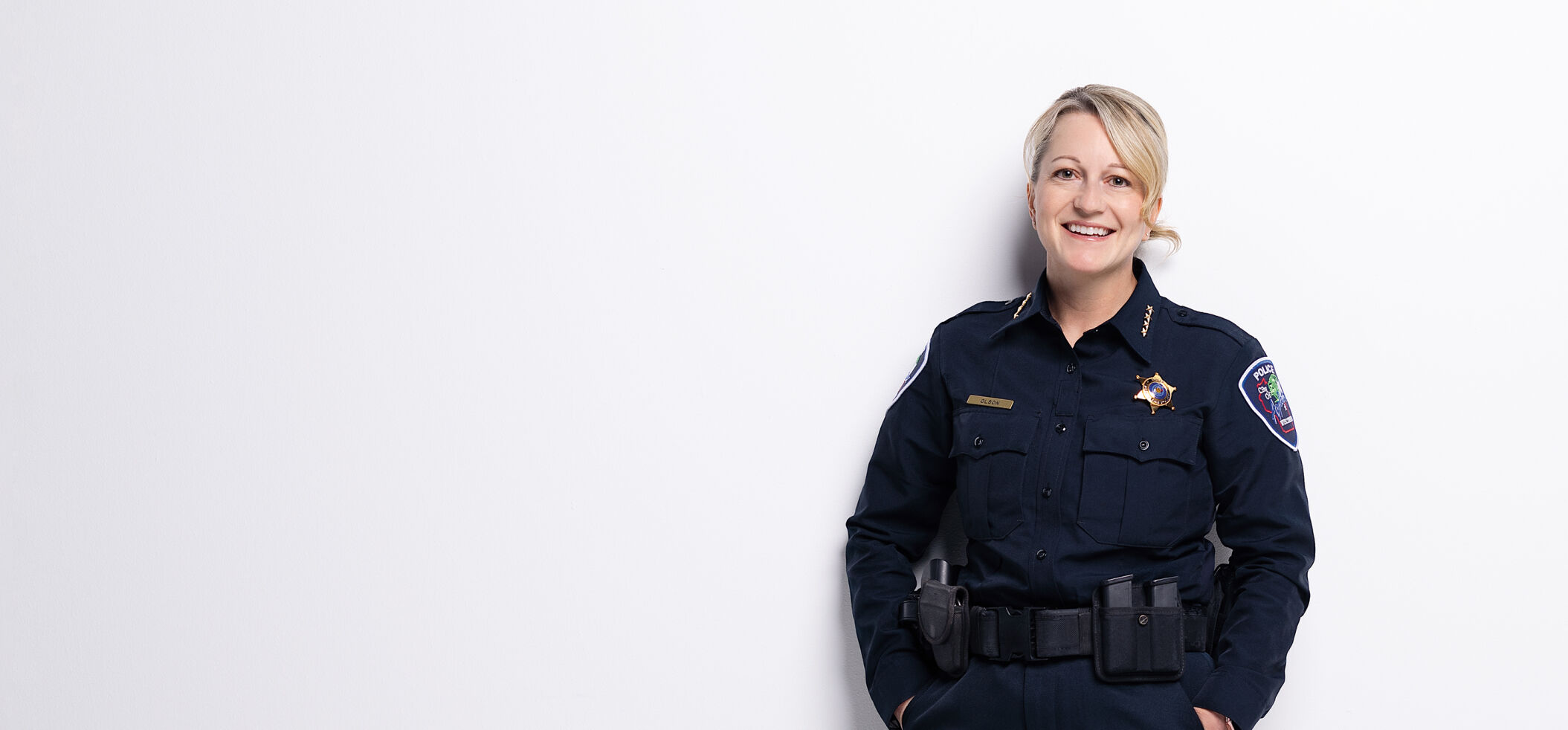

Photograph By Shane Van Boxtel/Image Studios
Only 3% of police chiefs nationwide are women. That includes Polly Olson, who has spent 22 years with the Appleton Police Department and took the helm of the agency in January. Olson, who says she has always been drawn to the helping professions, originally envisioned herself in medicine. It was after earning a biology degree and working in nursing, phlebotomy and pathology roles that she eventually became a deputy Outagamie County coroner and built relationships with detectives who urged her to consider a career change. In 2000, the mother of two young children enrolled in the recruit academy at Fox Valley Technical College. And “the rest is history,” says Appleton’s first female police chief. She sat down with Insight to discuss why she hopes her career has brought her to the right place at the right time.
Insight: You’ve worked as a school resource officer, sex offender registry specialist and a lieutenant overseeing the detective unit — was there a point at which you began envisioning yourself as a police chief?
Olson: The chief previous to me, Todd Thomas, described me as a ‘reluctant leader.’ I hadn’t heard that term before, and it really resonated with me. I’ve always been one who kind of immerses myself in whatever role it is that I take on, and then I find myself at points being open to opportunities for other things that have come my way. So I think I have created these opportunities because I do work hard, but I’ve not been one of those persons who was always looking for the next thing, I guess. I would have been content with any of the other positions I’ve had, because when I’m doing those roles I really enjoy what I’m doing.
What ultimately appealed to you about the opportunity to become chief and how do you see your role today?
When I stepped into the role, we had just gotten through COVID and all the protests and a lot of turnover in our agency. Our police department came out on the other side better than most, and I think we have a history of having really strong leadership within our agency, so for me to step in my first thought was, ‘how can I make it even better?’
How has the recent national rhetoric around policing affected your day-to-day work?
It’s important to be aware of things that are happening nationally, but you have to be able to put it into perspective as well that there’s also a lot of value that should be placed into the experiences we’re having locally. And yes, there are things that pop up locally that can be concerning at times, but overall the relationship we have with the community here is second to none. It’s hard for me to walk down the street most days, honestly, without having someone reach out and say thank you. Sometimes there’s some constructive criticism, too, and that’s good. I want people to feel comfortable to say, you know, ‘I didn’t like how you did A, B or C’ or ‘have you thought about doing it this way?’
What has been your experience as a woman in policing?
It’s not unusual for me to walk into a training or conference and be one of the only women in the room. I’d like to do everything within my power in the years I have left to try and change that, you know, try and recruit and get more women drawn hopefully to a career in public safety because it’s been really rewarding for me. There just aren’t a lot of women, for a variety of reasons, that are drawn to this career. There’s been a minority in our agency, and we’re really trying to change that but struggling in the recruiting piece. Right now, we have 10 women working for us in sworn positions, so it’s less than 10% of our force.
Why do we need more women in public safety?
The diversity benefits the community, absolutely. We [women] just have different communication skills, just being able to listen and connect with people. [The] approach to problem-solving is different. And female officers in particular tend to be more drawn to things that drive connection with the community and that relationship-building piece; they see the value in it. In order to really have effective policing in a community you have to be able to build trust, you have to be able to build transparency and connect with your community members. Women sometimes do that better. Not to take anything away from the men, those are just some of the strengths in this field that I’ve seen that women can have.
What keeps you up at night?
What keeps me up at night quite honestly is the mom side of my brain that worries about the safety of my staff. I just feel so much love and pride for each and every officer that I have, and every civilian member that works for us, and I just want them to be safe. Unfortunately, we see it almost every day across the country that police officers are getting killed in the line of duty and it’s hit close to home a number of times this year already, where [Wisconsin] has lost officers to violence. From a crime standpoint, the drug and fentanyl crisis is really scary right now. I really feel for parents. It’s not like it was when we were in high school and you’d hear about peer pressure to smoke a little bit of weed. This is truly very dangerous stuff that will kill you with just one time of use. So how do you prevent that from happening? It’s here, it’s in this community, and it’s much more prevalent in this community than I think most people want to accept. And that worries me, because I think I have a responsibility as a leader in this community to do something, but I don’t have all the resources I need.
Why is Appleton the place for you?
I really just love this community. Growing up here — I was a graduate of Appleton East High School — [I’ve been able to see] this community grow and become more diverse and see the introduction of the arts, the introduction of different cultures and the different restaurants and just all the different festivals, the special events, you know. And I know the work that it takes to put on many of these events just due inherently to the work I do, so I really have a lot of admiration for those that continue to push forward to make all those things happen in this community. I love living here. Especially as I’ve gotten older and been able to do some traveling across the country, you go to other parts of the country and see how other people interact. There’s something special about the Midwest and something very special about Northeast Wisconsin. That’s why I’ll never leave here; it’s just how we treat each other. We’re kind, sometimes almost to a fault, but I love that about this community and I wouldn’t want it to be any different.