

Photographs by Shane Van Boxtel, Image Studios
It’s no accident that great cities and civilizations of the past developed along rivers. As a source of water, the river is a giver of life. As a source of transportation, it was fundamental to commerce — along Wisconsin’s mighty Fox sprung up the world’s largest concentration of paper mills. But before the Industrial Revolution, Wisconsin’s Fox River was wild with rapids. The north-flowing, 39-mile stretch from Lake Winnebago to Green Bay plunges 168 feet — equal to the total drop at Niagara Falls.
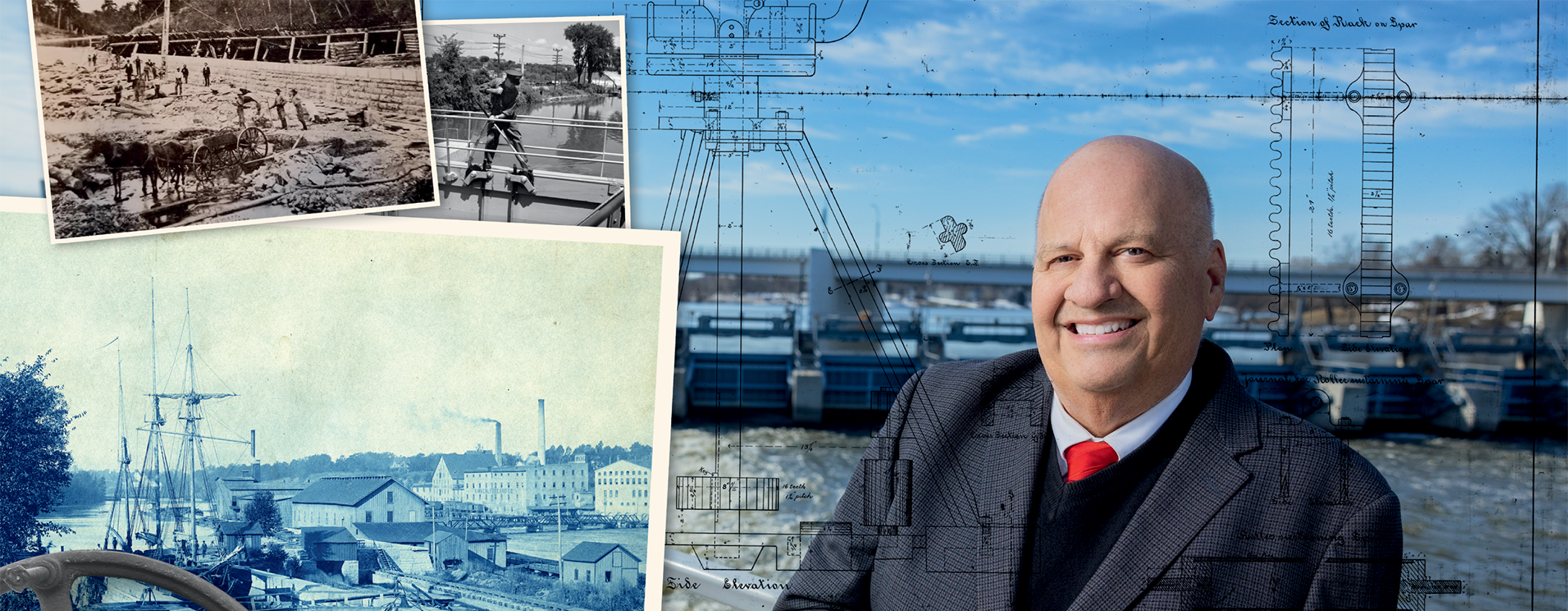
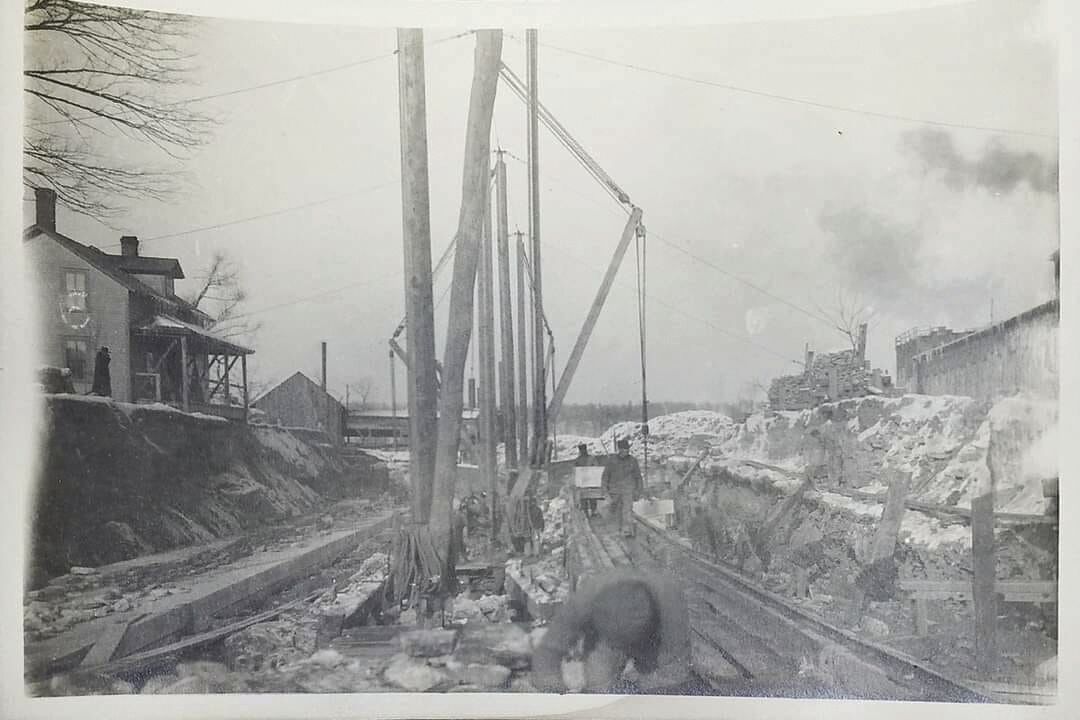
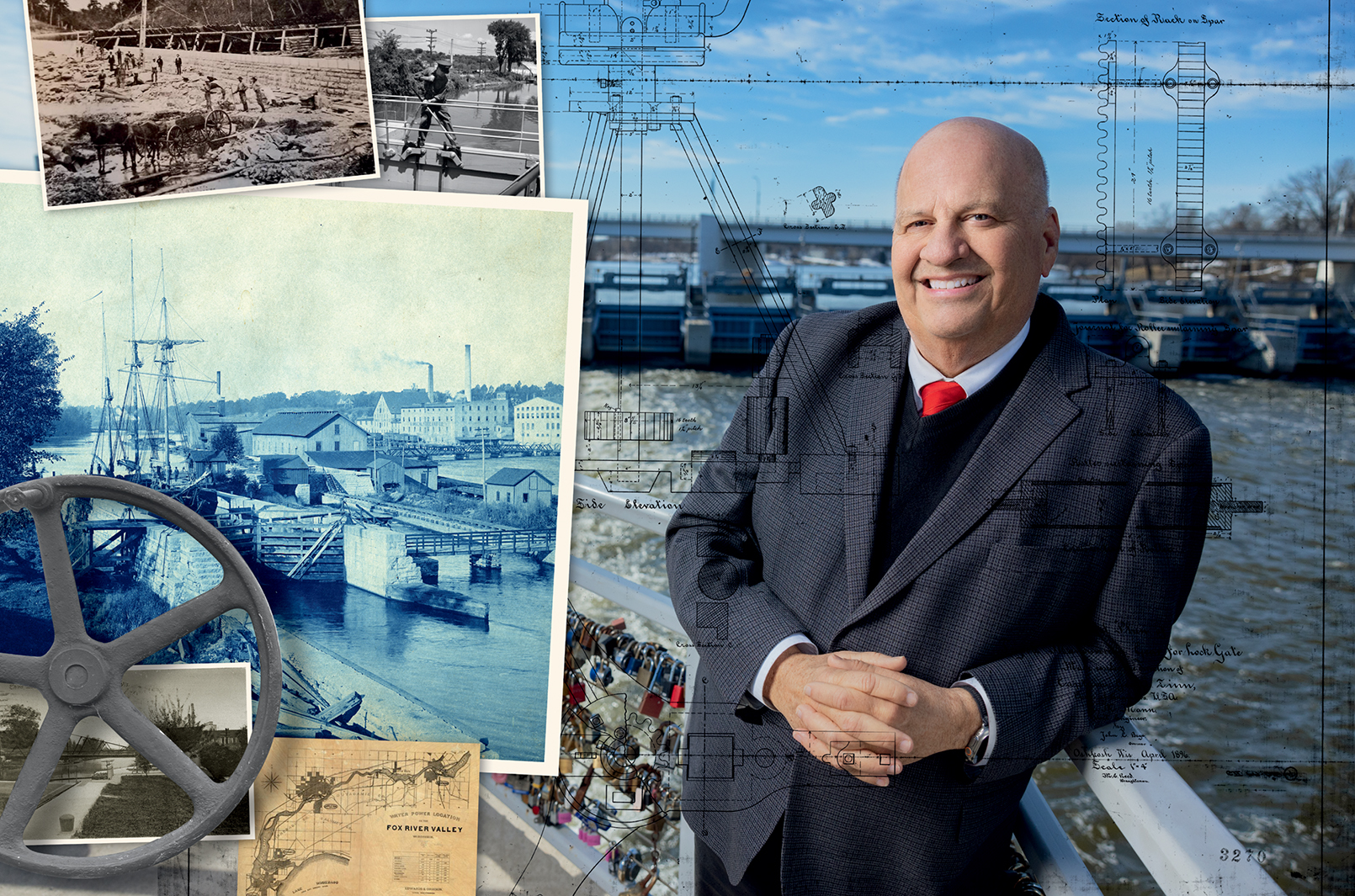
Without an incredible feat of engineering in the 1850s, the Fox Cities we know today may have looked very different. Using horses, dynamite, hand tools, virgin Douglas fir and stone rubble, European immigrants built a series of 17 locks to tame the river for navigation and set the table for the development of hydroelectric dams. Once complete, a system that culminates with 12 to 14 revolutions of a cast metal turnstile permitted passage along the Fox River.
And today, nearly two centuries later, it is exactly the same.
Living history
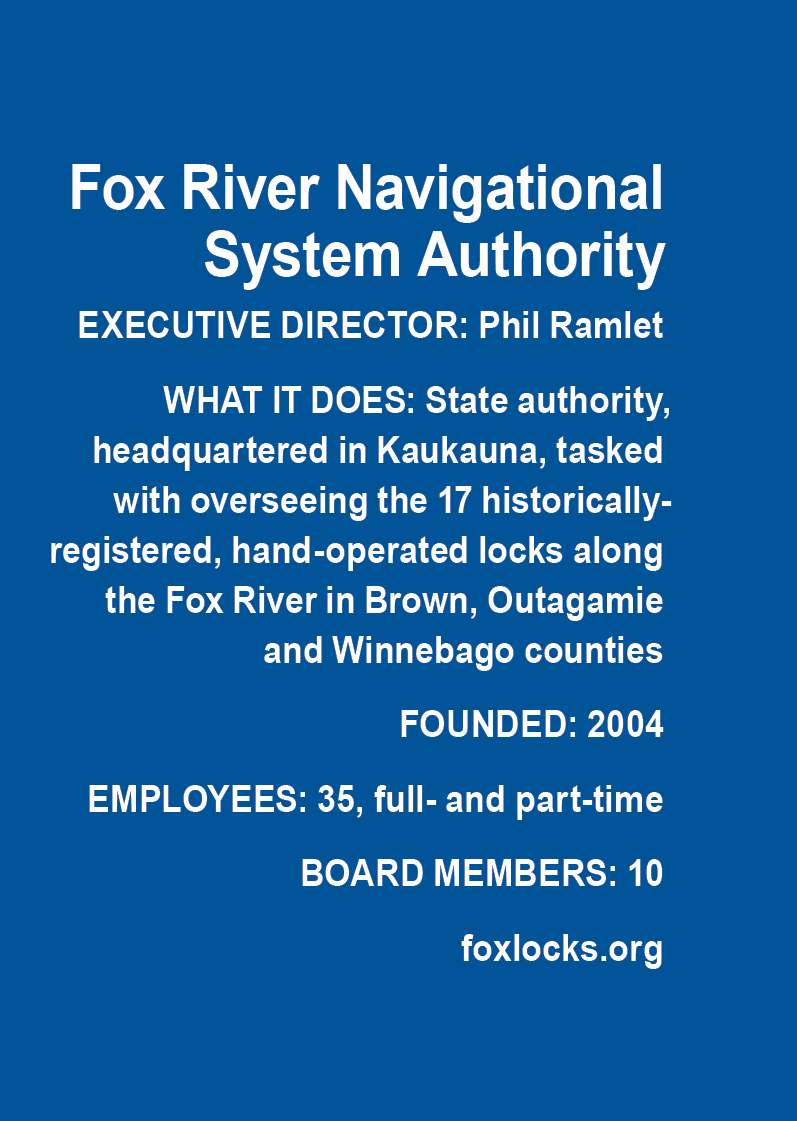
Phil Ramlet was retired from his role as president and CEO of OMNNI Associates when he agreed to take on a one-of-a-kind leadership role last May. The Fox River locks are among a precious few, and the largest, fully-restored, hand-operated lock systems in the world. And fully-restored means exactly that: The locks are on the National Historic Register of Deeds, meaning craftsmen used original patent drawings to hand-cast gears and mechanisms to exact historical specifications. It was a painstaking refurbishment process that started in 2005 and lasted nearly a decade.
Ramlet was heavily involved in the restoration and says it was one of the state’s great historic preservation challenges. The federal government abandoned the locks for nearly 50 years and ultimately proposed in the 1980s that they just be relegated to history.
“They just wanted to fill it in and leave it,” Ramlet says. “The community leaders came forward and said, ‘you know, this is worth saving.’”

Ron Vandehey, who was elected mayor of Kaukauna in 1982, played a pivotal role in two key actions that led to what today is known as the Fox River Navigational System Authority — also known as FRNSA or Fox Locks: the formal transfer of lock system ownership from the federal government to the state, and fundraising for the restoration process.
“There was a substantial payment from the Corps of Engineers to the state, and we became an independent agency operating under the auspices of the state of Wisconsin,” says Vandehey, who remains active on the FRNSA board today and recruited Ramlet to his current role as executive director. “If we were going to accept the locks in the transfer, we were going to make them viable and operative. We had an obligation to finish the job.”
Another way of describing that payment from the U.S. Army Corps of Engineers to the state of Wisconsin: Ramlet’s present-day budget. As executive director, Ramlet finds himself at another pivotal moment for Fox Locks. Since it was formally established in 2004, the authority has essentially been functioning off investments of the feds’ initial $11.8 million payment, which has now grown to about $16 million, as well as some grants and donations. Additionally, Fox Locks’ lease with the state of Wisconsin expires in 2034, and FRNSA needs to be proactive about renewing it, Ramlet says.
“The system has been really well managed, and really good fiscal decisions have been made,” says Mary Schmidt, a marketing consultant who is working with Ramlet to raise awareness and support for Fox Locks. “Truly, this is Phil’s vision to sustain the system over the long term with enough funds to cover operational costs. That’s really key. He’s opening the door, and I think Phil has a real approach to managing the organization more like a business versus a seasonal attraction.”
Because yes, while the locks are a beautiful piece of living history and no longer essential for commerce, they still play a major role in both economic development and natural resource management.
Reclaiming the river
There was a long period of time in which the Fox River was not viewed as a community asset, following decades of pollution by companies who essentially used it like a sewer, says Beth Olson, a program director for the Wisconsin DNR who has overseen the historic cleanup of PCBs from the Lower Fox River since 2010.
In fact, 2023 represents a milestone for the Lower Fox River PCB Cleanup as it comes to a formal close. Olson says the amount of polychlorinated biphenyls, or PCBs — the now-banned but long-used carcinogenic industrial chemical compound — that have been removed from the river over the last 20 years would fill dump trucks lining end-to-end from Green Bay to Miami. Of course, PCBs don’t actually fill trucks because they are invisible toxins. But despite PCBs being an invisible threat, Olson says removing them has produced results you can see, hear and taste.
“Regulation of toxic pollutants has led to a huge comeback of the bald eagle and other water species,” Olson says. “In the ’70s, we had fish consumption advisories and I think that was a real wake-up call for anglers. It’s a world-class walleye fishery in the lower segment of this river.”
A healthy river means the return of healthy wildlife, as well as significant increases in the value and appeal of being in or on the river — a phenomenon that drives economic growth throughout the region.
“I think the key going forward is continued development along the Fox River,” Ramlet says. “Boaters love a place to go.”
Indeed, a recently-popular social and recreational jaunt for members of the Appleton Yacht Club was upstream to Lake Winnebago via the Menasha Lock. The initial restoration of the lock was a boon to downtown Menasha, as boaters tied up and explored the community in droves each summer. But in 2015, that came to a halt as FRNSA voluntarily closed the lock due to concerns about the invasive round goby.
Finding a way to prevent the six-inch fish from entering Lake Winnebago and re-opening the Menasha Lock are top goals of not just economic development champions in Menasha, but of Fox Locks and the DNR, too.
An electric barrier has been identified as having potential to solve the round goby issue. By the end of the summer, Ramlet says, Fox Locks hopes to have an official project price tag in hand. He knows it will have a lot of zeroes.
“We’ve met with our state and federal politicians; we don’t feel we have the money internally to be able to handle that, so we would look for state and federal government to help us,” Ramlet says.
Menasha is one of two Fox Locks that are currently closed. The lock at Rapid Croche near Wrightstown was closed due to invasive sea lamprey in the early 1980s through an act of the Wisconsin legislature. While Menasha is the priority, Ramlet says he is hopeful that the electric barrier technology could also be a solution for re-opening Rapid Croche and subsequently full navigation through the Great Lakes. (“These locks were originally envisioned as a military development to be a gateway from the Great Lakes to the Mississippi,” Ramlet says.)
“I think that working together with the scientists and the agency and the recreationalists we can probably find some good solutions to move forward and fulfill the mission to reopen the locks,” says Jean Romback-Bartels, Northeast Wisconsin director for the Wisconsin DNR and Fox Locks board member. “We just have to continue to work together.”
River life, river heritage
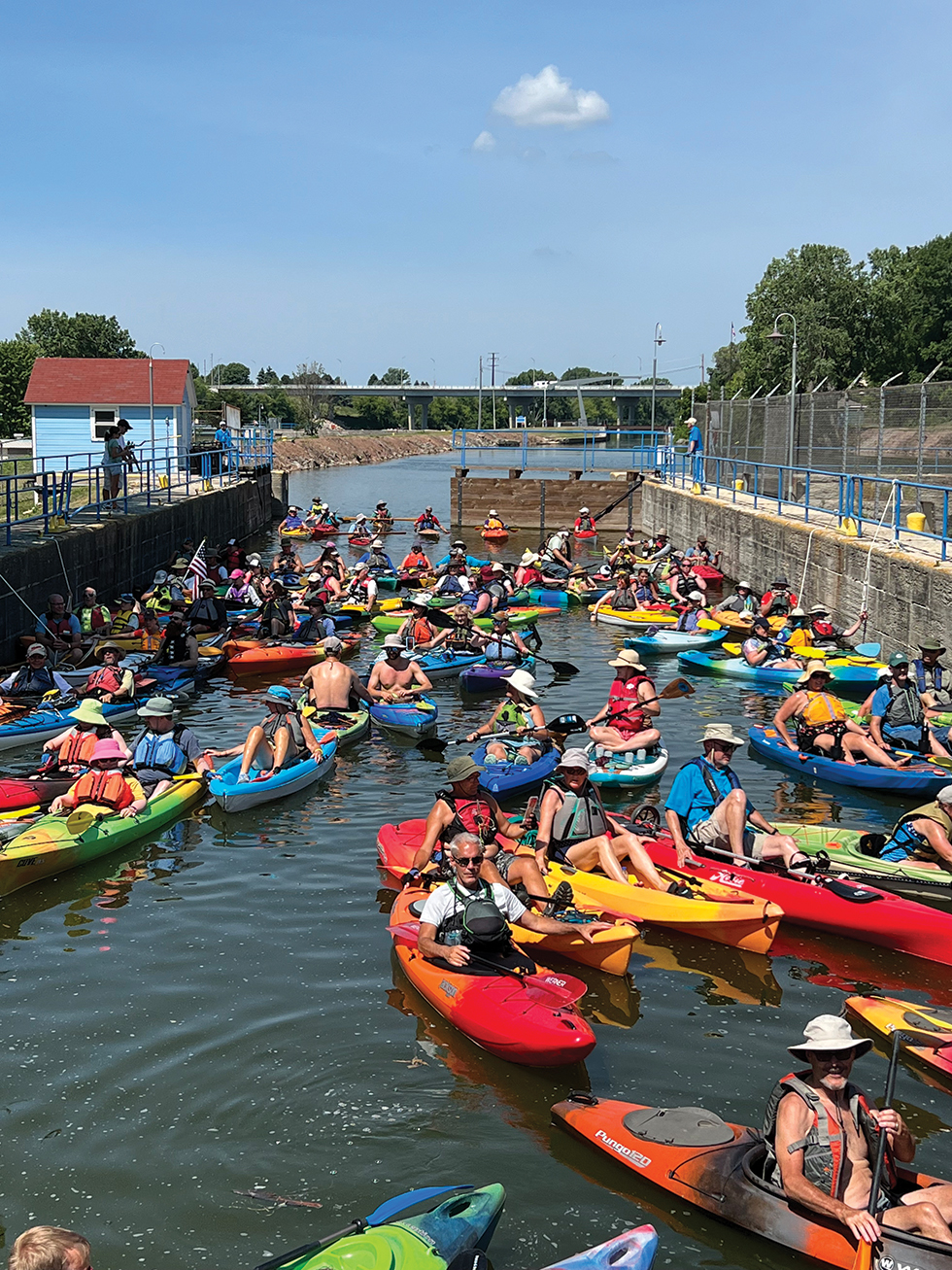
Among the recreationalists who would love to see Menasha re-opened are Dave Horst and Jeff Mazanec of Northeast Wisconsin (NEW) Paddlers, a nonprofit organization that has attracted hundreds of novice and experienced kayakers from and to Northeast Wisconsin for lessons, trips and events like group paddles. These have included a re-creation of the Marquette and Jolliet expedition and a “Park to Park” event through the Fox Locks that at its peak saw 189 colorful boats fill a lock at one time. As part of its mission, NEW Paddlers today works with Fox Locks to advocate for river accessibility to paddlers.
Horst, a longtime community journalist, has studied and developed a personal passion for the Fox River’s history.
“There’s not much in life that’s the same as it was 150 years ago,” Horst says. “I just think everybody needs to experience what a gift the Fox River is to this region; you can do it in a kayak, you can do it in a motorboat or you can sit on the shore and just watch the river go by. It’s out there for everybody to enjoy.”
These days, one doesn’t have to get in the water to enjoy the river. The Nelson Family Heritage Crossing between Little Chute and Kaukauna is one of the latest additions to an elaborate trail system that allows hikers and bikers to enjoy the riverfront.
In addition, Fox Locks has begun restoring the nine locktender houses along the river and hopes to eventually open some to the public as mini museums or visitor centers.
“This is an important part of not only the state’s history, but our national history. I think there is great potential to bring in more [tourists],” says Ramlet, who has pictures of everyone from local schoolkids to Japanese nuns visiting Fox Locks. “When people come to visit our area they love to go see Lambeau Field, but there are lots of people who would love to take a look at our boating facilities and locks.”
Growing up on the Riverview Golf Course in Appleton, just a creaking staircase away from Lock One, Pat Spaay spent his childhood fashioning rafts for catching frogs and carp, splashing in the water with friends and occasionally finding himself in the path of the “crabby old man” who tended the lock.
“He doesn’t mean to chase you away,” Spaay remembers the locktender’s wife telling him and his friends, plying the teens with peace offerings like homemade cookies.
Despite his many fond memories, Spaay says, “I’ll bet you 50% of the people who live in Appleton don’t even know what the locks are or where they are. [I hope we can] draw more people down there to see how things were constructed in the 1840s and ’50s before the advent of hydraulic cranes. It’s a pretty amazing experience.”
‘Our ultimate responsibility’
Today, Spaay laughs about his fond memories of mischief on the river. The crabby locktender wasn’t actually that old, and he wasn’t really crabby, either — he was just concerned for Spaay’s safety. And perhaps those memories of his old neighbor were somewhere in the corner of the Kimberly-Clark retiree’s mind in 2015 when he came home and announced to his wife that he was applying for a job as a Fox River locktender.
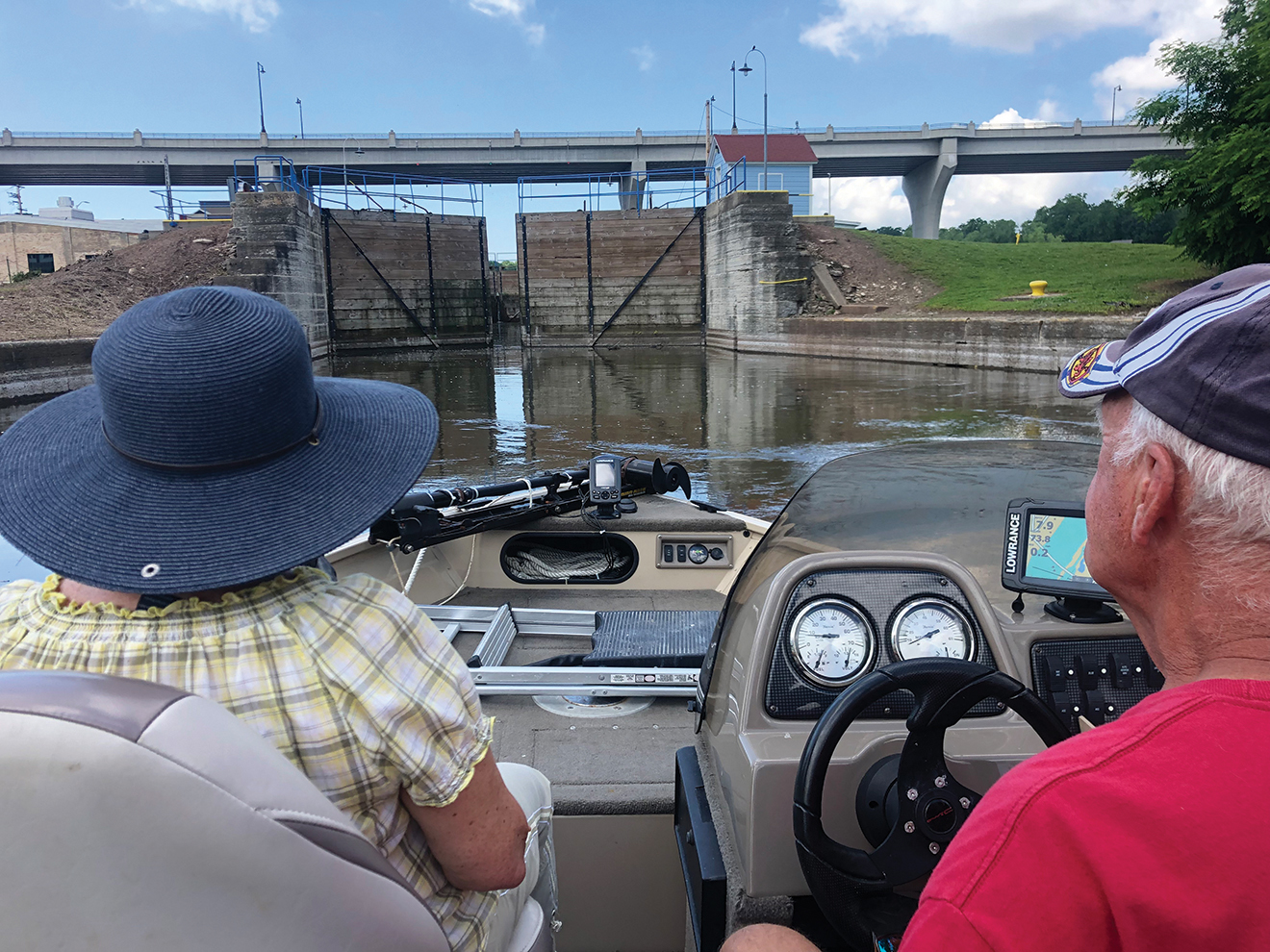
Spaay says he hasn’t once regretted his decision to get more involved with Fox Locks as a public servant. Of course, his job is much easier than that of yesteryear’s locktender. The Fox Locks today are operated only seasonally, with limited hours, and primarily serve recreational boaters. But the process, if not the demand, is exactly the same: throw a rope, open the valve, twist the turnstile.
“One for danger, two for dock, three for bridge and four for lock,” was the key to identifying the meaning of blowing horns in the early 1900s, when locktenders lived on site with their families and responded to vessels all day and night, year-round.
Today, Fox Locks employs locktenders from May through September — mostly college students and retirees who enjoy history and socialization. A trip into the lock usually means intensive interaction with and a history lesson from the locktender.
Schmidt says celebrating history and culture is and will be a key emphasis of Ramlet’s tenure as CEO.
“The big thing that Phil’s been able to do is make people understand that this system is not just for the boaters,” she says. “It’s also for people who love history, who love culture, who love the area and who just want to see how these crazy things work.”
As Fox Locks seeks to maintain its facilities and grow programming, Ramlet says the organization will seek out greater donor support, in addition to grant opportunities. Fox Locks is launching a fundraising campaign aimed at preserving the system for future generations.
Erosion, sink holes and maintaining a 170-year-old technology are ongoing, costly challenges. The Fox Locks Preservation Fund has been established through the Community Foundation for the Fox Valley Region to sustain operational support. Ramlet says the willingness of Curt Detjen, the community foundation’s president and CEO, to serve as a fiscal agent and allow for the tax-deductibility of gifts has been pivotal.
“We have had early, positive response from community members and elected leaders regarding the need to preserve and grow the lock system for future generations,” Ramlet says.
For Vandehey, it’s a resource worth investing in.
“The river and the lock and dam system is a gift that we inherited; those of us who are on it today, we didn’t make it happen,” he says. “That happened over 150 years ago, and it’s our ultimate responsibility to make sure those that follow us will have that same opportunity.”