
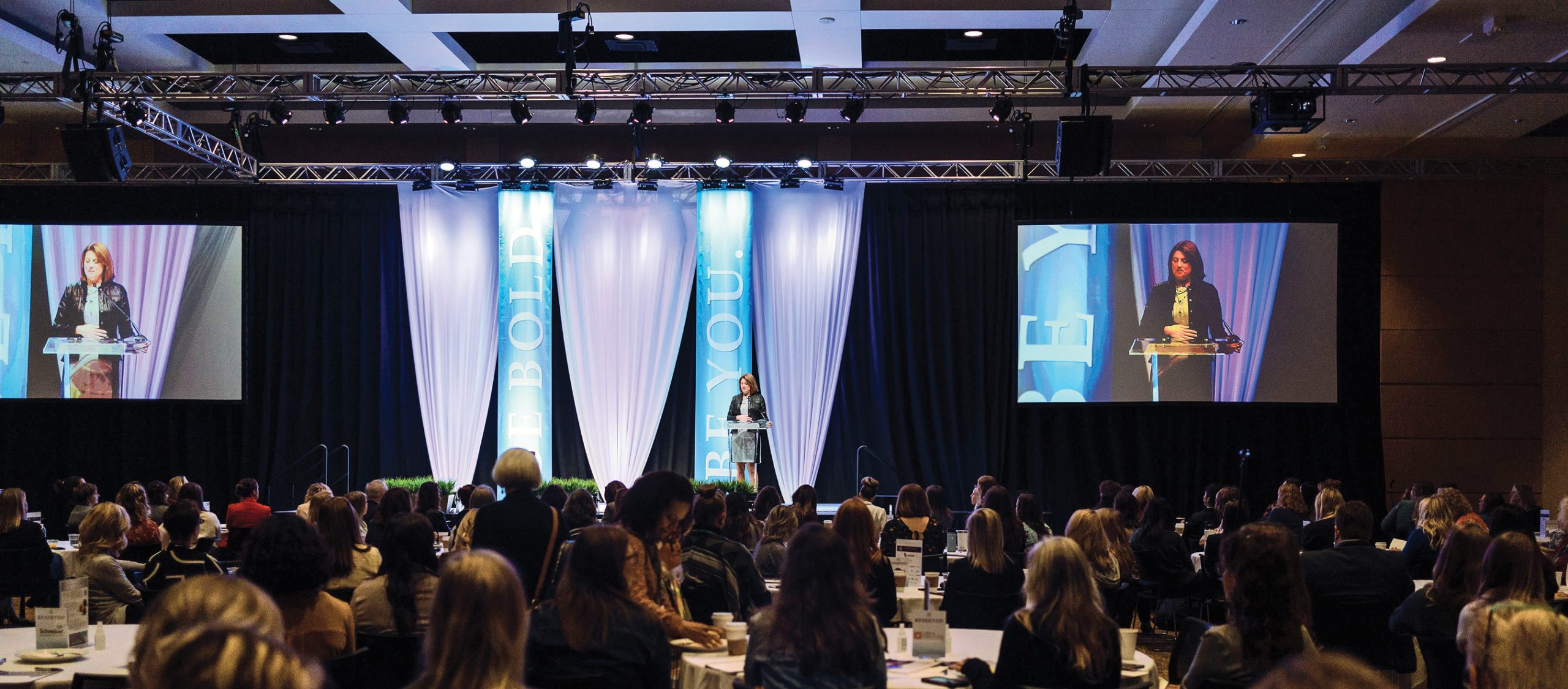

For Kristina Spang, the disappearance of jokes was the first sign.
Spang, who serves as vice president of aftermarket product and support at Pierce Manufacturing, is known for her jokes and sense of humor at work, but putting in long hours at a fast-paced job while caring for her aging father left her with little energy for anything else.
When her team members started commenting that they missed her workplace humor, Spang got the wakeup call she needed.
“It was like they were saying, in a good way, that I have a problem,” says Spang, who shared her experience during a panel discussion at last month’s Women’s Leadership Conference in Green Bay.
Unfortunately, Spang is hardly alone in her experience. Nearly half of female leaders in Northeast Wisconsin report feeling burned out, says a new survey from the University of Wisconsin-Green Bay’s Institute for Women’s Leadership (IWL).

“The report underscored the extent to which women were exhausted to the point of stepping out of their careers. That’s significant when we think of the challenges we face from a talent perspective,” says Janet Bonkowski, IWL’s executive director. “[Employers] will lose access to a talent pool at a time when they can’t afford to.”
These days Spang is back to her jovial self, but it took a renewed commitment to intentional well-being that required buy-in from herself, her family and her employer.
“Even if you fall out of your ‘funk,’ you can get back into it,” she says, “but it’s being very deliberate with your plans and sharing them with others to hold yourself accountable.”
Leaning in, leaning out
If you want to see just how deeply the theme of burnout resonates, try attending a presentation on the topic at a professional women’s conference.
At the 2022 Women’s Leadership Conference, presented by New Sage Strategies, it was standing room only for the session led by Colleen Hauk, CEO of The Corporate Refinery, a California-based consulting and training firm. Hauk shared her own experience as a corporate executive struggling with burnout and how she successfully created a more balanced personal and professional life.
“I don’t know if this is a good thing or bad thing that so many of you want to be in this session,” Hauk joked as KI Convention Center staff rolled stacks of extra chairs into the conference room.
It may not be either good or bad, but it certainly supports the Women’s Career Development Snapshot Report’s findings that working women in the New North are struggling with mental and emotional health.

Lora Warner is the director of UWGB’s Center for Public Affairs and was the principal investigator for the report, which was completed in summer 2021.
“Our purpose was to understand how women are doing, be able to do an even better job attracting and retaining them into our economy and our region, and give actionable data to employers,” Warner says. “It’s such a huge potential strength of our economic situation in this region to have talented women contributing to our economy. But we are at risk of burning out women.”
More than 800 women in Northeast Wisconsin responded to the survey, representing the commercial, public and nonprofit sectors. Almost half of respondents reported that feeling burned out was a “definite” challenge at work, 38% reported feeling overwhelmed and 31% had challenges with their own mental health.
“[The survey] was right in the thick of the pandemic, so we knew women would be feeling burned out, overwhelmed and having mental health concerns, but it was much higher than I even [expected],” Warner says.
Contributing to these feelings of workplace burnout is women’s lead role in caregiving at home. The survey showed 50% of women are responsible for all or most of their households’ childcare and homeschooling.
But it’s “working daughters” — women who care for an adult dependent — who are at the greatest risk of downshifting their careers. The report revealed that 20% of respondents are responsible for care of an adult dependent, such as a parent or family member, and a quarter of them said they were considering downshifting their careers. Women ages 50 to 59 reported the highest interest in scaling back their professional commitments.
“That’s a pretty important finding,” Warner says. “These are women who may have reached a higher level in their career and are in the executive office or serving at higher leadership levels. We are at risk of losing our veteran women leaders because they are caring for an adult dependent and I don’t know if that’s on [an] employer’s radar.”
A 2019 McKinsey & Company report found that executive teams made up of more than 30% women are more likely to outperform those with fewer or no women. Companies in the top quartile for gender diversity on executive teams were 25% more likely to have above-average profitability than companies in the fourth quartile.

“What that is saying is you have a greater chance of corporate success if you have a diverse team,” says Vicki Updike, founder of New Sage Strategies and The Women’s Leadership Conference. “Having a diverse team is one thing, but using your diversity is another. Leaders have to build that trusting space where every voice is heard.”
But despite the increased performance that women bring to most business sectors nationwide, female executive representation remains below 25%.
“We know more women equals more success and we know we have a labor shortage overall,” Bonkowski says. “When women step back, you lose talent. You lose diversity of perspective and thought. And you lose champions [who] advocate for changes to policies and systems as they relate to women in the workforce.”

Room to grow
The Institute for Women’s Leadership works to assist women and their organizations address and adapt to women’s needs. The data from the Women’s Career Development Snapshot Report will help inform the IWL’s programming and offerings, which can augment employer initiatives.
Bonkowski says there is a gap between the benefits offered by employers and benefits women utilize, especially as it relates to mental health and counseling services. For example, while 58% of companies provide counseling services, only 10% of women utilize them.
Looking at benefits differently, Bonkowski says, can help both employees and employers. While traditional benefits such as health insurance and paid family leave are still vital, Bonkowski says adding non-traditional benefits can have a big impact.
Bonkowski points to professional development opportunities as an example. The data suggests that women are looking for opportunities to grow professionally but don’t know where or how to access them. Employers who offer innovative benefits, such as mentoring and career coaching, will have an advantage when it comes to attracting and retaining talent.
“I think the research provided us an opportunity to pause and look at benefits in a new way,” Bonkowski says. “If we could provide an emerging female leader the opportunity to regularly meet with women mentors over a cup of coffee and talk about common issues, that’s a simple benefit with a low cost of admission. Women aren’t asking for the world.”
Due to women’s high interest in downshifting their careers, employers may consider offering them alternatives like flexible work schedules and monthly allocated work-time hours for informal leadership initiatives and networking.
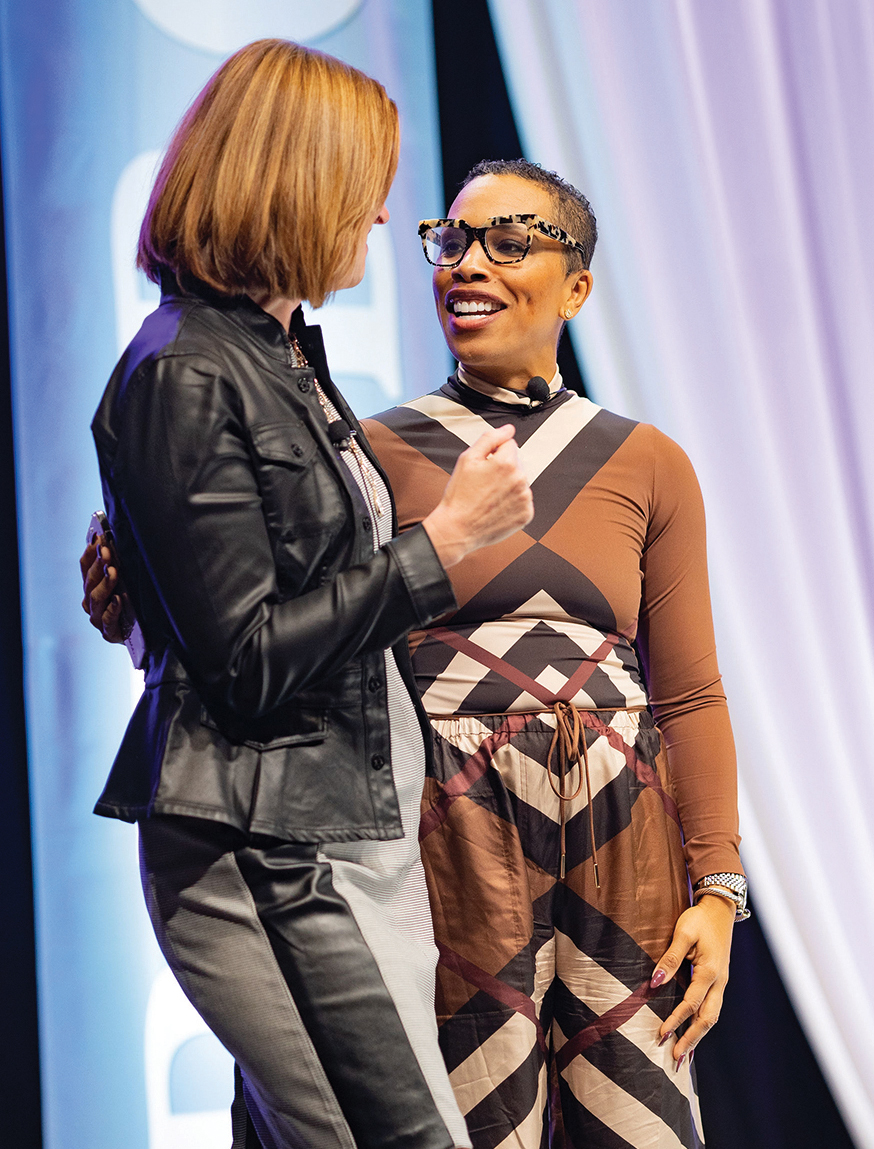
Tina Robinson-Adamski, Oshkosh Corporation’s vice president of finance (commercial), shared her unique alternative to downshifting during the Women’s Leadership Conference panel discussion. Robinson-Adamski, who is also a mother of three, proposed and is now working in a hybrid job shared with her colleague, with each of them working three days a week.
“I felt like I could be a great parent and worker at the same time,” she said.
While hybrid job shares and flex time may not be options for all positions, these solutions can serve as inspiration for creative alternatives to downshifting that may keep more women in the workplace.
“We feel it’s our duty to do it all and be this superwoman,” Updike says. “Because we put that pressure on ourselves, we are looking to downshift our careers and that would be such a disservice. The world needs women leaders more than ever.”
On the web:
Visit uwgb.edu/womens-leadership/insights to explore the data from the Women’s Career Development Snapshot Report.

