

While health care workers make up 10% of the workforce, they experience about 48% of recorded workplace violence, according to the Centers of Disease Control and the Bureau of Labor Statistics.
There has been an uptick in violence at health care facilities since the 2020 COVID-19 pandemic, according to the CDC. It’s an unfortunate trend that caught the attention of Jamin Homan, a registered nurse and patient safety officer at ThedaCare.
“Around the time of COVID-19, it just seemed the prevalence of workplace violence started to rise, particularly for those of us in health care,” he says. “Add to that the increased number of patients living in our communities with cognitive and neurologic conditions such as stroke, dementia and Alzheimer’s disease that can impact decision-making, and it was evident the challenge many of our team members face in their day-to-day vocation.”
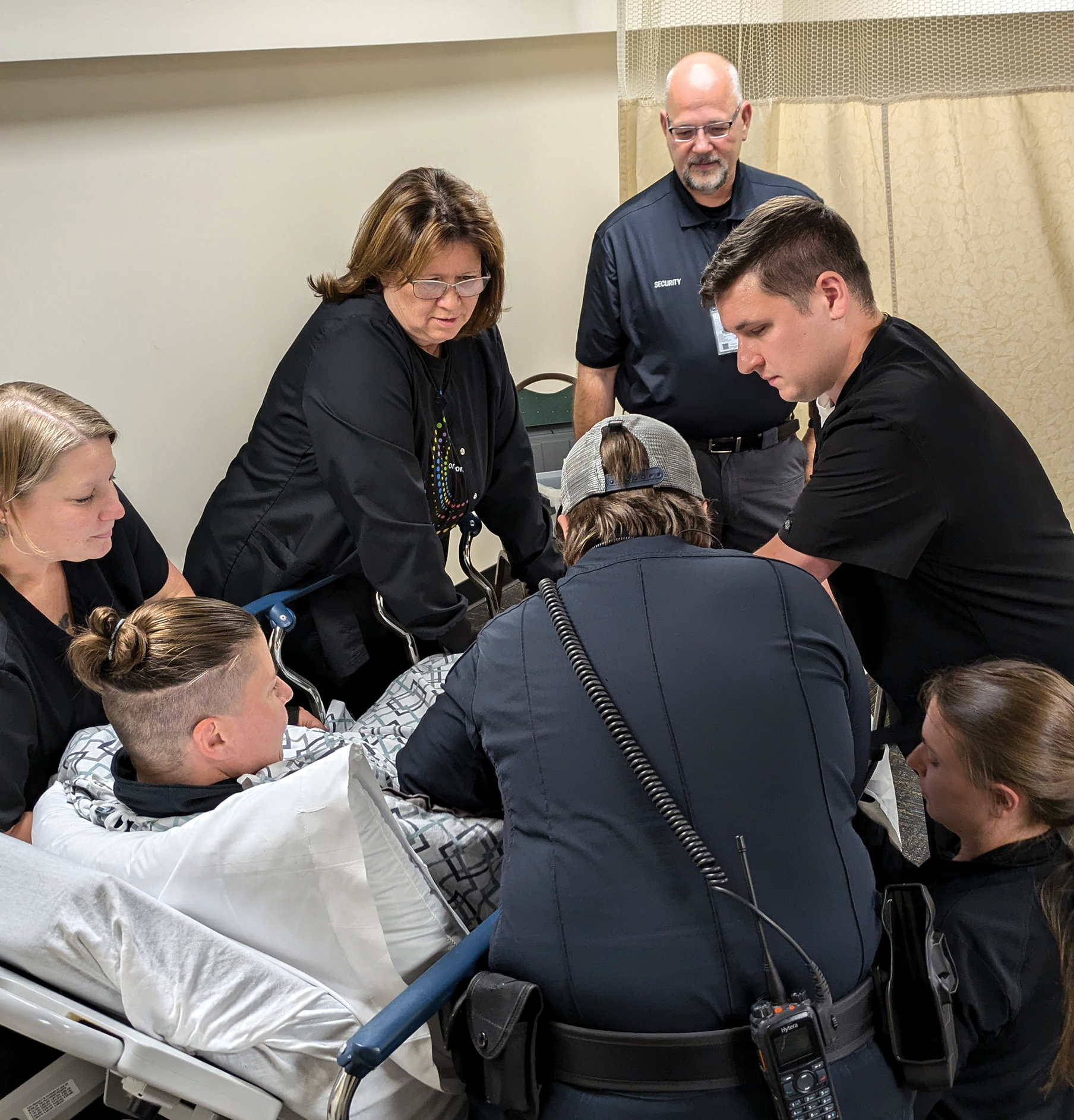
In a desire to keep patients and staff safe, ThedaCare launched training in October 2024 at ThedaCare Regional Medical Center-Neenah that educates staff in de-escalation techniques. Trained team members include experts from safety and security, patient safety, employee health, nursing and psychiatry.
“Caregivers are often focused on providing patients the best care possible, even during instances where a patient is growing increasingly agitated,” Homan says. “If we do not de-escalate that agitation, we know at that point it’s like a tinderbox. We want to do everything we can to support the patient and help prevent an incident of violence.”

Homan says the training helps staff to anticipate when someone might become violent and respond with new skills.
Kevin Verdine, security supervisor at ThedaCare, used his 34 years of experience in law enforcement to create a scenario-based training program in a mock patient room. He says it is an approach that is new to many health care staff, but effective in helping them build new skills and teamwork.
“Scenario-based training has opened the eyes for many,” Verdine says. “We’ve pulled our scenarios from real incidents that have occurred at our campus here at Neenah.”
Homan says they also have incorporated approaches and tactics learned from larger facilities in more urban areas and grown their relationships with law enforcement.
They are sharing the effort with others in the industry. Homan and Verdine presented the program during a Wisconsin Hospital Association meeting in August, and Homan has presented information about the training to nursing students at the University of Wisconsin Oshkosh.
Homan says team members have expressed appreciation for the proactive approach, and Verdine adds that it provides de-escalation skills they can use beyond the workplace.
They have trained about 90 nurses and security officers who then become members of the behavioral emotional response team. According to Homan, it has reduced incidents of violence by 76%.
With more than 5,000 team members in ThedaCare, Homan says, “we are just getting started.”
By the numbers
According to the Bureau of Labor Statistics, 20,050 workers in the private industry experienced trauma from nonfatal workplace violence in 2020. These incidents required days away from work.
Of those who experienced trauma from workplace violence:
73% were female
62% were aged 25-54
76% worked in the health care and social assistance industry
22% required 31 or more days away from work to recover
22% involved three to five days away from work

