

On the web
See the fused glass pieces: waupacaarts.org/shine-fused-glass-gallery
Learn more and see a video of the installation: waupacaarts.org/shine-community-art-project-2025
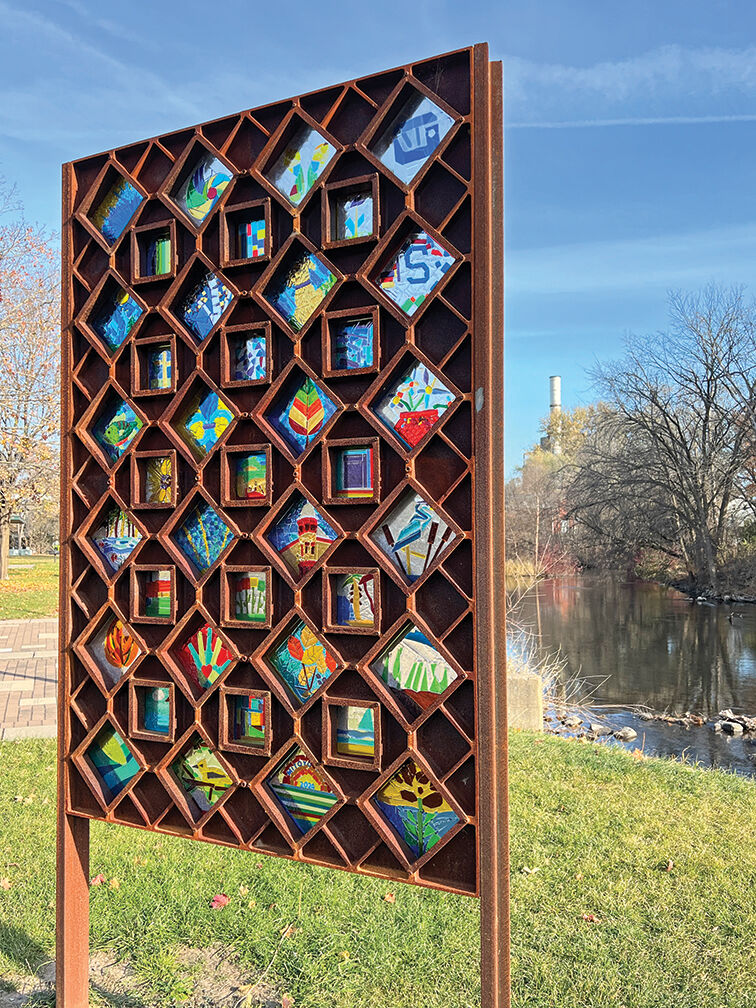
When the Waupaca Community Arts Board had a plan for a community art sculpture — one that would showcase dozens of original fused glass panes made by local residents — Waupaca Foundry was ready to help.
With a special 3D sand printer, foundry staff created molds for the project’s eight-foot casted frame panels. The SHINE Community Sculpture was completed in May and displays more than 170 original fused glass tiles at the city’s Rotary Riverview Park.
The four panels, which were set in place with the assistance of Faulks Bros. and Waupaca County Parks & Rec, stand in a Stonehenge-like square, capturing light as the sun rises and sets.
The design and creation of the molds and the pouring of the frames was completed in 2024. Waupaca plant manager Mike Hemmila was involved in the early design phase of the project; the project leader was Elijah Kallio, Plant 2-3 tooling-engineering manager, who gave a presentation on the project during the Manufacturing First Expo & Conference Oct. 29.
The 3D printer was the best option to make the molds because the castings were larger than the foundry’s vertical molding machines. Each of the eight-foot sculpture panels took four unique cast pieces weighing 240 pounds, with the full assembly weighing more than 1,100 pounds.
“Each time you make one of these molds, you’re only making the assembly to make one of those castings, and it takes 13 hours to print the cores for one of those [16] castings,” Kallio says. The foundry donated more than 210 hours of sand printing time, plus machining, assembling, washing, pouring and finishing.
“The amount of man hours and people who were involved with this is pretty incredible,” Kallio says.
Molds reached 2,600 degrees Fahrenheit when the iron was poured. The foundry also completed a pre-rust process to ensure rust didn’t run onto the stained glass pieces once installed.
A combination of additive sand printing and FDM (Fused Deposition Modeling) style printing was used to build the diamond-pattern windows that ultimately would hold the glass art.
“I’m really happy with how they turned out,” Kallio says.
The foundry has had its 3D sand printer for about five years and uses it frequently for other production needs as well as for prototyping, Kallio says.
Community members created the fused glass tiles in free workshops led by artist Mary Beisner and supported by a grant from the Wisconsin Arts Board and funds from the state of Wisconsin and the National Endowment of the Arts.
“I think it is very important when the large businesses have the ability and can participate in giving back and helping the community,” Kallio says, “because it’s what makes the community what it is.”