
Small and medium sized businesses may face competitive challenges unless efforts are ramped up to help them address sustainability goals, according to officials who ran a Sustainable Business Accelerator in Green Bay last summer.
Christa Kananen, Sustainable Business Council director of strategic initiatives, says businesses that wait to address sustainability may face higher investments of time and money in the long run.
In 2024, a large energy users roundtable was convened as part of the city of Green Bay’s effort to pursue carbon neutrality by 2050. The group was asked what businesses need to pursue clean energy and they responded that the largest businesses already have the resources, capacity and – in many cases – plans to pursue clean energy and other sustainability goals.
“Their feedback was that the smallest organizations – small and mid-size businesses in the community – lacked the internal resources and internal capacity to navigate the changing world of sustainability and take advantage of the existing resources available to them,” Kananen says.
In response, the Sustainable Business Council created the Green Bay Sustainable Business Accelerator with funding from the Daybreak Fund. The six month accelerator included in person meetings and consultation with the goal of having participating small businesses implement one nature-based solution at the end.
Kananen says the accelerator had limited success in meeting its original goals, but it provided some key insights into what is working for small businesses in the Green Bay area.
“Sustainability isn’t a strong market driver (locally),” Kananen says.
Market demand and cost reduction have driven sustainability efforts at large companies and at the global level, according to Kananen.
“From regulation to supply chain resilience, sustainability has become table stakes,” Kananen says. “When Northeast Wisconsin companies don’t feel that demand locally, they risk getting left behind.”
Firms that trade nationally and globally are under increasing regulatory and consumer demand to operate in sustainable ways. Kananen says that oftentimes large companies ask suppliers and business partners to demonstrate similar investments and commitments to help meet the demands they are seeing.
The capacity constraints that small and midsize companies face limit their ability to address efficiency and waste reduction. That becomes a long-term issue that impacts their ability to compete.
“They end up paying more in the long run because they can’t afford the investment of time, money and attention,” Kananen says.
Kananen says they also heard from businesses in the accelerator many local customers may not see the value in sustainability efforts or may fear those efforts are increasing consumer costs.
Finally, there are local policies and regulations that may inhibit sustainability efforts.
“Green Bay is at an inflection point. It’s going to be up to all of us to decide if sustainability is going to become a value driver. Are we going to put our money where our mouth is,” Kananen says.
She argues that small businesses need resources that they can access with the time and funds they have available and local policies that support rather than inhibit them.
That has led to the creation of the Nature Based Solutions Toolkit, which was released by the Sustainable Business Council Oct. 15. The toolkit offers an index of solutions that address energy and greenhouse gas, waste management, water stewardship, biodiversity and land use. It also includes a list of contractors and vendors who can help a small business – including some that offer low-cost and no-cost services.
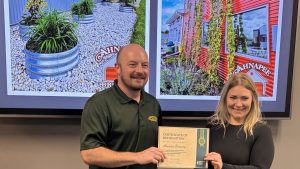
Nick Calaway of Ahnapee Brewing participated in the sustainability cohort and says it gave him a broader understanding of what sustainability efforts include. Ahnapee implemented some landscape changes with native pollinator plantings that also help reduce maintenance and he wants to recoup rainwater for its grounds as part of the accelerator. But the broader understanding of sustainability also led him to have conversations with vendors about how to reduce trips and save fuel consumption.
Calaway says the cost savings for some of the efforts are small, but they add up and make sense to him.
Kananen says the sustainability accelerator model run in Green Bay could be used by other communities and says the Nature Based Solutions Toolkit provides help for businesses across Wisconsin.
Finally, Kananen says small businesses need to tell their story. She says that a well-run smaller business is investing in the community, worker safety, energy and waste efficiency but sometimes they don’t see that as a sustainability effort, while their bigger competitors are touting the same efforts in order to earn consumer trust and grow the business.
Scaling sustainability for small businesses

Get Our Email Newsletter
Local news about the companies, people and issues that impact business in Northeast Wisconsin and beyond.