


Like the steam engine, assembly line and computer before it, the fourth industrial revolution is poised to forever change manufacturing. Accelerated by factors ranging from the COVID-19 pandemic and labor shortages to rapidly increasing affordability of technology and ubiquitous connectivity, Industry 4.0 today is a topic on minds and lips everywhere — including the New North region.
“We went through this tough period for all industries, but there’s a lot of optimism and engagement with Industry 4.0 coming out of it,” says Jamie Lynch, associate professor of sociology and director of the Strategic Resource Institute at St. Norbert College, who led the NEW Manufacturing Alliance’s recently released 2021 Industry 4.0 Needs, Skills & Talent Survey.
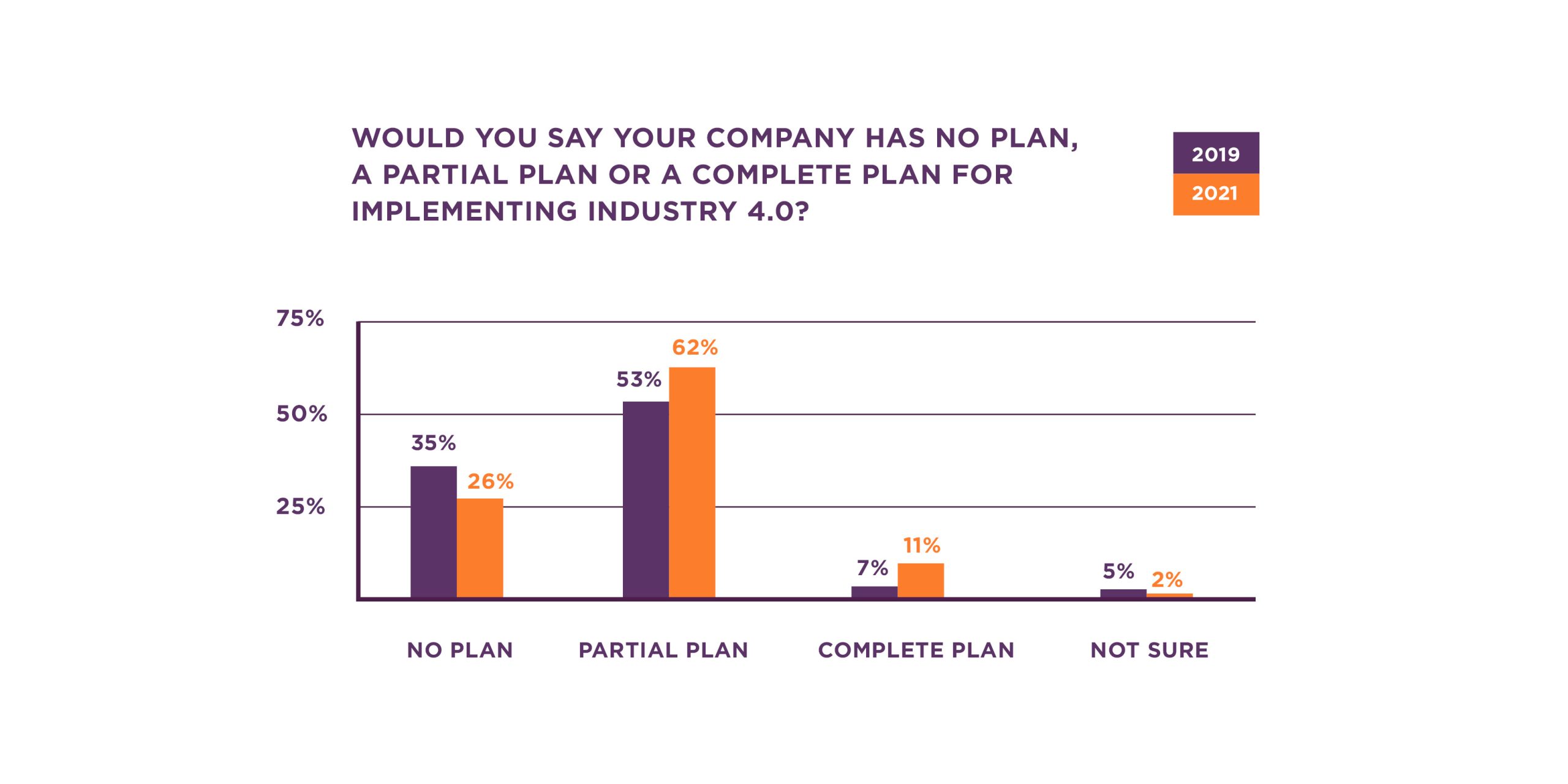
On a national scale, a survey by the MPI Group last month found that 60% of manufacturers believe I4.0 will have a significant impact in their industries in the next five years. The NEWMA survey findings support that trend, with 73% of 2021 survey respondents indicating they have a complete or partial I4.0 implementation plan — up from 60% when the same survey was conducted in 2019.
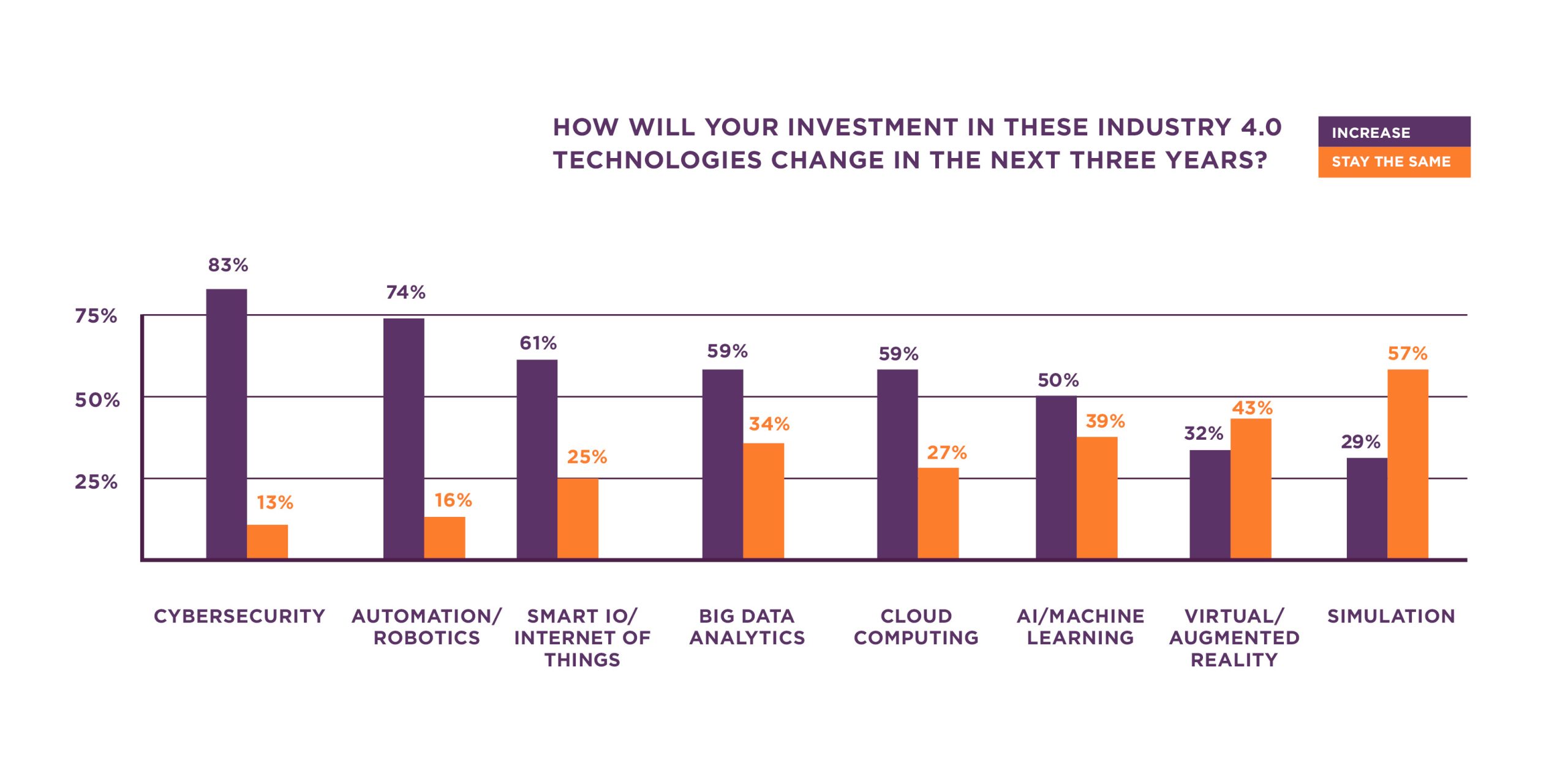
When comparing the 2019 and 2021 survey outcomes, Lynch says the commitment in Northeast Wisconsin is clear. New North companies are focused on cybersecurity, with 97% reporting some level of investment. Other top I4.0 investments gaining traction in the region include cloud computing (81%), computer science (81%), Industrial Internet of Things (79%), and automation/robotics (79%). IoT made the biggest leap in the two-year time frame, moving from 59% to 79% investment.
Return on investment
Brad Nye, vice president of manufacturing for Alliance Laundry Systems in Ripon, says that while I4.0 technologies are “nothing new,” the technology has rapidly improved and, more importantly, the ROI calculation for implementing I4.0 is becoming exponentially more favorable for companies.
“It’s like a hockey stick-shaped graph, really,” he says. “You’re seeing more and more of it, and the cost to do it is just becoming less and less. The initial Andon investment business case had a two-month payback, and we actually did better than planned. It was just incredible.”
Nye says Alliance Laundry Systems recently installed Andon, a system that quickly alerts operators about a problem on the line, and plans are in place to go completely paperless in the coming years.
According to the global management consulting firm Kearney, the unit selling price for I4.0 technologies has decreased by as much as 70% in recent years, in large part due to an influx of new vendors in the marketplace. And rapidly advancing technology also has reduced the costs of the accessories, infrastructure, training, consulting and process updates that go along with tech upgrades.
Again, IoT stands out for its particular progress. Reasons include the introduction of edge computing, which provides real-time processing of data closer to the production asset; the expansion of cloud infrastructure; the emergence of 5G; and the improvement and increased affordability of sensor technology. The cost of sensors dropped 7% each year from 2008 to 2020, 10% in 2021 and is expected to drop 10% again in 2022, according to Kearney.
Where tech meets talent
I4.0 also requires manufacturers to make workforce changes on a variety of fronts. Nye says Alliance Laundry Systems added six to seven new positions when it stood up its smart factory team a little over two years ago.
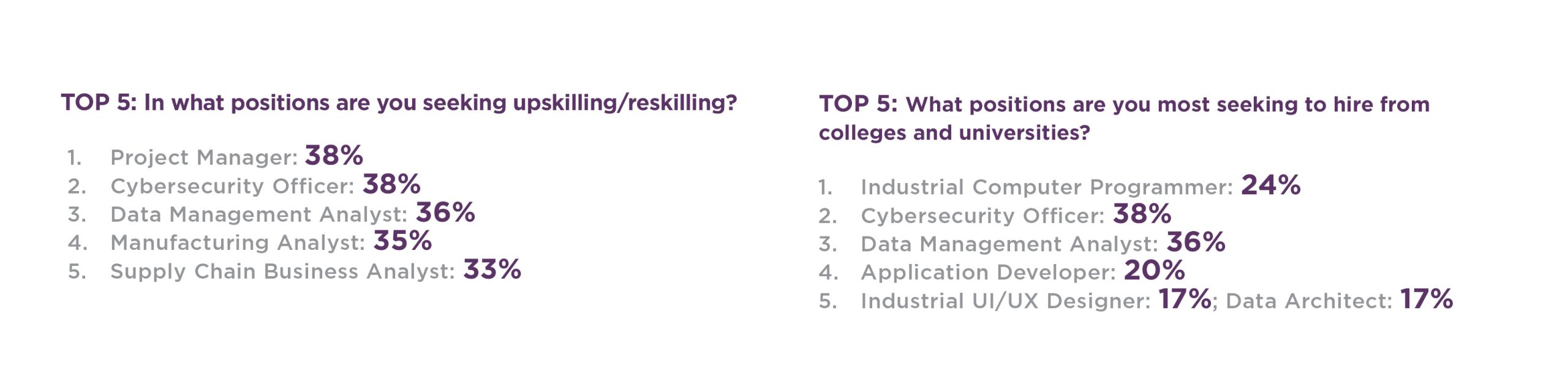
According to the NEWMA survey, New North manufacturers are looking for talent in the areas of cybersecurity, application development, cloud computing, and automation and robotics. And, as Lynch points out, employers are not necessarily seeking specialists in these areas but rather increasing these skills across all departments.
“[I4.0] is an area of increasing value for hiring, but also upskilling,” he says. “Employers are looking to hire, but they are also seeing it as a core principle of any area they’re in. They are moving away from thinking of it as a technology to thinking of it as a core business practice.”
But assessing exactly where skill gaps exist in the workforce is a challenge, Lynch says. Only 42 percent of NEWMA survey respondents say they have diagnostic measures in place to determine what new knowledge employees need. “If they don’t fully understand where the gaps are in the process, they may not get as much return on investment,” he says, adding that groups like NEWMA and educational institutions should flag this finding as particularly informative to their work, both in terms of providing support for reskilling workers and educating the workforce of tomorrow.
“Everybody needs engineers, but when good engineers show up we need to be prepared to receive them,” Lynch says.
Planning for the future
Experts say the primary reason manufacturers fail to implement I4.0 is the absence of a complete plan. In the New North region, 11% of 2021 NEWMA survey respondents described their Industry 4.0 plan as “complete,” up from 7% in 2019. That still leaves several manufacturers in the “partial plan” or “no plan” categories — but there’s room to move forward. Three out of four manufacturers say they are working to do exactly that.
Resources are available, including through Wisconsin’s highly regarded technical college system and its collaborative partnerships like NEWMA’s Power Business Intelligence & Visualization Training program at Northeast Wisconsin Technical College. The NEWMA Industry 4.0 Task Force and its data analytics program offered through LinkedIn Learning are products of the 2019 Industry 4.0 survey that have helped move the needle. In response to the 2021 survey, NEWMA is adding similar training for project management.
Professionals from across the state also are connecting through the Wisconsin Internet of Things Council. Sala Sander, who coordinates the WIoT Council, says manufacturers are surprisingly open and willing to share. “When you talk to people, they just say, ‘I’m so glad I’m not alone,’” she says.
“Industry 4.0 is growing in importance,” Lynch says. “This [survey] sends a really strong message to our educational system here that this is an area that should be highlighted and celebrated.”
Here’s the thing …
Wisconsin IoT Council fosters smart connections
Three years ago, Jeremy Udovich, regional sales director for Madison’s HiQo Solutions, Inc., partnered with the Sheboygan County Economic Development Corp. to incubate a new organization: a subsidiary of the Midwest IoT Council focused on a state ripe to be elevated to a nationwide leader for manufacturing smart and connected products. Today, the Wisconsin Internet of Things Council has 63 member companies and has provided outreach, networking and educational opportunities to thousands of Wisconsin professionals at all stages of their IoT journeys. Insight on Manufacturing recently caught up with Udovich, who remains active as council chair, and Sala Sander, who administers the program from her office at the SCEDC, to find out how manufacturers looking to get “smart” are leveraging the council.
So, what exactly is IoT?
Udovich: If you were to Google that question, you’d probably get 10 different answers, but all along the same lines. At its simplest form, IoT is putting a computer on a device so it can sense things, see things and communicate things.
What does the WIoT Council do?
Udovich: We started out by saying [access to IoT knowledge] was what was going to elevate the state, because our manufacturers didn’t have all the resources or the wherewithal to go find the knowledge. It’s expensive; it takes time. You put multiple executives on a plane and tell them to spend a week or two out in [Silicon] Valley or in some other region of the world where they’re doing IoT. We need to figure out how to do it here, so we decided we would hold a quarterly symposium and build a membership around getting folks together to talk IoT on a regular [basis].
Sander: Every month we have at least one event — either a quarterly symposium or a free virtual event. The point is to educate; that’s why we exist.
Udovich: And while access to knowledge was where we started, the real “aha” that has occurred has been the networking — getting all of these individuals from different industries in one room together and starting to bounce ideas off of one another. It’s a lot of fun to get everyone in the room and give them some education from the stage, but the smile comes on our faces when we realize that these folks are getting connected. That has been really, really magical.
Sander: You come to network, and I’m not talking about getting a sale. I don’t know how many people, when they are asking for help, can immediately get the VP of innovation — but that’s who we can connect them to. You’re not alone in your journey, so who better to talk to than people who are coming to our symposiums?
Who makes up the council?
Sander: We believe in manufacturing being the heart of Wisconsin, and our program reflects that.
A lot of members are what we call technical service IoT enablers — the ones who provide the data to help manufacturers. They have their own membership type because that’s the other big interest. But of course, we are working with manufacturers, and we keep the membership at one-to-one, so for every manufacturer we have a technical service company. We want the manufacturers to be the focus.
Udovich: We also have people from academia, and then there’s other service providers like cybersecurity firms and attorneys that are working with manufacturers.
Has interest in IoT increased since 2019?
Udovich: The interest has always been there. Folks were aware of it three years ago, so we weren’t educating too many people on “what is IoT;” they were already hearing either from their competitors or sales team or marketing group. But now, in terms of adoption, more and more companies are actually down the path. Just about everybody today has at least gotten started in some way, shape or form, whether it’s an early proof of concept or they already have a product to market. We rarely, if ever, hear “no, we’re not interested.” They all want to be involved because they know that this is still a very new topic for them, very complex, and there’s a lot to learn. They don’t want to go it alone.
What topics are your members most interested in right now?
Sander: Cybersecurity and data analytics, for sure.
How does one become a member?
Sander: If people are remotely interested in the council, they are welcome to just call me. I talk to a lot of people who don’t sign up right away, and that’s OK. They come to a few events before they think, “OK, this has a business case for me to join.” And, you know, for a small- to medium-sized manufacturing company it’s as little as $750 a year to have front-row seats to some Silicon Valley-level information.
wisconsiniot.org
— Kate Bruns

