
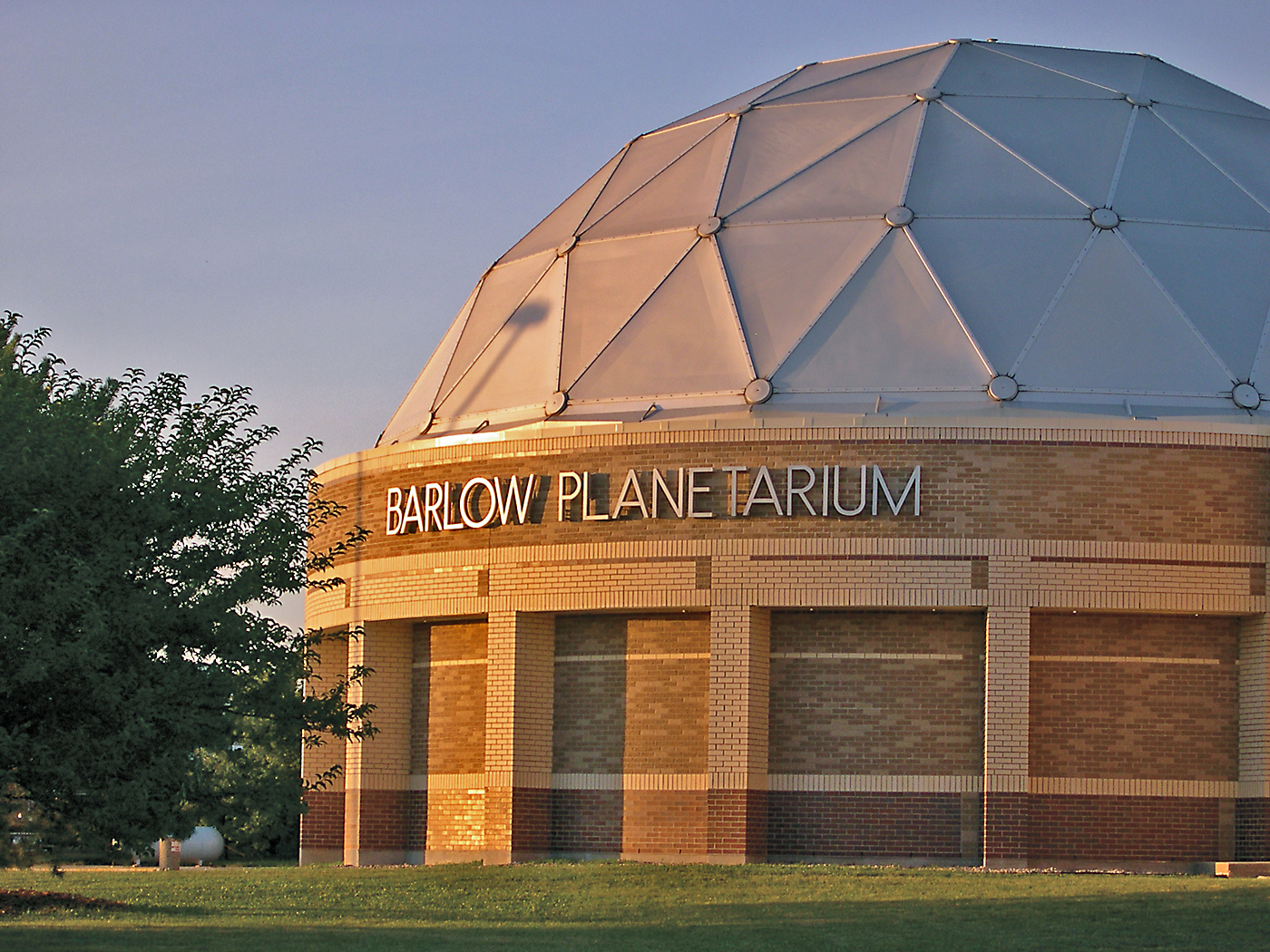

Rick Beal served as an usher at the Barlow Planetarium’s grand opening in 1998. The Northeast Wisconsin Stargazers (NEWSTAR) president and self-described “science nerd” recalls the excitement surrounding the debut of what was then the largest planetarium in Wisconsin.
“There was a lot of fanfare and public interest,” he says. “When it opened, it was the preeminent planetarium in the Midwest. It had the latest and greatest technology.”
Nearly three decades later, that cutting-edge technology has become both the planetarium’s greatest asset and most pressing challenge. The Barlow now operates the last functioning Digistar II projection system in the world — an impressive distinction until replacement parts are needed.
The Barlow Planetarium has established itself as a unique regional asset, drawing more than 900,000 visitors to the former UWO Fox Cities campus in Menasha. In the 2023-2024 academic year, the Barlow welcomed more than 27,000 visitors, including nearly 18,000 students and scouts from 60 Wisconsin school districts.
But the facility is now facing critical equipment needs. Teri Gee, who became the planetarium’s manager in 2022, says the facility has gone from 32 slide projectors to just 10, and it lost all its video projectors last year.
“This was supposed to have a 15-year lifespan,” Gee says of the Digistar II projector, “and we’re at 27. We definitely got our money’s worth.”
Upgrading comes at a significant cost, says Gee, who points out the biggest challenge is the planetarium’s analog system.
“Everything went digital in the planetarium world about 2003,” she says. “You can’t just piece in parts that are digital with parts that are analog. In order to upgrade, we literally have to replace everything.”
That includes the star projector, lighting systems, sound equipment and projection infrastructure.
When UW Oshkosh announced its Fox Cities campus would close in June, it created additional uncertainty for the Barlow’s future. Gee and her small team — just three full-time employees — have adapted to both the equipment limitations and institutional transition.
When video projectors failed, Gee drew on her background as a former professor to quickly develop PowerPoint-based school shows. The team also secured a portable planetarium through grant funding, allowing it to bring shows to distant school districts and to serve as a backup during the planetarium’s future upgrades.
This summer, the planetarium successfully transitioned from university control to oversight from Winnebago County, which voted to fund campus operations through the end of the fiscal year.
Now Beal is leading a capital campaign to upgrade the planetarium’s equipment and reclaim its prestige. The effort centers on the newly formed Future Barlow Foundation, a nonprofit organization that will handle fundraising. Current board members include Beal, DeWitt Law Firm Partner Kathryn Blom and Menasha Joint School District Superintendent Matthew Zimmerman, with new members being recruited.
The exact funding target is pending a facility assessment, but estimates suggest around $2 million will be needed. The upgrade would replace the current patchwork of analog systems with two synchronized digital projectors and a hybrid system featuring both digital capabilities and an opto-mechanical star projector that will also serve as backup.
“My goal is to get us back to being the preeminent planetarium in the Midwest again,” Beal says.
While visitors might see the planetarium primarily as entertainment, Beal emphasizes its broader significance and points to research ranking the Green Bay-Oshkosh-Fox Cities metropolitan area as the 18th most favorable place in the U.S. for establishing a technology hub, driven partly by the region’s educated workforce and cultural amenities.
“Institutions like the Barlow are what make a community like the Fox Cities a desirable place to come and live and work,” Beal says. “Planetariums and astronomy are the gateway to STEM education and careers.”
While the task at hand is large, Gee remains optimistic about the facility’s potential, noting that in its first nine months of operation the Barlow drew 40,000 visitors. “Once we’re upgraded, I think we’ll easily surpass that,” she says.
For Beal, the investment represents more than preserving a local attraction. It’s creating an institution that can serve the community “in perpetuity” without relying on government funding.
“Things like planetariums are really important to social, cultural and intellectual development,” he says, “and those are inseparable from economic development in the long run.”
For more information, visit barlow.winnebagocountywi.gov