
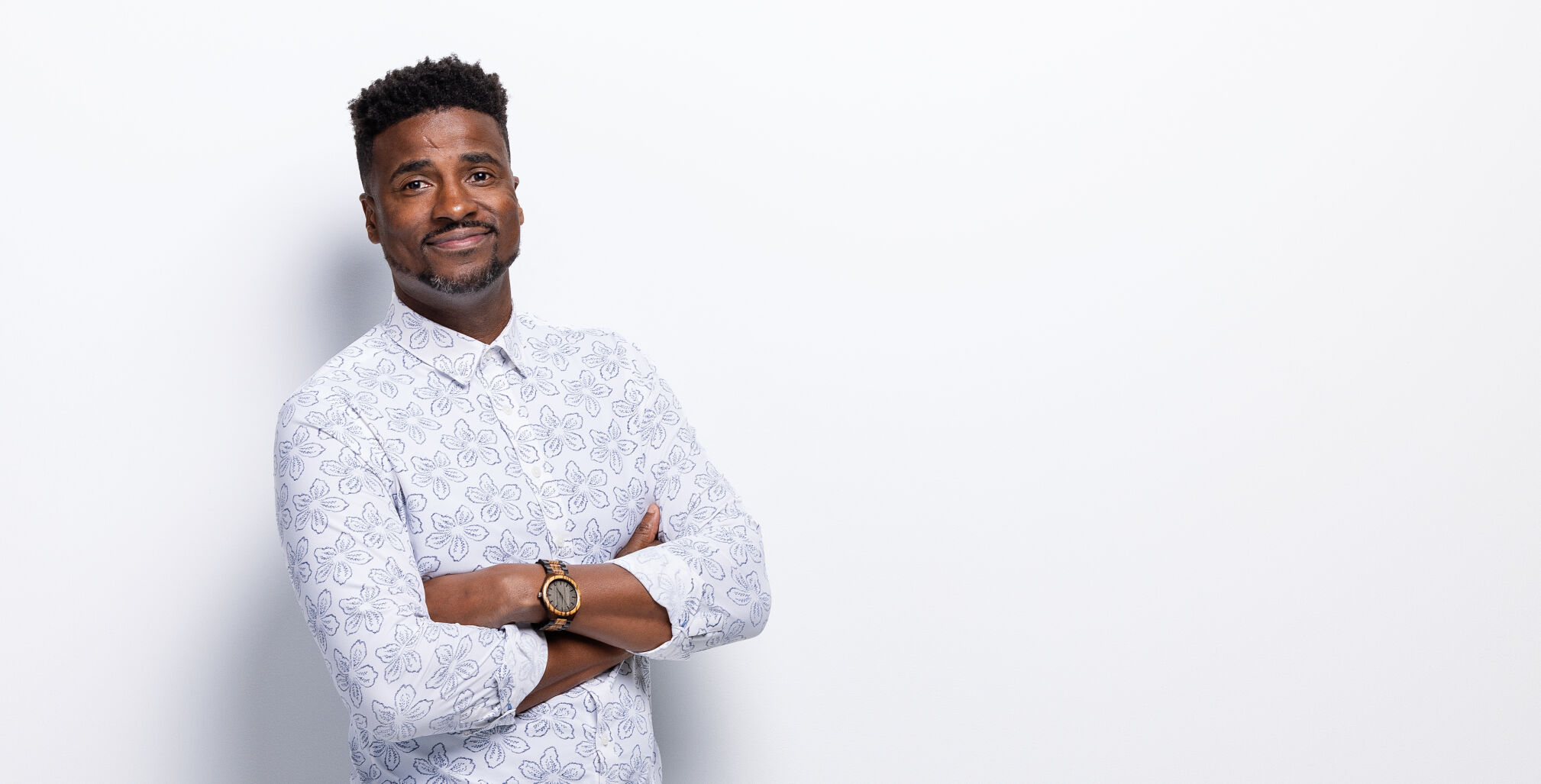

Photograph by Shane Van Boxtel/Image Studios
We all have the same 24 hours in a day, but what Rashad Cobb does with his may look a little different. Over his last 18 years in Green Bay, Cobb has served on more than a dozen committees, boards and task forces. His prolific volunteer work, community activism and nonprofit career earned him the title of Green Bay’s Citizen of the Year in 2022.
Today Cobb serves as the first chief operating officer for Brown County United Way. While Cobb says 2023 is the year of the organization “repaving its lane,” it most certainly is not letting up on its direct program support, neighborhood impact initiatives and advocacy efforts.
Insight: How did you end up working in the nonprofit sector?
Cobb: I went to Marquette University for business and supply chain management because I was fascinated by the concepts, but I knew I would never work a day in that field. As I got closer to college graduation, people were like, “Man, I’m gonna miss you listening to me. I feel heard when I’m talking to you.” I started to think maybe I should go into counseling. My first job when I was in Northeast Wisconsin was at a human services counseling agency, so I got a chance to talk to a lot of counselors and found that wasn’t the path I wanted to go. So I just continued to put my foot forward and just show up. You got to show up and you got to show out. It’s not enough just to be there. You got to participate. And so that’s what I do. I try to show up and show out. My career actually has all been in the nonprofit world, but this position with United Way is my first internal role in an organization. My previous roles have always been external.
What have you been working on since starting your newly-created COO role in September?
As an organization, we’re working towards ensuring that every member of the Brown County community has the things that they require to live a life that allows them to meet their needs and to thrive, and to be healthy financially, mentally and physically. When I came onto the team, I said 2023 is a year of us not saying yes to too much. We will lead on some stuff; we’re going to power some stuff with our funding and our advocacy. Sometimes you’re going to be a connector and sometimes we will be a convener. And sometimes we’re going to sit back and I think all of those things are equally important. I think we’re doing a good job of repaving our lane. I also think there’s an opportunity for us to reset as an organization and do a better job of defining who we are. I think historically we’ve been known as a pass-through organization, but we’ve got relationships and historical knowledge from working with groups so we can talk about program efficiency, program outcomes and measurements. I think this is where our value add is specifically, as it relates to being the place that receives dollars and then makes decisions on how they go out into the community.
United Way got its largest grant in history last year — $999,737 from the state’s Equitable Recovery Grant Program. How will those funds be used?
They will be used for our Mobile HubCAP (Community Access Partnership) Initiative. It’s going to give us the ability to partner with agencies to take their show on the road. If you created a heat map to show where our grant dollars go and where our time and advocacy goes, I think it’d be really clustered in Central Green Bay. But how do we get out to Denmark? How do we get out to Pulaski? All these communities are part of Brown County, and this Mobile HubCAP is going to give us an opportunity to reach them. We’re going to secure three vehicles — a passenger van, a class-C RV, and a semi-truck and trailer — that will be able to show up in various communities. We’ll rely on relationships and expertise of people in those communities to get resources out to those communities. Those neighborhood needs may look different in Pulaski or Denmark, so we’re going to work to figure out what those needs are and get the right community partners in there, but I’m thinking there’ll be things like housing resources, mental health services — really a basic needs focus.
What are you personally prioritizing professionally this next year?
I’ve worked my way into all of these places and crevices in the Green Bay community. I often find that when I’m in these spaces, I am the only one. What I’m most looking forward to is bringing along other people who look like me. I do not think I live in a community where people do not want diverse faces in diverse places; I just think people struggle to develop relationships. When I talk to a lot of white brothers and sisters about wanting to diversify their boards or their staffs, they’ve been doing things one way forever. But if you want to see something different after work on your ride home, you have to take a different route home. People of color have historically always had to interject ourselves in white spaces to get the things that we want and need. I offer the challenge to my white brothers and sisters to do the same. If you need diverse [representation] — which can be across abilities, sexual orientation, veteran status — you have to do something different. You can’t do the same thing. What I’m doing personally to try to aid that is when I’m on a board with a committee opportunity, I go back to the young kids I mentor or I go back to the Boys and Girls Club so I’m personally bringing people into the things that I sunset from. I’m looking forward to helping the next generation of individuals begin to come into those spaces because they may not appear welcoming. It’s not always the easiest to be the first or the only, but that’s the work I’m trying to do now — empower people and uplift people.