
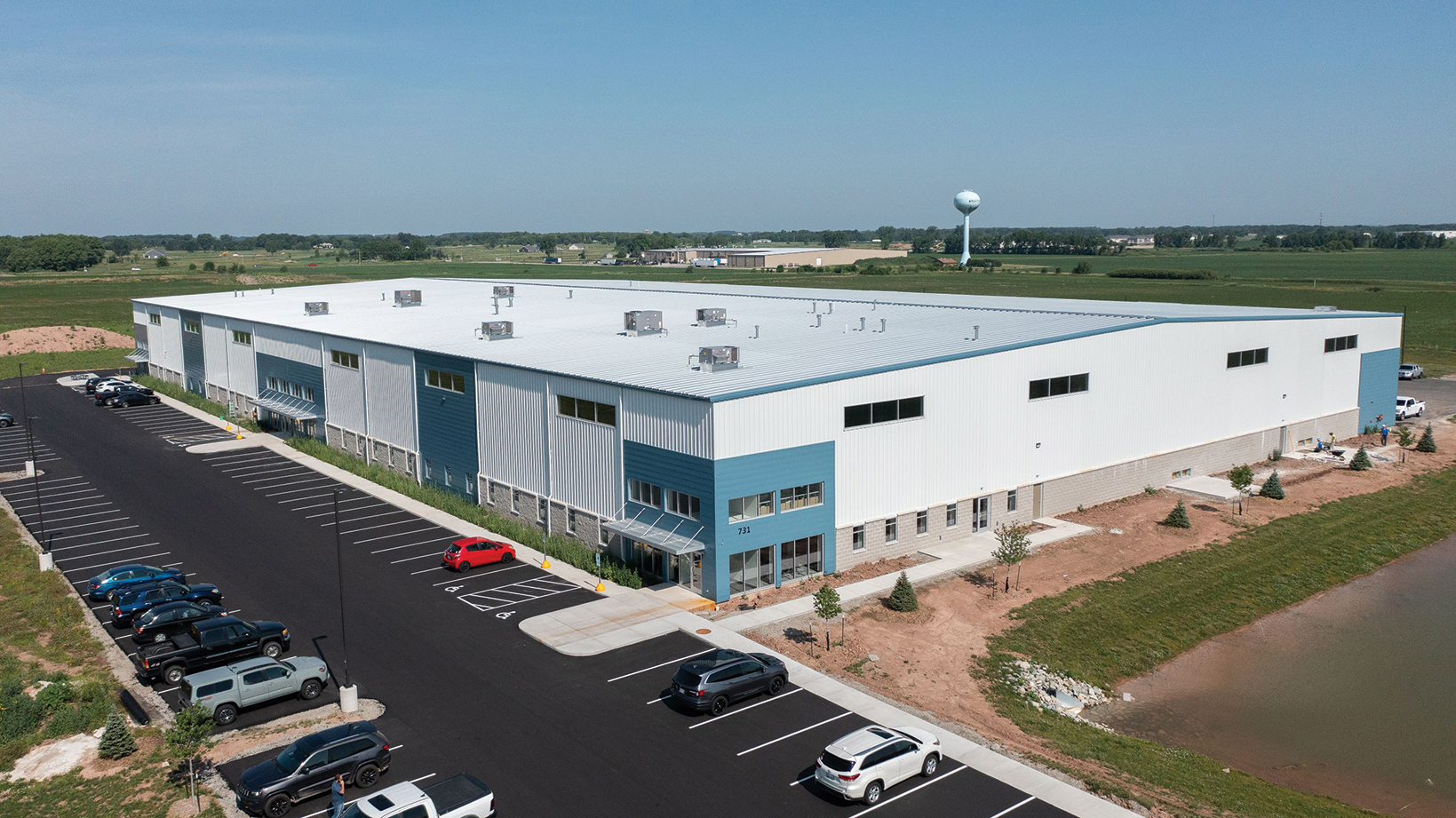

After 30 years in operation, Pieper Automation decided it was time to bring its two Northeast Wisconsin facilities, which were operating on the east side of Green Bay and the south side of Neenah, together into one location.
The company first considered modernizing its existing buildings to attract engineers and employees as well as to make them more customer-facing, says Branch Manager Katie Tesch. But ultimately Pieper Automation decided that a new facility would help accomplish those goals — not that there was much available when they started searching.
“It was very challenging,” Tesch says. “The market was pretty hot. We started looking last year in the September time frame, and there was not a lot on the market. Things were going really fast.”
Enter the spec building solution: a way investors can meet demand for space as manufacturers grow or consolidate space, especially in a market where high interest rates are making manufacturers think twice about building new facilities.
The 100,000-square-foot spec building along Interstate 41 in Wrightstown was completed in 2022, thanks to a partnership between Consolidated Construction Co., Inc., NAI Pfefferle and a local development group, which identified the location as ideal for light manufacturing or warehouse space. Officials say the building can expand up to another 160,000 square feet as tenants seek more space.
The building quickly leased its three available suites, with John’s Refrigeration in one and Pieper Automation and Pieper Electric in the other two.
Trending up
With only about a 2% industrial vacancy rate in Northeast Wisconsin, the need for manufacturing space is growing.
In general, manufacturing construction spending on new facilities in the U.S. is robust at $189 billion — which is triple the $63 billion average rate seen in the 2010s, according to an Axios report. This trend in construction spending is largely attributed to foreign direct investment in large-scale U.S. facilities.
Domestically, some investors and manufacturers have been hesitant to build because of interest rates in the current lending market.
“I think it’s becoming more difficult for developers who are building these projects to make the numbers work, now especially with a more restrictive lending environment,” says Manny Vasquez, vice president/partner at Pfefferle Companies. With recent rising interest rates as well as the costs of materials and labor, he says, “it’s risky stuff. And I think especially on the speculative side, because you don’t have that tenant lined up for that building.”
But for NAI Pfefferle and its partners, the Wrightstown building made sense — particularly the location, which could pull labor from both Appleton and Green Bay, Vasquez says.
That was one of the appeals for Pieper Automation, Tesch says: “It’s a really great hub to hit the center of the Fox Valley, which gives us great access to our customers. But it also gives us a great employee pool.”
Peter Thillman, chief economic development officer for Shawano County Economic Progress, Inc., agrees that the cost of new construction is deterring companies from building new. But he says some are going forward anyway because they don’t have any other options. There also is strong demand from businesses outside of the area wanting to locate in the Shawano area.
Recently, the Shawano area has seen expansions by Komatsu, which just completed a 48,000-square-foot-plus expansion at TimberPro. Arrowcast continues to make significant investments in growth, and Belmark added 80,000 square feet “because they can find the labor force here in Shawano,” Thillman says.
While the unemployment rate in the area is around 2%, Thillman says, “we’re still exporting 40% of our labor force to surrounding counties for work. Once the wages come to what [workers] could achieve in Brown, Outagamie and Marathon counties, they’ll stay home.”
Kelly Armstrong, vice president of economic development for the Greater Green Bay Chamber of Commerce, says the need for space speaks to the strength and the diversity of the manufacturing industry in the area, which has continued to grow even through the COVID years; among the chief challenges is speed-to-market issues.
“Usually when you need an expansion, you need it today, because you need to be able to fill the orders that you have,” Armstrong says. “Or maybe a new contract that was signed for a new order that’s coming in, and you need that today.”
Companies that don’t have the time to wait for a new building might consider moving out of the area to find adequate space.
“Having the available space ready for someone to expand is really in our best interest as a community,” Armstrong says.
The challenges of growth
Constructing a new building can be extra challenging with ongoing supply chain issues. Some builders are even choosing to work with alternate building materials to avoid the longer lead times in obtaining certain materials. For example, bar joists were difficult to get for a while, says Curtis Schroeder, vice president of architecture and design for Consolidated Construction, so builders were using roof purlins instead.
There are different reasons for the long lead times on some items. Among them, getting people back to work at full capacity following COVID means some things are taking longer to get. Currently that means contractors are having to order early if they want electrical switch gears or elevators, which have had such long lead times that contractors have had to order during the bidding process to ensure they arrive by the time the project is ready to be completed.
“You have to think creatively to solve a problem so you get exactly what you want in the time that you need it,” Schroeder says.
During the Manufacturing First Expo & Conference Oct. 25 in Green Bay, Schroeder and other Consolidated Construction experts spoke in a breakout session about some of these trends, including the increase in interest rates. They talked about what can be done to alleviate the costs of construction, such as taking advantage of grants and TIF districts, Schroeder says. The team also spoke about site selection, echoing the advantages of the Wrightstown location.
“It’s extremely important — it’s much more important than it was five or 10 years ago because you almost need to look at where an employee base is, and where can you pull from competitors,” Schroeder says. Additionally, from a construction standpoint companies need to consider where they can find subcontractors and tradesmen to build and maintain the building.
Expansions are being sought by all types of manufacturers, including tool-and-dye shops; those that work with plastics, food and dairy; and other types of businesses.
“I think everybody — which is great to hear — is in a growth mode, and everybody needs a little bit more space,” Schroeder says.
For those seeking new spaces, “there’s an emphasis on ‘worker comfort,’” says Steve Diedrich, Consolidated’s senior vice president of economic development. “Think of the old, dirty factory; that’s just not the case anymore.”
New factories are climate controlled and have added amenities like gyms, breakrooms and natural lighting — “all that kind of stuff that you wouldn’t expect to see in the manufacturing facility we saw built in the ’60s, ’70s and ’80s,” Diedrich says.
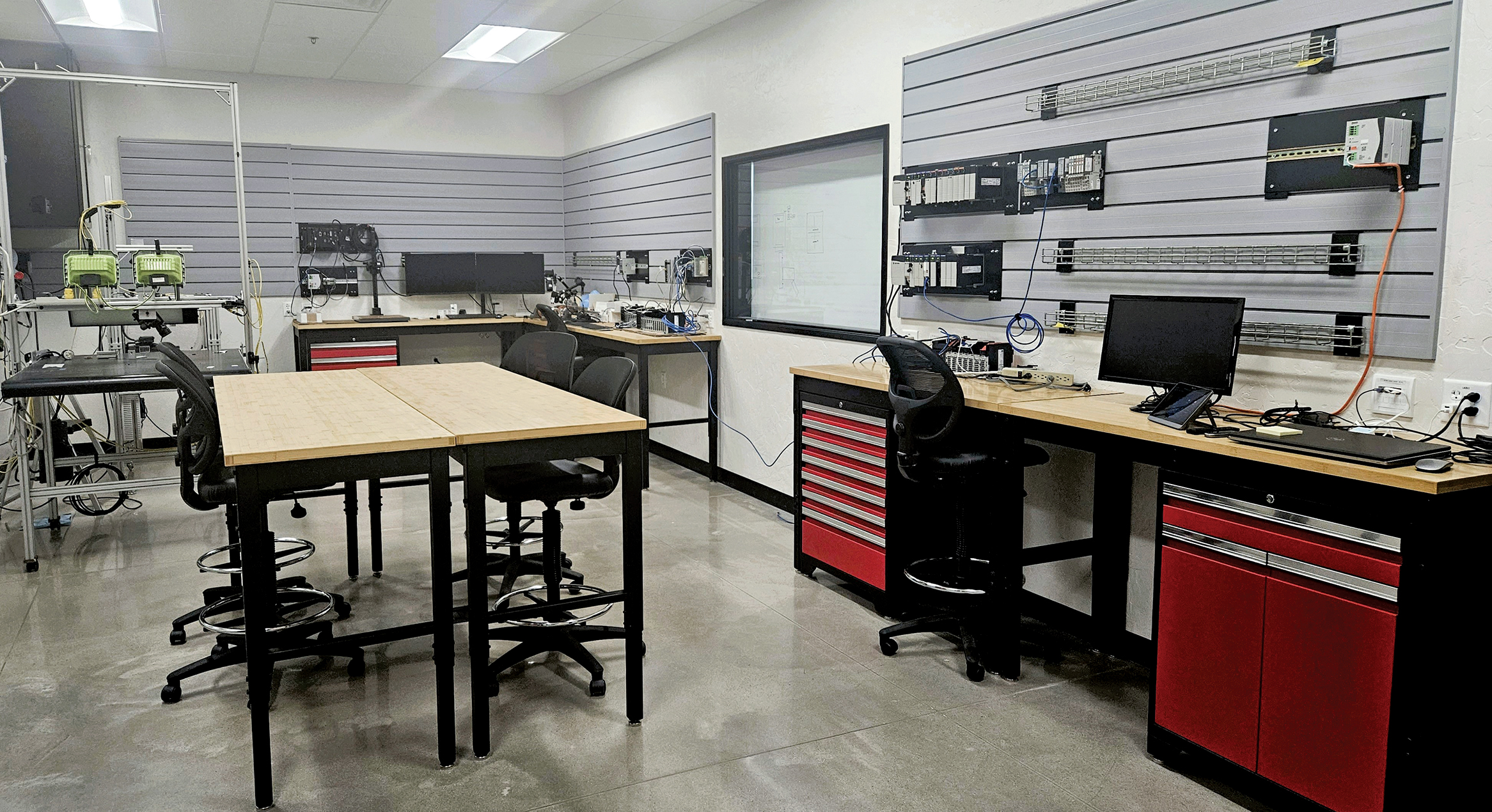
For Pieper Automation, the ability to dictate the design of the Wrightstown building’s interior was ideal. Most places the company found either had a lot of manufacturing space with just a little bit of office or vice versa. “We needed a lot of both,” Tesch says. “And that’s really unusual, so it was very difficult to find any facilities that met those requirements and weren’t the same age as the buildings we were already in.”
The company expanded its manufacturing space to about 30,000 square feet from the roughly 20,000 square feet it had in its previous two buildings, with office space comparable to what it had before.
“We wanted to have a place where we could all be in one place, where people wanted to come to work … we see advantages with people being in person, in collaboration and building relationships,” Tesch says, noting that the company added amenities like a wellness center, a patio off the lunchroom, collaboration space furniture near large windows, and standing desks. It also added an innovation area adjacent to its manufacturing space.
Pieper Automation moved into the Wrightstown building July 6 and Pieper Electric Group moved into the building this fall.
“It’s been a great thing for us just seeing the change in energy and engagement with having everybody in one place,” Tesch says. “You can just feel it.”