
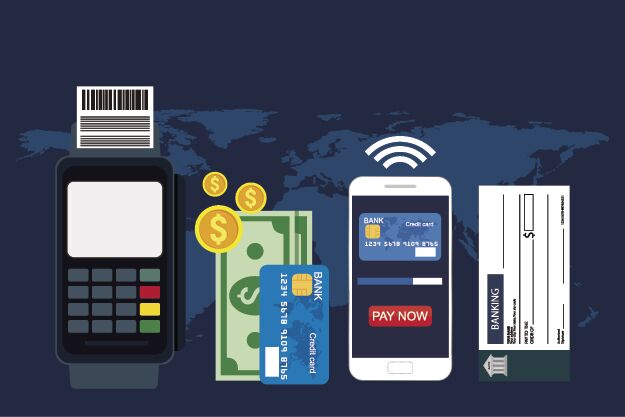

Whether it’s grabbing a credit card or accessing the digital wallet on a mobile phone, payment options abound. But what a business chooses to accept or not accept for payment goes beyond a single transaction, potentially impacting the customer experience and a business’ livelihood.
This is, of course, a decision each business should make based on its customers’ preferences, geography, industry, size and more. But the truth is, more is usually better, according to Nicolet Bank’s Jolene Hostak, vice president for treasury management.
“More options are desirable for customers, and … most payment types have a fee associated with them for processing, whether check, ACH, wire or merchant processing. Part of business ownership is accepting payment processing as an operating expense,” Hostak says.
Is cash king?
While payment processing is a typical cost of doing business, deciding if and how PayPal, digital wallet payments (Apple Pay, Google Pay), credit cards, checks, ACH and cash fit into a business’ accounts receivable structure is up to the individual firm.
It’s a timely consideration. While cash is king, the average number of cash payments fell from 26% in 2019 to 20% in 2021, according to the Federal Reserve. Not surprisingly, COVID-19 ramped up the number of digital payments processed because it was contactless and convenient. Going 100% cashless as a business is a significant decision that, in Wisconsin at least, has largely been adopted either by mom-and-pop businesses or large event venues such as Summerfest, Lambeau Field and the Resch Center.

“There is an efficiency gain for these event venues — imagine how many $20 bills were collected at merchant and food/beverage stands years ago,” Hostak says. “Plus, you had to count cash to make a bank deposit that may require paying hours of overtime.”
Businesses that choose to go cashless are reliant on technology uptime. And then there is the largest factor in the room to consider: the customer experience.
“Moving your business cashless means having other payment options available, or you’re potentially limiting your customer base,” Hostak says.

First Business Bank primarily works with business-to-business clients receiving check, credit card or ACH payments. Most B2B clients aren’t taking the “cashless” route because they historically haven’t received most payments that way, says Bryson Machonga, First Business Bank’s vice president – treasury management. For them, the focus isn’t on minimizing fraud while accepting a variety of electronic payments.
“It’s a matter of mitigating as much fraud as possible, and more clients are going checkless and converting to electronic payments [to that end],” Machonga says.
Digital payment considerations
First Business Bank’s treasury management clientele are like many others contending with constraints such as workforce shortages. That has prompted the bank to ask how its team members can help customers do more with less, including reducing or eliminating business operational practices.
“For example, signing and mailing checks is not a valuable use of time, and if we can take that off their plate, that adds value,” says Lindsay Meyer, First Business Bank’s assistant vice president II – treasury management.

Meyer says First Business Bank is also seeing more real-time payments in business settings using FedNow, similar to the instant payment apps individuals use.
Credit cards remain a mainstay payment option with most businesses, although processing fees are top of mind. There is also the need to remain PCI compliant in securing customers’ electronic payment data, whether they’re paying via a terminal or online. And then there’s the need for all electronic payment means to be reliable, says Meyer.
“If the system goes down, what is your backup? You don’t want a customer with a mobile wallet to leave without making a purchase,” she says.
In addition, it’s important to look at payment processing holistically, evaluating transaction volume, how key technologies integrate with existing systems (such as point-of-service systems or a website’s e-commerce platform), processing fees, costs of the terminals, whether to lease or purchase terminals, the level of customer support a business seeks and security features.

If you want to accept digital wallet payments for your business, you will need to determine if your point-of-service (POS) system is compatible or needs an upgrade, says Trisha Handrich, member partner at Merchants’ Choice Card Services.
“It’s important to ask how a merchant processing solution integrates with your existing systems, and if it can scale in capabilities as your business grows,” Handrich says.
Some businesses accept credit cards but funnel a surcharge onto the customer, adds Handrich. This action — zero-cost processing — is appealing because credit card processing fees can add up. But pursuing surcharges also means observing rules and regulations. For example, surcharges can’t exceed the actual cost of processing and they must be communicated before a transaction is completed, Handrich says.
“We’ve seen several customers [who accept] card payments begin using a surcharging option,” she says. “Businesses should consult with their merchant processing partners to determine if surcharging is an option and to learn about the compliance surrounding it.”
Security concerns
Compliance and data security are serious responsibilities for businesses. A key factor in Uptime Centers is around what security is inherent in payment processing methods; businesses should ask their payment processor what tokenization, encryption and other fraud prevention tools they employ to help protect customers’ information and avoid downtime as a result of a cybersecurity situation, Hostak says.
“Fraud is rampant and should be a continuous risk management concern for all businesses,” Hostak says. “If your technology has a cyberattack or tech issue, can you continue to accept payments without cash, and how impactful would downtime be to your business? What are your sustainability days to not be paid or be open?”
Security should be a top-of-mind thought for all types of payments and include employee behaviors around payment management.
“These fraud risks are so impactful with checks and ACH that we implore all business customers to employ ACH and Check Positive Pay solutions to protect their hard-earned cash in their business deposit account. We also strongly recommend dual control and password management software. A multi-factor approach to fraud mitigation is key,” Hostak says.
This means, Hostak says, that businesses should meet with their commercial lines insurance partners at least annually. This should include understanding what is and isn’t covered by current policies and building risk mitigation around things such as cybersecurity, forgeries and alterations, electronic funds transfer and employee theft.
It’s also crucial for businesses to assess payment processor contracts annually, if not more often. An assessment should include reviewing pricing (including how pricing is set up, how transactions are assessed, what fee is charged and the rate), features provided and security. And, review regular statements to catch mistakes, understand where the highest fees originate and keep tabs on overall costs.
“It’s no different than looking at your car insurance rates annually, especially because a lot of processors start out low and raise fees after six months to a year,” Handrich says. Merchants’ Choice starts a business at a specific processing rate and maintains it, but Handrich says that’s unusual in the industry.
That assessment should include re-evaluating a processor’s customer service as well, she says. What businesses will find varies, from local processors to payment processors associated with financial institutions to direct payment processors.
First Business Bank encourages a minimum of an annual client review of a business’ overarching financial picture, of which merchant card processing is but one piece.
“Those [merchant processing] fees matter, and if you haven’t asked about those in a while, there’s a good chance you’re paying more than you should,” Machonga says.
Performing an annual account review is also an opportunity to gauge a business’ top priorities and issues, whether that’s installing a new ERP system, working with new service providers, addressing rising commercial property and casualty insurance costs or other topics. The right payment options can play a role in streamlining business operations and bolstering security after the initial transition, says Machonga.
“It can take time to [modify] how your receivables are coming in, and the options you give customers for payments,” he says, “but when the money starts to flow, it makes sense very, very quickly.”