

Organizations need money, but they also need humans.
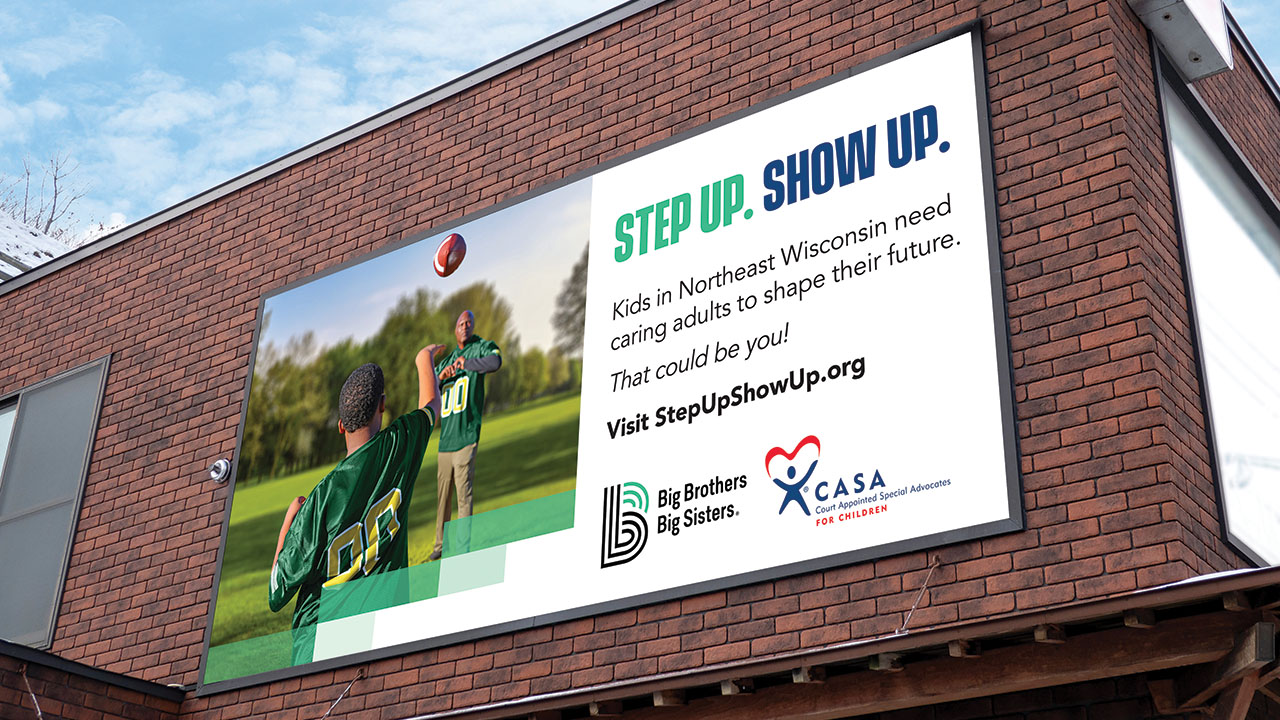
This was the guiding principle that led to the October announcement of a new collaborative marketing campaign to help connect children who need them with caring adults.
“Step Up. Show Up.” is a coordinated effort to recruit volunteers for four Northeast Wisconsin nonprofits: Court Appointed Special Advocates (CASA) Brown County, CASA Fox Cities, Big Brothers Big Sisters of East Central Wisconsin and BBBS Northeast Wisconsin. Monica Stage, executive director of the J. J. Keller Foundation, says the campaign is the result of more than a year of conversations with the participating entities and proved to be a unique exercise in nonprofit collaboration.
Stage calls the project a “yes and” for the J. J. Keller Foundation, as it was important to maintain the foundation’s existing support for core programming of the four nonprofit partners.
“We were only able to move at what I would call the speed of trust,” she says.
As the vision has become reality, the foundation and participating nonprofits leaned into the expertise of the De Pere-based agency O’Connor Connective, which will be working to help develop the campaign strategy and bring it to life through creative, analytical and implementation support.
Launched on Oct. 29, the campaign aims to strengthen the volunteer recruitment funnel through storytelling, media outreach, digital advertising, community partnerships, volunteer spotlights, public relations, employer engagement and shared branding. But all final decisions about leveraging connections and administering volunteer opportunities will go back to the four partner organizations. “Step Up. Show Up.,” Stage says, is what marketing professionals might call a “lead gen” exercise.
A Big Sister volunteer herself, foundation board president Marne Keller-Krikava says she understands intimately why the collaboration had to be handled with care.
“Nonprofits are so busy and so underfunded and under-resourced that they’re just doing their best to get by day by day,” Keller-Krikava says. “The value I think we bring is saying … no, we’re not cutting your other funding. We’re just trying to do something new and different.”
Keller-Krikava says she isn’t aware of a similar project in the foundation’s past, but she is excited to see an issue that has been top of mind for her for many years brought to the forefront: how to get kids off the waiting list in those four agencies.
“We know kids do well when they have somebody in their life,” she says. “It can just be one person. I think a lot of people know that, but what do you do about it?”
Isolation and mental health are a public health crisis, and the meaningful personal connections found through organizations like CASA and BBBS should be considered a basic need, Stage says.
“There’s a public perception of, ‘you’re a foundation; you give out money.’ [We want to] shift that mindset beyond dollars and cents to how do we show up and care for people,” Stage says. “I think changing the community conversation is something we would love to do.”