
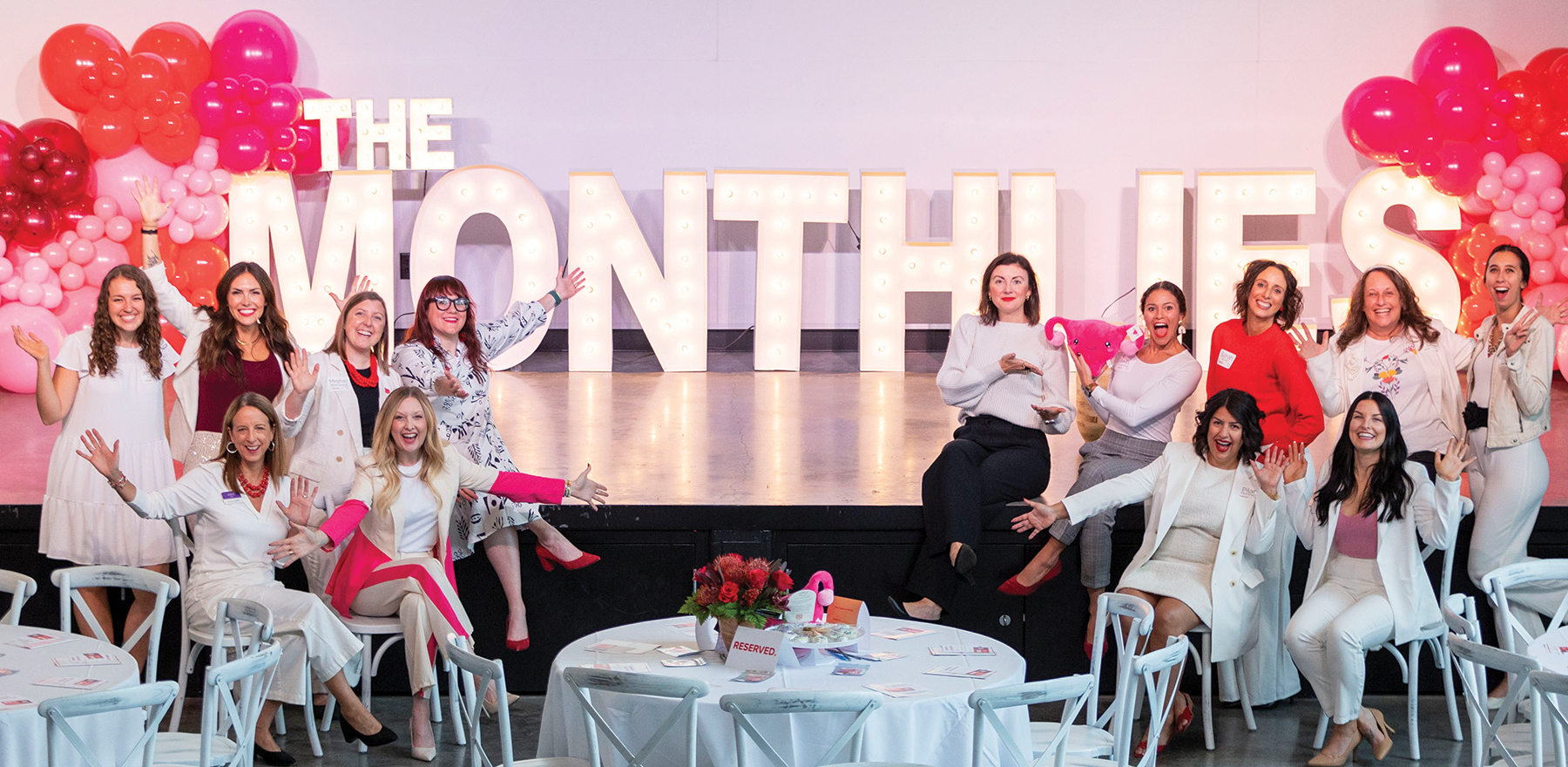

Three Northeast Wisconsin women chose not to go with the flow when it came to the lack of access to menstruation products for school-age girls. Instead, they created a coalition to tackle it head-on.
Alison Fiebig Vasquez, vice president of strategy, brand, marketing and communications at Emplify Health; Julie Keller, executive director of the Women’s Fund Fox Valley Region; and Liz Wollenberg, chief systems and strategy officer at Feeding America Eastern Wisconsin, established The Monthlies Project in 2021. Their mission: Secure and distribute menstrual products to those who need them most and raise awareness about the educational inequities tied to period poverty.
As of September, the initiative had distributed 1,149,230 menstrual products through 175 partners across Northeast Wisconsin. Feeding America manages product procurement and delivery, the Women’s Fund oversees funding, and Fiebig Vasquez brings her brand storytelling and marketing expertise.
National surveys show one in five U.S. students experiences period poverty — a lack of access to menstrual products that negatively impacts physical, mental and emotional health. For many, it means missing class, showing up late or feeling anxious about period care, factors that contribute to chronic absenteeism and educational inequity.
The group chose to focus on supplying products directly through schools and youth‑supporting organizations, ensuring students’ dignity.
“Period products aren’t covered by WIC or other supplemental programs,” Wollenberg says. “We partner with any community organization serving school-age menstruators because [a lack of menstrual products] is not only a barrier to education but also participation, such as going to the Boys & Girls Club or the library program.”
If families struggle to afford food, menstrual products are often out of reach as well.
“If somebody can’t make ends meet to get food for a couple of weeks, they’re likely not able to get period products, either,” Fiebig Vasquez says. “Reaching 1 million products distributed in May is evidence that people don’t have as much access to period products as we may think.”
Beyond providing products, The Monthlies Project also advocates for systemic policy change. The founders see opportunities to improve state law and funding, including eliminating the “pink tax,” which still applies to menstrual products in 18 states, including Wisconsin. The group has already connected with Wisconsin lawmakers to advance the conversation.
“Period Law, the national organization focused on this, reached out to us,” Keller says. “They said we were the perfect people to talk to about this.”
The Monthlies Project also highlights practical disparities, like how school budgets routinely cover toilet paper but rarely menstrual supplies.
“You can’t imagine taking toilet paper out of the school budget, but when we talk about [menstrual products] and bring these things to light, people typically say, ‘Oh my gosh; that doesn’t make sense,’” Wollenberg says. “So it’s not just policy change, but normalizing the ability to talk about periods and the things around them.”
The coalition’s success reflects the power of collaboration between its founders; an advisory group called “The Regulars;” an event committee for its annual fundraiser, An Event, Period; and countless community partners and volunteers. The next event is set for March 26 from 5 to 8 p.m. at the Fox Cities Performing Arts Center in Appleton.
“What’s unique about the design of the initiative is that it isn’t a stand-alone nonprofit with staff and overhead costs. We identified employers in the community willing to commit to the cause and share community resources to make an impact on the issue,” Wollenberg says.
“We’re fortunate our community is very generous,” Fiebig Vasquez adds. “It has been amazing to see how the community has rallied; it’s been incredible to see the type of ‘hug’ from the community with this work.”
To learn more about The Monthlies Project, visit monthliesproject.com.