
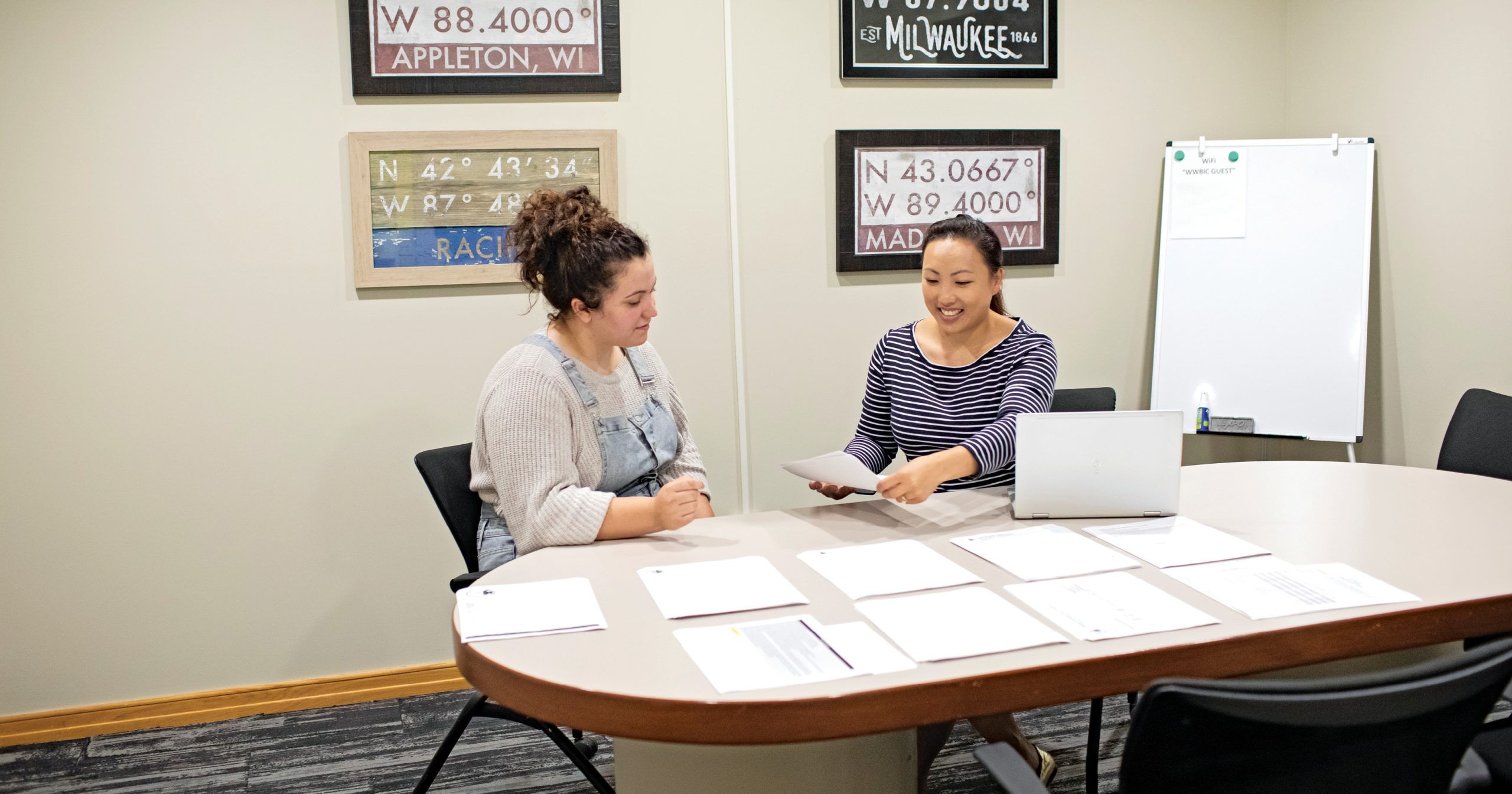

When the pandemic arrived and small businesses searched for direction, Colleen Bies saw an opportunity to assist. As a small business owner herself, Bies knew she could help walk others through the process of seeking loans, grants and other assistance.
“I had this idea of going online and recording a bunch of free webinars because I had noticed that during the pandemic, people that really needed the help didn’t get that. And the people that didn’t really need the help, got all the help they needed,” says Bies, who also has a finance and accounting background.
Then, a colleague told her, “‘I keep seeing this job posting on LinkedIn — sounds an awful lot like what you want to do.’” The position was with Wisconsin Women’s Business Initiative Corp., or WWBIC.
WWBIC, which has offices in Appleton, Milwaukee, Madison, La Crosse, Kenosha and Racine, offers small business assistance in three main areas: education, lending and coaching.
The organization focuses on individuals who face barriers in accessing traditional financing and assistance. While WWBIC was established as a women’s organization, it helps anyone, with special focus on people of color, those with lower net worth and veterans. Its services can aid those wanting to start a business or to take their business to the next level.
“WWBIC’s goals and what they do, and the kinds of people that they help, and the kind of help that they provide, is everything that I personally want to do in my life, and it fits my values and my goals as a person,” says Bies, who is now WWBIC’s Northeast regional project director and based in Appleton.
Bies, a child of Hmong immigrants, is also a veteran who spent more than 12 years in the military, including a deployment to Iraq. She owns Colleen Bies Photography in Neenah and this year sold Fika Tea Bar in Appleton to a new owner to free up more time.
People coming in to WWBIC for help might face language or cultural barriers, a lack of resources or other challenges such as difficult family circumstances. Most of the time, it’s simply that someone has an idea and doesn’t know where to start.
“All of our education is making sure that people have that knowledge and information because it is so hard for a business owner to go onto Google and find a million different things. They don’t know how and when things apply to them — or don’t apply to them,” Bies says.
WWBIC launched in 1987 with an initial mission of helping women gain access to capital. “At that point in time, women were still not allowed to apply for loans without a man,” Bies says.
WWBIC continues to be a micro-lender, offering up to $250,000 in loans to small businesses.
“Anytime someone goes through the loan process with WWBIC, it is a longer process, and it is more in depth,” Bies says. “The whole purpose is making sure that the business owners are super solid on their business plan, on their goals and on their strategy before we even say yes to them.”
Because of that, WWBIC can take clients who other lenders consider high risk. That might include having low credit scores or a criminal history or wanting to start a business that doesn’t have a high return, such as a day care.
“We have a 92 percent payback rate, and that’s because we do go through such a strict process of vetting everyone and making sure that they are really solid in how they’re going to succeed,” Bies says.
Small business owners are matched with a consultant who works with them regularly to keep them on track, offer advice and provide them with counseling and resources.
“Small business owners are able to employ and give people work, and we want that because that’s what builds our communities,” Bies says. “That’s what builds our organization and our people and the world, really.”
Since 1987, WWBIC has lent over $82 million and helped more than 8,000 entrepreneurs create or retain more than 12,500 jobs statewide. Last year, it directly issued $1.6 million in Paycheck Protection Program loans.
The Appleton office, which opened three years ago, is administering a $780,000 grant with Calumet County to help businesses impacted by COVID-19. The fund will offer $12,000 grants to up to 65 microenterprises in small communities.
“In the end, it’s for a lot of businesses that genuinely just are hardworking, and they just need a little bit more help because they’re doing everything that they can already,” Bies says.
Since beginning with WWBIC in May, Bies has seen the impact of the organization’s services — and it doesn’t take a large loan or grant to make a big difference. For example, the agency has been facilitating grants to small businesses for laptops and a one-year subscription to QuickBooks through the Small Business Administration Program for Investment in Micro-Entrepreneurs (PRIME).
“It’s just amazing because there are some people that are just in tears when they get these laptops,” Bies says. “They’re just like, ‘I don’t even know what I would’ve done.’”