

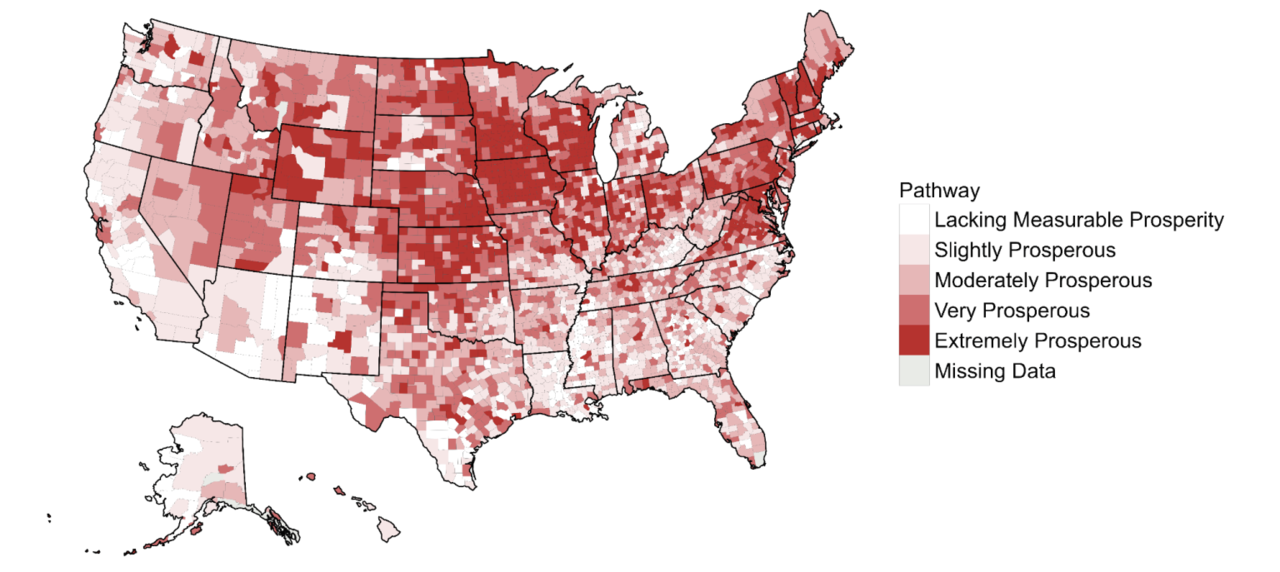
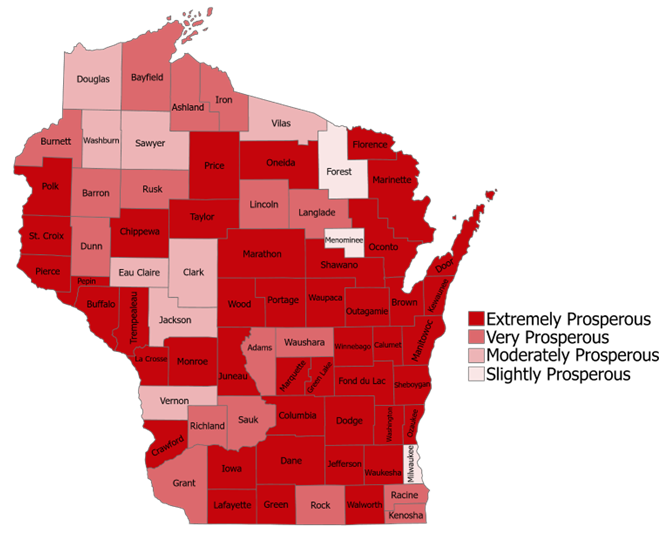
Wisconsin is at the center of one of the largest concentrations of prosperity in the United States, according to a WIndicators study released by the University of Wisconsin Extension’s Community Economic Development division.
The state routinely fares better than the national average on all four dimensions of prosperity: poverty, unemployment, housing, and education.
Eighteen Wisconsin counties have consistently scored better than the national average, and none of our state’s counties fall into the lowest typology category, “lacking measurable prosperity.” Doctoral student Danielle Schmidt, and Professors Tessa Conroy and Steve Deller, wrote about the topic in Understanding Wisconsin Prosperity in a National Context.
They used a method that measures prosperity by identifying the counties that perform better than the national average across: education, housing, poverty, and unemployment. It results in a score of 0 (lowest) to 4 (highest). The highest scoring counties perform better than the national average across all four dimensions of prosperity, while the lowest scoring counties perform worse than the national average across all four dimensions.
The intuition is that places with populations that are more educated, with better quality housing, lower poverty rates, and lower unemployment rates are generally the most “prosperous” places.
According to the report, Wisconsin counties have seen large improvements in poverty rates and unemployment rates from 1990 to 2020. Those improvements have driven the state’s rise in prosperity measurements.
Wisconsin has consistently outperformed the nation for housing quality and relative expense, which the study authors said can be leveraged for further community development initiatives.
Of concern, however, is the change in how Wisconsin compares to the national high school dropout rate – a key indicator of educational attainment. In 1990, 93 percent of counties scored better than the national average high school dropout rate, meaning more Wisconsin teenagers graduated high school compared to the rest of the nation. Wisconsin has since fallen behind on this indicator. Now, less than half of Wisconsin counties score better than the national average. That suggests a clear need to consider education as a key opportunity to improve community well-being.

