
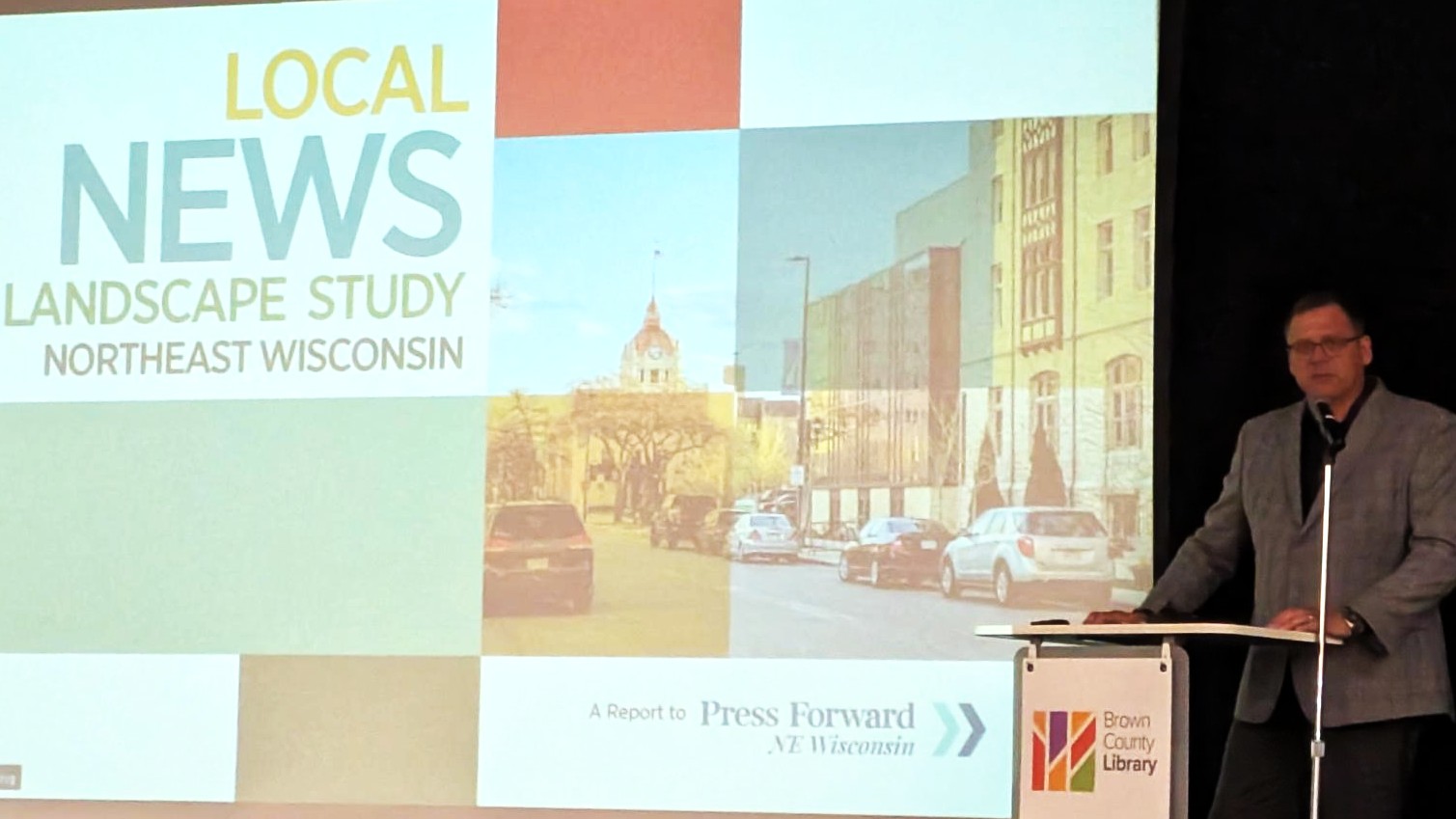

A new regional study finds that local news remains an important and trusted source of information for residents across Northeast Wisconsin, but also residents don’t always feel adequately informed.
Commissioned by the Greater Green Bay Community Foundation through the Press Forward Northeast Wisconsin chapter, the “Local News Landscape Study, Northeast Wisconsin” was conducted by the University of Wisconsin–Green Bay Center for Civic Engagement.
It provides a snapshot of how residents in Brown, Kewaunee, Oconto, and Outagamie counties access and value local news.
“At community foundations, we see first-hand how strong communities and strong local news go hand in hand,” said Dennis Buehler, President and CEO for the Greater Green Bay Community Foundation. “Local news helps people understand the issues that shape their daily lives and stay connected to what matters to them. As the media landscape continues to evolve, this study gives us important insight into how we can work together to sustain and strengthen this essential resource for the public good.”
Key Findings:
Local news is valued, but residents don’t always feel adequately informed about the issues that matter most to them. While respondents were most likely to feel very well informed about sports, they placed the greatest importance on news that affects their daily well-being, such as healthcare and public safety, as well as jobs, local businesses, and the local economy.
Residents rely on a mix of sources to stay informed. General online news websites, Facebook, and broadcast television were all commonly used daily sources. Although social media provides a convenient way to encounter local information, participants did not necessarily view it as their most trusted source.
Trust in local journalism is strong. Overall, survey respondents express greater trust in traditional local news sources than in social-media based sources—with younger residents more likely to rate print newspapers and radio as very trustworthy, and older residents expressing greater trust in broadcast television and online newspapers.
Residents want more relevant, everyday community coverage. Many are looking for news that better reflects their communities, experiences, and a wider range of local perspectives.
Cost and access affect engagement. Only 12% of survey respondents report paying for a local news subscription, with many relying on free online sources and social media despite lower trust.
Local journalism continues to influence civic life. Nearly half of survey respondents (47%) reported taking some form of civic or community action because of local news. Of those, the most common actions were voting, discussing local issues with family and friends, and attending community events.
The study also points to how news habits could evolve. When asked to consider where they expect to get information about their community over the next five years, 45% of respondents said they are very likely to rely on their personal networks. Television news is also expected to remain a key source of news for many residents.
The full “Local News Landscape Study, Northeast Wisconsin” is available at ggbcf.org/community-initiatives/press-forward-ne-wisconsin.