

By Nikki Kallio
From the time Rebecca Nelson was very young, she loved raising tropical fish — even working in an aquarium shop during high school to support her habit.
Later, as an adult, that fascination with fish would play a pivotal role in her career as a hydroponics farmer.
While Nelson enjoyed growing things in a controlled environment, the use of fertilizers in the process left her dissatisfied. With her interest in fish still strongly in place, Nelson discovered some research that combined fish and plant culture — or aquaponics.
“It was everything I ever imagined would be a perfect food system,” says Nelson, who along with her husband John Pade is co-founder and owner of Nelson & Pade in Montello.
The company is a trailblazer in the field of aquaponics, having published a journal starting in the late 1990s and establishing an innovative demonstration greenhouse that eventually attracted people from 110 countries.
Now the company sells aquaponics systems in every size, from those for home gardens to large-scale commercial operations.
“Over the years, we have taken what was really an obscure science project and scaled it up to commercial food production systems,” Nelson says.
Aquaponics has attracted commercial and hobby farmers around the world, as well as schools, universities and food banks. People gravitate toward the natural fertilizers, the efficient use of water, and the self-contained and sustainable fish-and-plant production system that aquaponics provides.
For Nelson and her team, “it really just comes from a love of food and wanting other people to have access to high-quality food.”
The benefits of aquaponics
“When you look at it from a science point of view, it’s incredibly simple,” Nelson says. “It’s just like the ecology of every lake or stream, because you’re feeding the fish, the fish waste breaks down through natural biological processes, and the nutrients are released for plant growth.”
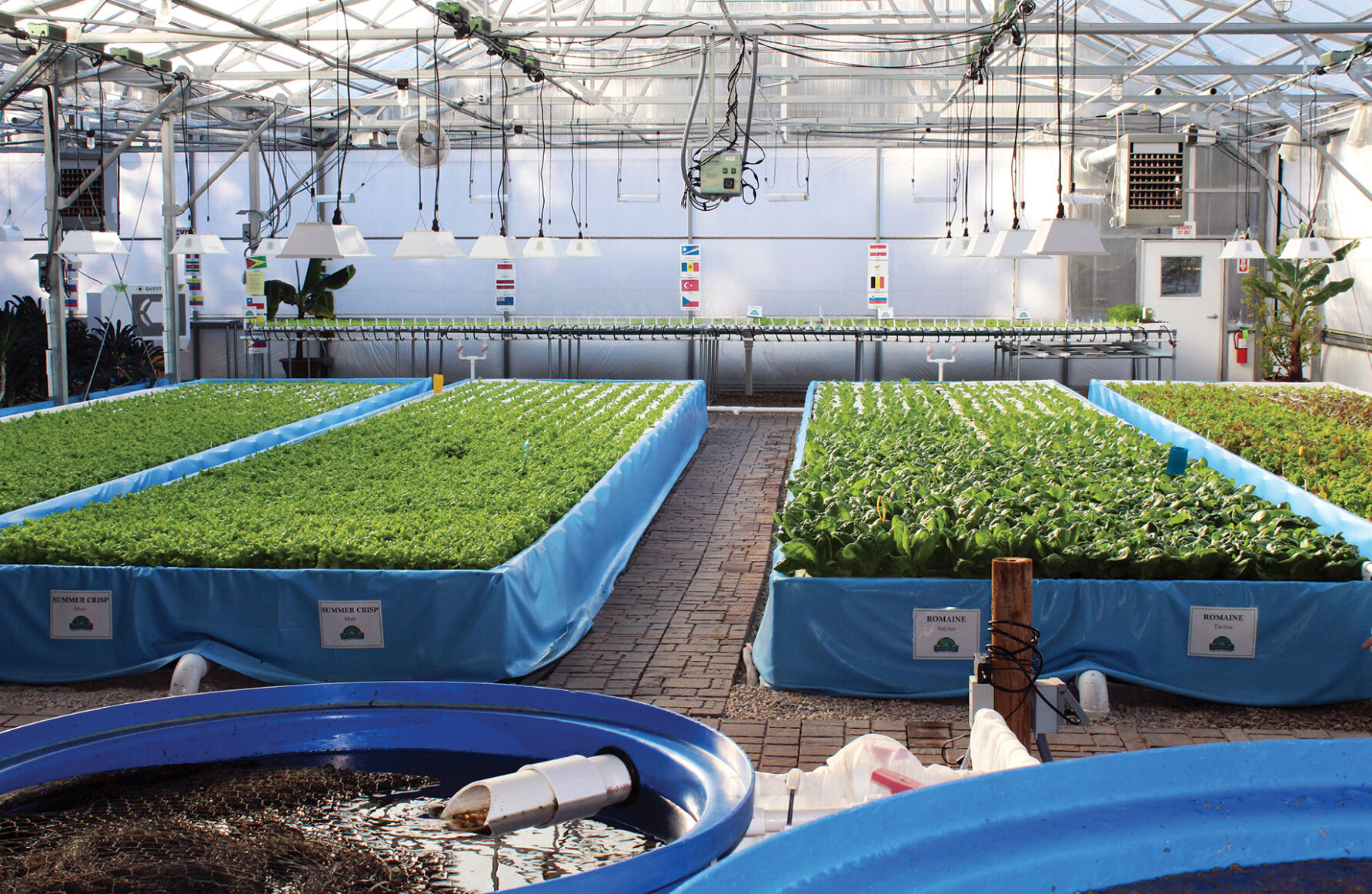
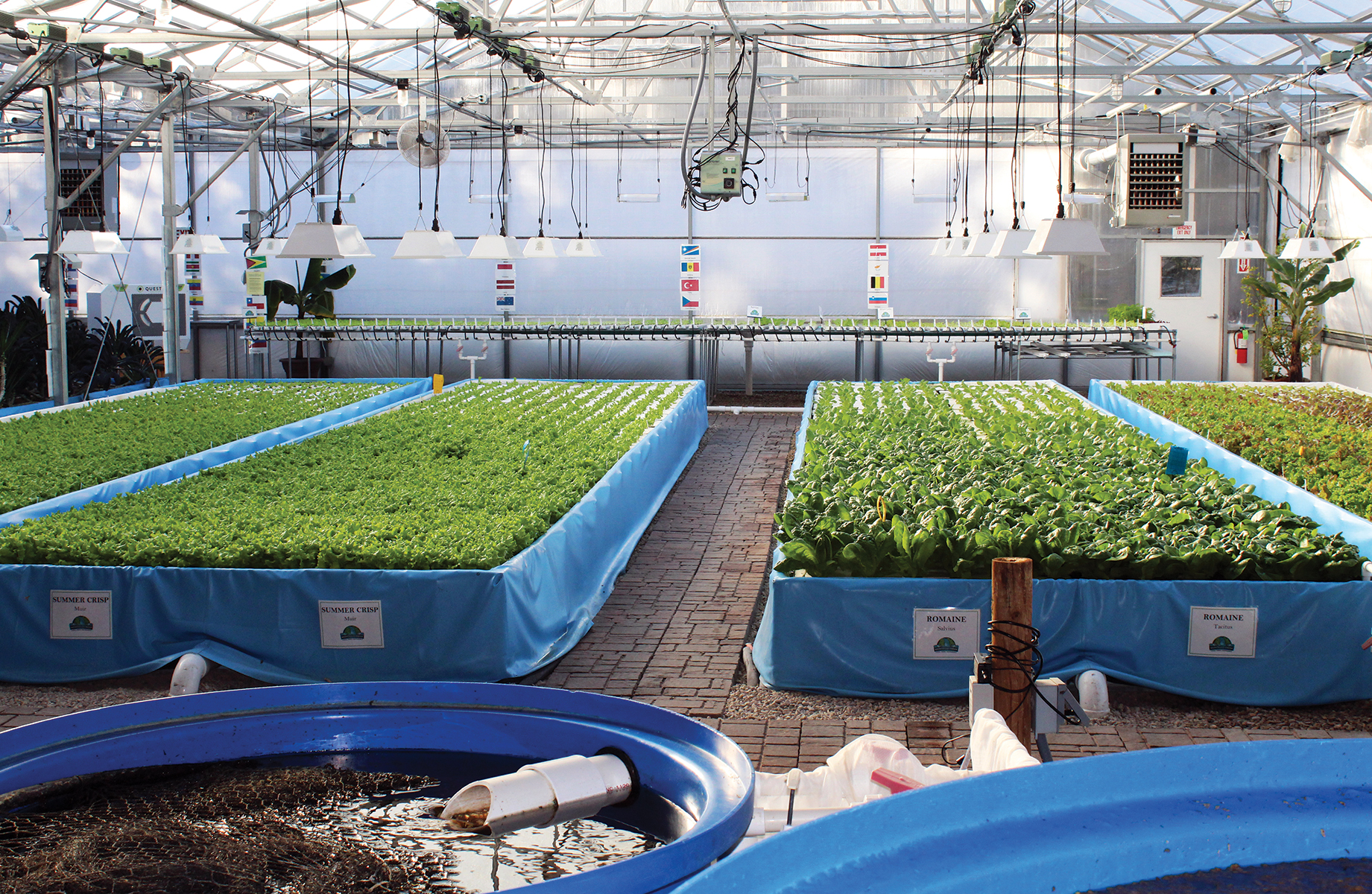
Fish are raised in a large round tank separate from the plants, which grow on rafts floating in other tanks. As the nutrients are released from fish waste, the water is sent to the plant tanks, Nelson says. The plants take out the nutrients and help to clean the water for the fish.
“The water just circulates for the system 24 hours a day. And we can grow an extraordinary amount of food in the footprint that we have,” Nelson says.
Fish are harvested about every six weeks.
Aquaponics also allows farmers to avoid pests and insecticide use because plants are grown in a controlled environment, says Chris Hartleb, a UW-Stevens Point fish biologist with a specialty in aquaculture.
There’s also a reduced cost of fuel and transportation with locally produced foods, as well as a longer shelf life because the fish and the greens are produced near where they’re distributed.
“You can grow the similar amount of food and it’s a much smaller footprint in aquaponics than with traditional agriculture,” Hartleb says. “And it’s a conservation of water — aquaponics recycles water.”
Nate Calkins, who owns Lake Orchard Farm in Sheboygan with his wife, Mary, took Nelson & Pade’s five-day, in-person training course several years ago after researching new options for their farming operation.
Their sixth-generation farm, purchased in 1848, once had been a traditional cattle operation raising about 350 cattle. When Calkins, a former engineer, took over the farm with Mary in 2005 he saw opportunities to do something different.
“With my background in engineering, I try to be very efficient in my business,” Calkins says. “And what we were doing was not efficient at all.”
Calkins’ 350 cattle could consume up to 50 gallons of water a day — each — and while the farm had no shortage of water, “it’s very water-wasteful. It didn’t cost me much of anything, but it cost our environment.”
During the time he raised heifers, Calkins was constantly evaluating and working to change over the infrastructure of the farm, which now includes a bed and breakfast, event barn and golf course. He also wanted to keep an agricultural operation — but he wanted it to be efficient.
“We have 7.185 billion people on Earth right now, and we’ve got a lot of mouths to feed,” Calkins says. “So I wanted to be mindful in how I produced the food.”
In 2013, he discovered Nelson & Pade. Two years later, he launched his operation.
“When I was investigating what I wanted to cultivate, aquaponics just shined as really potentially the best thing you could ever get into from a food-producing standpoint, in terms of its resource management,” Calkins says.
Lake Orchard grows and harvests about 1,200 fish annually and produces up to 55,000 heads of lettuce every year. “Our water consumption is probably in the range of 250-350 gallons a day,” Calkins says. “From a household standpoint, a family of four can go through 400 gallons a day, easy.”
For fertilizer, “I use nothing besides the poop that the fish put out, and we feed a naturally-certified fish food that is mainly derived from fish renderings,” he says.
While there are environmental and health benefits to using the natural fertilizer produced by the fish, there are economic ones, too, as the cost of commercial fertilizers has soared following the Russian invasion of Ukraine — also one of the reasons food prices are increasing, he says.
“I’m sure there’s a lot of hydroponic facilities that are having a tough time with fertilizer and nutrient management costs right now,” he says.
Evolving industry
UWSP’s Hartleb encountered Nelson & Pade more than a decade ago and “thought it was fascinating the way they were growing fish using the wastewater then to feed plants and getting a second crop out of it,” he says.
Hartleb and Nelson talked about ways they could work together, and in 2009 UWSP started offering the first university aquaponics course in the U.S. The university also established the Aquaponics Innovation Center on Nelson & Pade’s property in Montello, where it researched different types of fish in the aquaponics process. (The center has since closed, but Hartleb says he hopes to raise funding to relaunch it.)
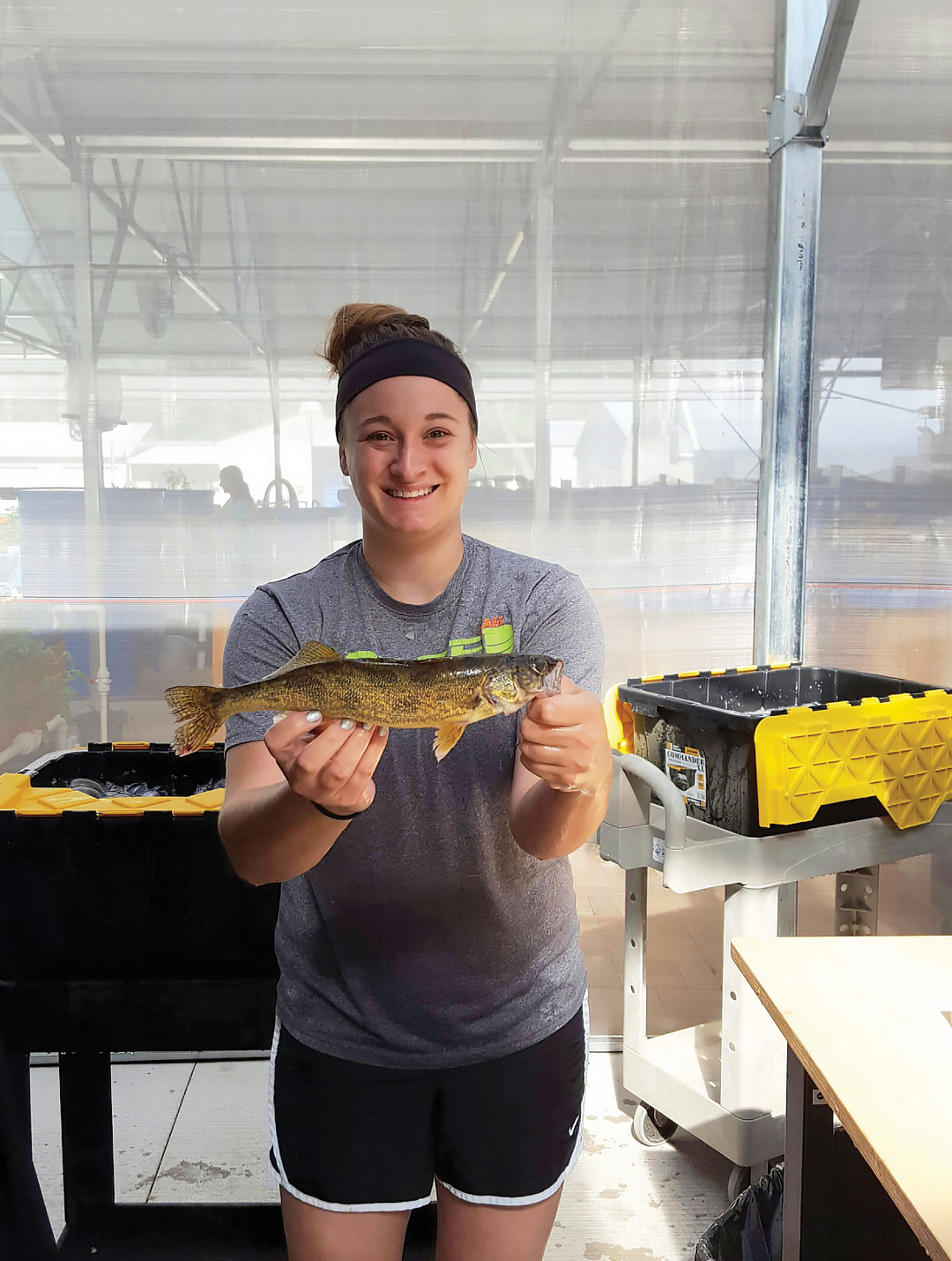
While the industry overwhelmingly raises tilapia, a relatively hearty breed, UWSP found potential in raising other fish including walleye, yellow perch, blue yellow sunfish and minnows, Hartleb says.
“We were very successful,” he says. “I think we showed that you can raise other fish that sell for a higher profit. And now it’s up to somebody — a nice, brave soul — to start launching a business with it.”
An operation in western Wisconsin is planning on opening a walleye operation, and Superior Fresh, which is the largest aquaponics operation in the world, raises salmon with its greens and distributes to wholesalers like Costco and Reinhardt, Hartleb says. “You can go to any Kwik Trip in Wisconsin and find their lettuce in the chilled section,” he says.
Overall, the aquaponics industry is seeing some larger-scale, aquaponics-focused operations opening alongside microfarms and hobby farms that use aquaponics to supplement their income.
“I’ve got people who are just recently retired and want to do something in retirement,” Hartleb says. “I’ve got others in which they want to add it on to their business.”
UWSP is continuing its aquaponics course with about 40 students annually. About two-thirds are UWSP students, and the rest are people from around the world who are interested in an aquaponics business.
Likewise, Nelson & Pade shifted to online courses after the onset of the pandemic, and training remains central to its operation. In the early 2000s, the company also started manufacturing aquaponics systems for sale. “As entrepreneurs, we just kept thinking we would do training, we would teach people how to do it,” Nelson says. “But there was nobody making systems.”
The smallest system leaves Nelson & Pade on a four-by-six-foot pallet and is less than 100 square feet fully assembled, says Jannel Dunn, chief operations officer for Nelson & Pade. “Our larger system will go out on about one-and-a-half to two semis and will be about 9,000 square feet of space,” she says.
Nelson & Pade also has clients outside of commercial and hobby growers, including schools, universities and food banks. In May, the company was filling an order for a large system for a food bank in West Virginia.
“It goes back to the food security,” Nelson says. “A lot of their donations are dry goods or canned goods, which really don’t provide the nutritional impact that they’re hoping.”
By having fresh vegetables and fish grown on site, those food banks can supply their clients consistently with high-quality, nutritious foods.
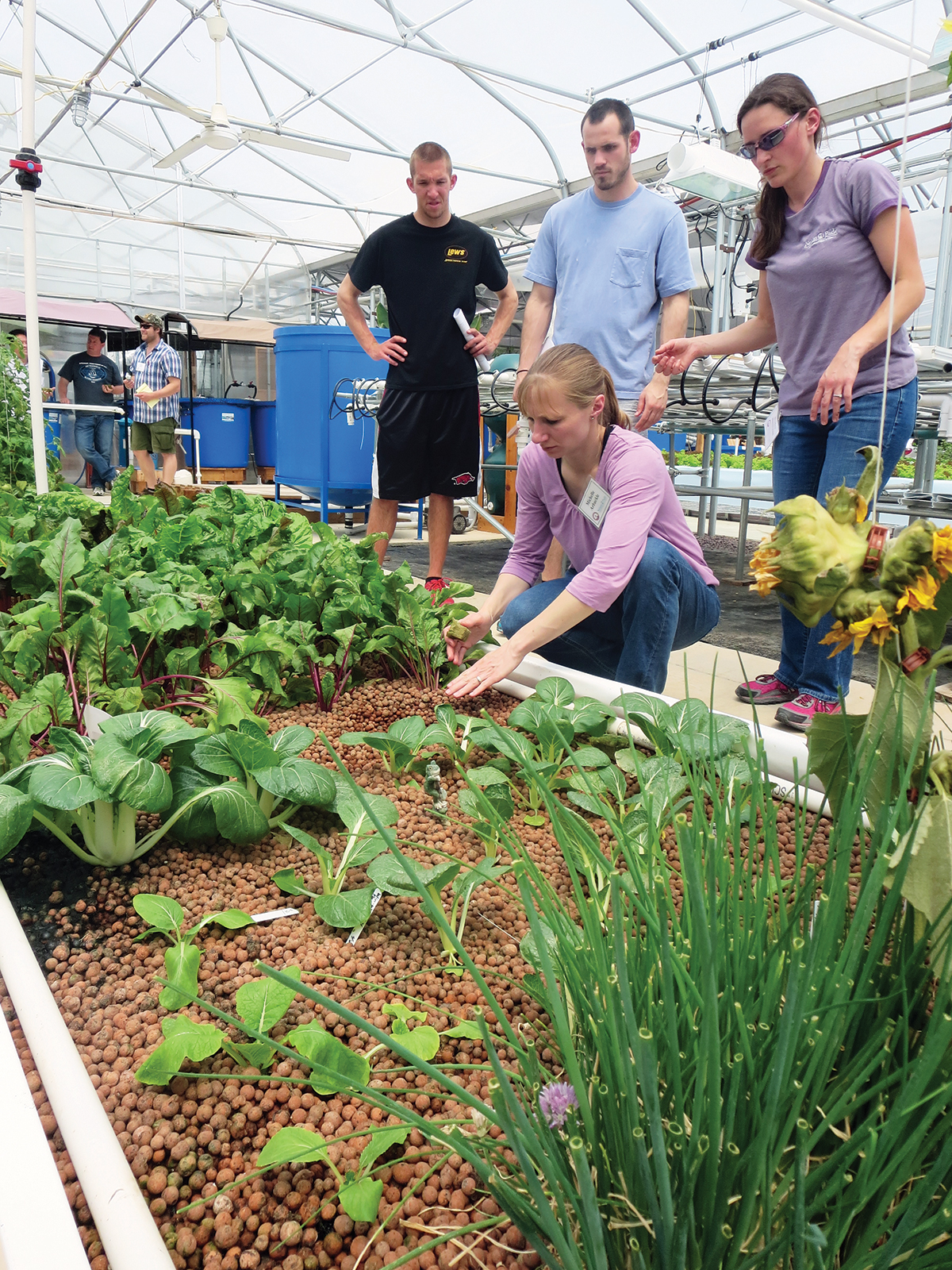
Another growth area for aquaponics systems has been within educational institutions.
“Historically the schools were interested in systems so they could teach science and biology and math and chemistry,” Nelson says. “But now we’ve got a couple of big commercial systems going in schools to provide food for the school, which is a very different twist.”
Food security overall is moving more and more into public consciousness, especially following the pandemic and with concerns about inflation, she says.
“A lot of the schools and individuals we hear from, and for people from other countries, that is the driving force,” Nelson says.