
When economic uncertainty arises, people and businesses usually recalibrate in predictable ways, reining in spending until the situation improves. The last two years, however, have laid waste to notions of predictability, as an insatiable demand for goods has raged on despite rising costs.
Both the commercial and residential sides of the construction industry are seeing that play out, as demand for projects remains strong, even though the price tag has increased as much as 30% to 40% versus prior to the pandemic.
Ben Bruns, executive vice president for the Northern Operations Group for Appleton-based The Boldt Co., says projects today are 25% costlier than they were a year ago. At the same time, the contractor has more backlog than it’s ever had in its history, and “it’s not even close.”
“I just think there’s so much money in the system that people are incentivized to do projects that they’ve been sitting on for a period of time. Even though the costs have increased in a lot of ways, it hasn’t stopped the demand,” Bruns says.
That high demand is fueling supply chain constraints, which is in turn feeding inflation. Bruns relates the story of a health care system in Houston that was doing two projects simultaneously and had to choose which project got the roof.
Further compounding issues, Amazon has been pursuing a large nationwide building program that has affected commodity prices for many supplies, Bruns says. Items such as roof joists became hard to procure, and the retailer ordered an astounding 4,000 generators. Amazon’s building spree is slowing, but it created yet another factor with which to contend.
Bruns says some of the biggest bottlenecks right now are around electrical components, including switchgear and transfer switches, as well as overhead and wood doors, door frames and hardware. The number and variety of supply shortages make it difficult to plan and execute projects.
“As builders, we’re having to look really hard at the conventions of what the cycle should be just to try to mitigate these surprisingly long lead times,” Bruns says, adding that clients have come to expect delays. “They might not like the news that comes their way, but they can certainly relate to it.”
Carol Karls, director of strategic growth for Immel Construction, says the Green Bay-based contractor is also battling supply chain constraints. “In the construction industry, we’re used to just-in-time delivery and schedules, so we’re used to dealing with these challenges. It’s just a bit more widespread right now,” she says.
Despite the challenges, optimism within the industry remains high, Karls says, noting that the chief economist for the trade association Associated
Builders and Contractors of Wisconsin anticipates 2022 will be a year of growth for the industry. Immel’s backlog for 2023 remains strong, and she predicts that will help position the company to weather the implications of interest rate hikes.
Karls says when material delays first emerged, it was challenging, but now firms can better anticipate setbacks and their impact on project schedules. It’s led companies and clients to plan further ahead for projects. At Immel, that includes researching alternative materials, forging strong partnerships with subcontractors, and communicating the project vision to clients early on to ensure they have the necessary resources to cement the project’s success.
While the hope is that supply chain constraints will work themselves out eventually, a persistent problem remains in construction. “The current forecast nationally is a labor shortage of 650,000 workers this year in our industry,” Bruns says.
Both Boldt and Immel are working with the NEW Construction Alliance, which was modeled after the success of the NEW Manufacturing Alliance, to collaborate with educators, workforce development, economic development and government to promote careers in the building and construction trades.
“Lack of skilled workforce is the most pressing issue for the industry. Yes, there’ll be some end to this pandemic or some new normal that comes out of it, but the lack of employees in the industry is going to remain a critical issue,” Karls says.
No slowing for residential
Demand for both new housing construction and renovations also has remained high throughout the pandemic. Shannon Meyer, president of Appleton-based Cypress Homes & Realty, says the market and industry are both performing well in Northeast Wisconsin.
The tight market for purchasing an existing home has led many people to consider new construction instead, Meyer says. “It’s driving a lot of people to look at building because of the bidding wars on existing, and then they’re paying a lot more money for an existing home that may need updates.”
Beyond that, people who have homes to sell are commanding higher prices and therefore have more equity they can cash out and apply to construction of a new home, she says.
Meyer says subdivisions sell out quickly once they’re developed. In addition to home construction and selling existing homes, Cypress develops real estate and is working on new subdivisions in Grand Chute and Appleton as well as finishing one in Menasha.
Increasing goods prices are touching the residential construction industry and affecting project timelines. Maintaining strong relationships with suppliers and subcontractors has helped the business navigate the challenges, Meyer says. Cypress also sets expectations for clients upfront.
“Years ago, it used to be that a home was built in 90 days. Now, when you come to build a home, we’re setting the expectation right from the beginning that our contracts are 175 days,” Meyer says.
The remodeling industry also is going strong. “We’re seeing almost historic backlogs in our work. That’s very incongruent with some of the challenges and pricing pressures that we’re facing,” says Dennis Ruedinger, who co-owns Oshkosh-based RH Design Build alongside architect Susan Hirschberg.
Ruedinger says the low stock of existing homes and new lots continues to fuel the desire for remodeling projects. Demand has maintained even though the cost of remodeling projects has increased somewhere between 30% and 40% versus pre-pandemic levels.
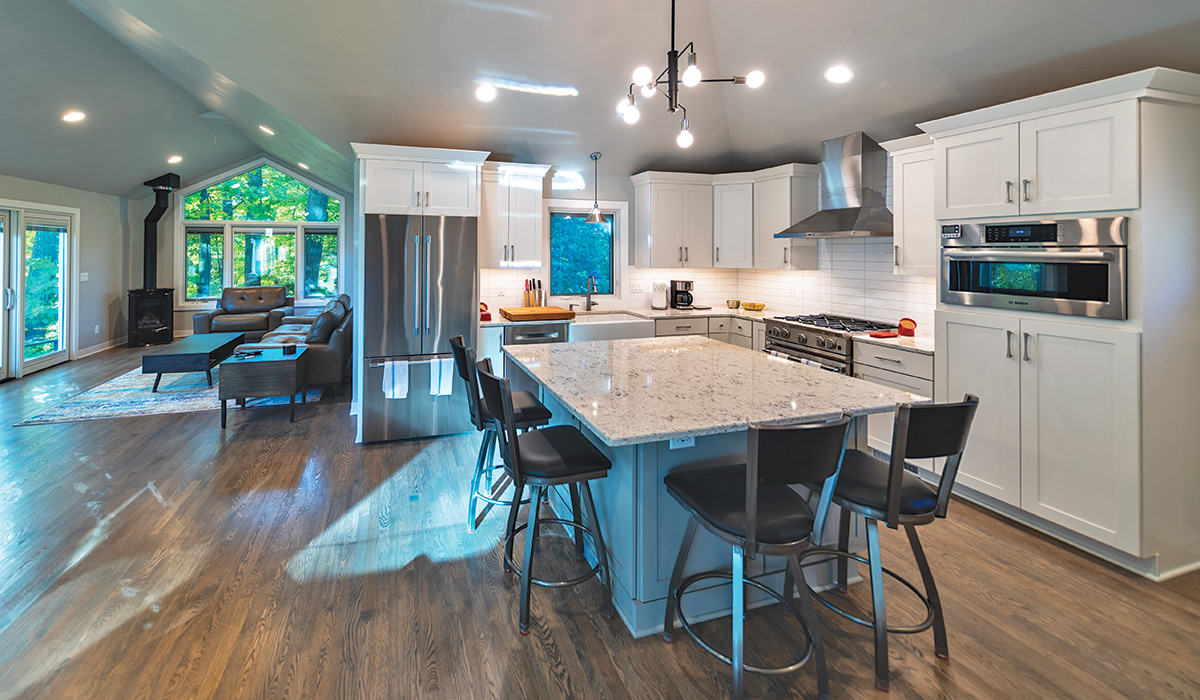
Paul Welhouse, president and owner of Welhouse Construction Services, says the pandemic has led to people spending more time than ever in their homes. “They see the pain points in their house, and they’re in it so often they want to solve the problem,” Welhouse says.
While the remodeling industry is performing well, it’s also facing challenges — including labor. Welhouse and Ruedinger, who are both members of the North East Wisconsin chapter of the National Association of the Remodeling Industry, say they have to pay more for talent and work harder to keep workers.
Both Ruedinger and Welhouse also say they are apprehensive about the implications of increasing interest rates. Welhouse says his firm takes nothing for granted and doesn’t turn down work. The two companies’ strong reputations have helped them weather tough times throughout their long tenures.
“We’ve been through many cycles. The sun is shining bright now, and we’re working sun up to sun down, but something tells me three, four or five years from now, it probably won’t be like this,” Ruedinger says, adding that he’s staying focused on what’s important. “We’re filing away money like crazy so that when it does happen, we can keep our quality people.”