
By Janet Weyandt
As the business community copes with a constantly changing economy and post-pandemic adjustments that are still being made, the status of the commercial real estate industry could be summed up in one word: tricky.
The factors that determine the feasibility of a commercial project, including cost of materials and construction labor, weren’t dealbreakers while interest rates remained low over the past several years, according to Garritt Bader, principal at GB Real Estate Investments in Green Bay. But now he says rising interest rates are adding complication.

“When interest rates were so low, we were far more able to get around that than we are now,” Bader says. “Now deals are much more sensitive. It’s trickier; it requires more creativity. That [doesn’t mean] deals are not happening. They are.”
Bader, whose firm has developed more than $15 million worth of retail, restaurant and mixed-use projects throughout Wisconsin, says growing interest rates change the way deals are struck and structured.
“They require more involvement, [for instance] from municipalities or from tenants being willing to pay more rent, structuring the term differently with longer leases,” Bader says. “Those are the things people are looking at right now.”

Charlie Dercks, principal at J. Ross & Associates in Appleton, says the previous period of low interest created a boom, leading to an “abundance of transactions” and a deficit in commercial real estate inventory, both for sale and lease.
“We have now transitioned into an environment where interest rate hikes are at a pace not seen in decades,” he says. “These two factors have been the driving force for landlords and tenants alike to hit pause and overall activity to slow.”
Deals are still being done, however.
“There continues to be high demand in certain sectors and geographic areas,” Dercks says. “As we begin 2023, the economic downturn and its severity will play a major role in all the basic economic variables and, in turn, commercial real estate activity.”
Bader says the unavoidable slowdown — a reaction to current conditions — doesn’t mean commercial real estate can’t and won’t rebound and continue to grow. First, though, adjustments have to be made.
“Municipalities can only do so much,” he says. “There are only so many levers that can be pulled. We will inevitably see business slow. The bar is being raised on what makes deals make sense.”
The old adage “no deal is better than a bad deal” comes into play a bit here, Bader says, as developers take stock of what is available and what conditions are needed for a beneficial agreement. “To be very clear, deals are still possible and happening; it’s just the changing nature of when and how quickly some of these can come together,” he says.

Remote work impact
Dercks says the commercial real estate industry was indeed affected by the rush to remote and hybrid work that came about during the pandemic. But it’s not universal, he says, and the impact of remote and hybrid work on office spaces has varied depending on several factors, including asset class and geographic location.
“I think this answer changes here based on each individual asset class and also the geographic area in which they are located,” he says. “One thing is for sure — there is a new variable in employment with the demand for the option to work from home.”
Furthermore, Dercks says, he sees the remote work trend as beginning to ease.
“We have seen this needle move from one side of the spectrum during the pandemic and are now starting to see it head back in the other ever so slightly as many businesses are now in their post-pandemic operations,” he says. “To me, the main influencers to this equation and where this needle hovers are the larger employers with 100 employees or more.”
Bader says the fear of a recession can become a heavier burden on the industry than actual economic downturn.
“Sentiment starts to play a role more than even the metrics,” he says. “As consumers or businesses become wary of a recession, they naturally pull back on things that force what you’re afraid of to occur.”
Bader expects the interest rate growth to slow down and, by this time next year, to be holding steady.
“By objective standards, if we technically enter a recession, rates will tick down,” he says. “I don’t think we’re going back to the world of 2-3% interest rates. If we go from 7-8% to upper 5 or near 6%, that is my hope. It’s a very cautious prediction, but that is my hope.”
The other wild card is unemployment, which is very low while open jobs remain high.
“In a normal situation when we’re at a more traditional level of employment, the thought of recession would maybe scare people more,” Bader says. “If people start getting laid off en masse, there are open jobs for people to go to right now. The level of employment right now is nowhere near traditional full employment. There are open jobs, and as long as those are there, I don’t think any recession that would happen would be severe enough to change the trajectory of what we’ve just discussed.”
Tech trajectory
While they are monitoring economic fluctuations, managing low commercial inventory and keeping an eye on the job market, commercial real estate professionals also have to stay abreast of advances in the technology that affect their business.
“Technology continues to be a driving force in all sectors, and commercial real estate is no different,” Dercks says. “Employers will need to adapt as new technology becomes available and offers new ways of doing business.”
That is particularly true in commercial real estate, because in order to be successful, developers must be agile.
“As we all know, this sector moves quite quickly,” Dercks says. “Businesses will have decisions to make as to which technologies to embrace and implement and which ones to keep an eye on or pass by altogether. These technological decisions have become common in daily decision-making, both personally and professionally.”
Bader says technologies such as county GIS websites have been a huge boost to his business.
“How you look up owners, how you find contact info — that has changed, and it is tremendous,” Bader says. “Finding property owners, locating tenants is much easier.”
Some things, like property tours, still have to be done the old-fashioned, analog way.
“[Buyers] have got to walk the space; they’ve got to feel it,” Bader says. “Where is my counter going to be? Where will patrons park?”
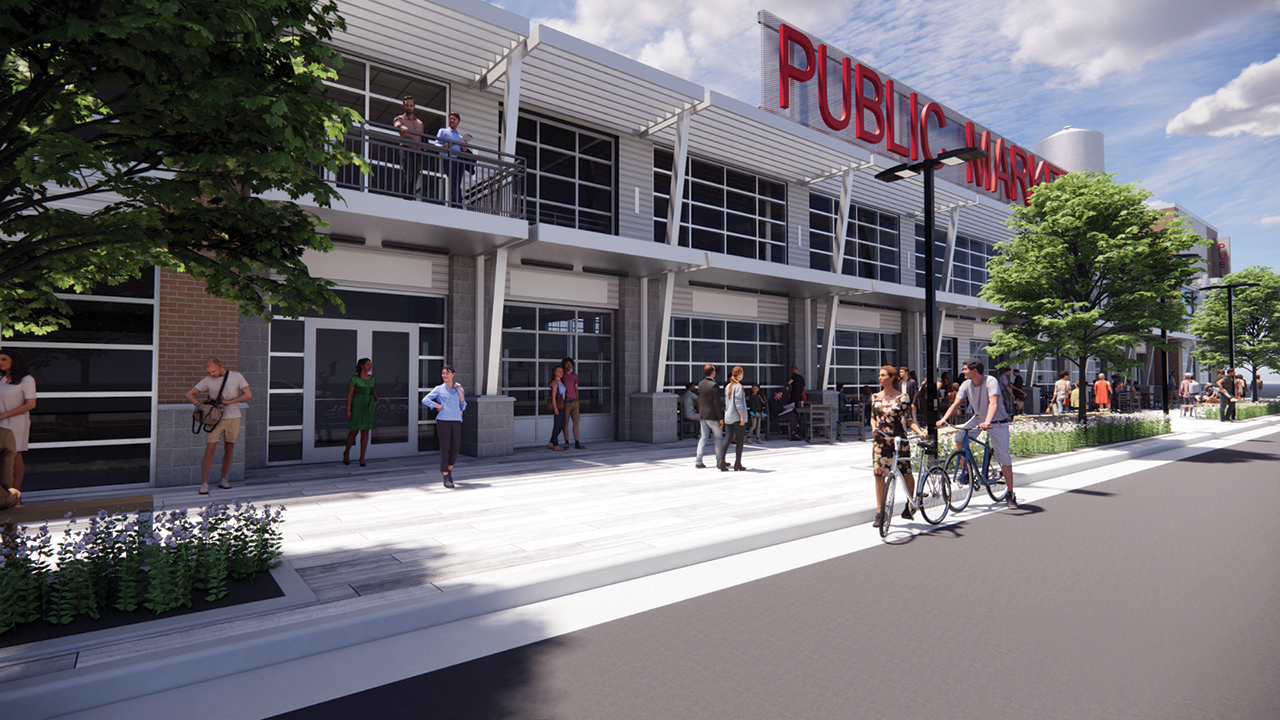
Bader says there is a lot of commercial real estate activity in the New North region. One example is the $10 million Green Bay Public Market, which is expected to draw more than a million visitors to Green Bay every year, and the adjacent $21 million apartment development.
“In Green Bay, large properties that had been vacant are almost all now repurposed or acquired,” Bader says. “The ongoing need for industrial space is a continuing story.”
Eric DeKorne of the Greater Green Bay Chamber agrees. He says the low industrial vacancy rate throughout Northeast Wisconsin is to be expected considering the region’s heavy manufacturing market, along with the pandemic, which has created an increased manufacturing demand. With increased demand, businesses are increasing capacity, which leads to reduced industrial and warehouse inventory.
“On the one hand, it’s good that we don’t have any empty buildings sitting around,” DeKorne says. “But on the other hand, it can be a little bit of a constraint for quick business growth opportunities.”
Though residential real estate claims the most headlines, commercial real estate rises and falls on the same tide.
“Rising interest rates impact all of real estate, whether you’re trying to buy a condo built in a commercial context or a developer like [me leasing] to a retail tenant,” Bader says. “Rising interest rates alter the dynamic of how those deals make sense.”