


For the third time since 2019, the Northeast Wisconsin Manufacturing Alliance surveyed its members on Industry 4.0 adoption and published the 2024 NEWMA Industry 4.0 Talent & Technology Survey, with this year’s results showing more technology investment than ever among New North region manufacturers.
But a large number are still behind the curve when it comes to implementing, or even planning for, the fourth industrial revolution. In fact, nearly a quarter (24%) of this year’s survey respondents say they have no Industry 4.0 plan at all.
“I would have expected more companies by now to have an Industry 4.0 plan, or at least a partial plan,” says Mo Abuali, senior digital director at Wipfli. “We’re seeing many companies dive into investments and do pilots — let me try this, let me try that. It’s important to assess, create a plan.”
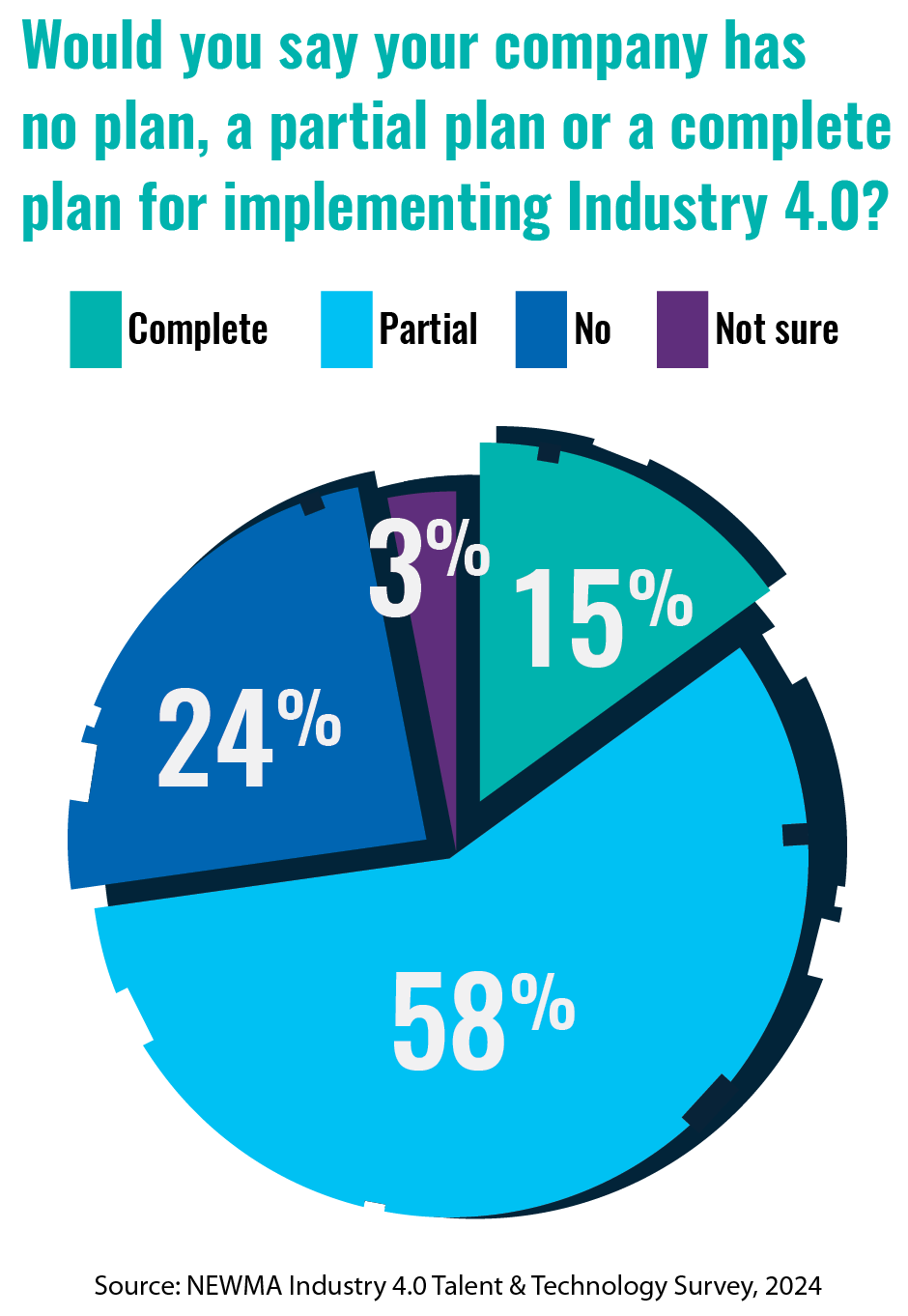
With Industry 4.0 ever-evolving, Abuali acknowledges a complete plan is never something one can just set and forget; a good plan starts with a three- to five-year roadmap, and then it’s evaluated annually.
When creating a plan, “don’t start with the technology,” cautions Aslinn Merriman, NEWMA’s Industry 4.0 task force chair. “That fades into the background,” she says. “Figure out what you’re trying to achieve and what success would look like. Understand your … North Star, but make sure to pivot as you learn.”
Abuali says planning must also include a realistic assessment of an organization’s digital maturity. Some manufacturers are dealing with legacy systems and machines on the shop floor, and some companies shouldn’t think about technologies like AI until they fix their ERPs, he says, or put their cybersecurity into the cloud.
“There’s a lot of foundational, I call it plumbing, that you need to put in place in order for these things to be built,” Abuali says. “But I think a roadmap is key.”
Weston Timmers, project manager with Werner Electric Supply, says most mid-sized manufacturers he sees have some pieces of automation equipment running on the floor, but many of them are disparate and not networked. Furthermore, many are collecting data, but manufacturers haven’t fully grasped how to use the information they’re acquiring or are stymied by cybersecurity concerns.
“Having a solid network design and infrastructure put in to help support all these tools is super important,” Timmers says. “And then to go a step beyond that, once we have a network designed and implemented, the team can do things like penetration testing and ethical hacking so we can close those doors off and make sure somebody nefarious doesn’t have access.”
Cybersecurity remains priority one
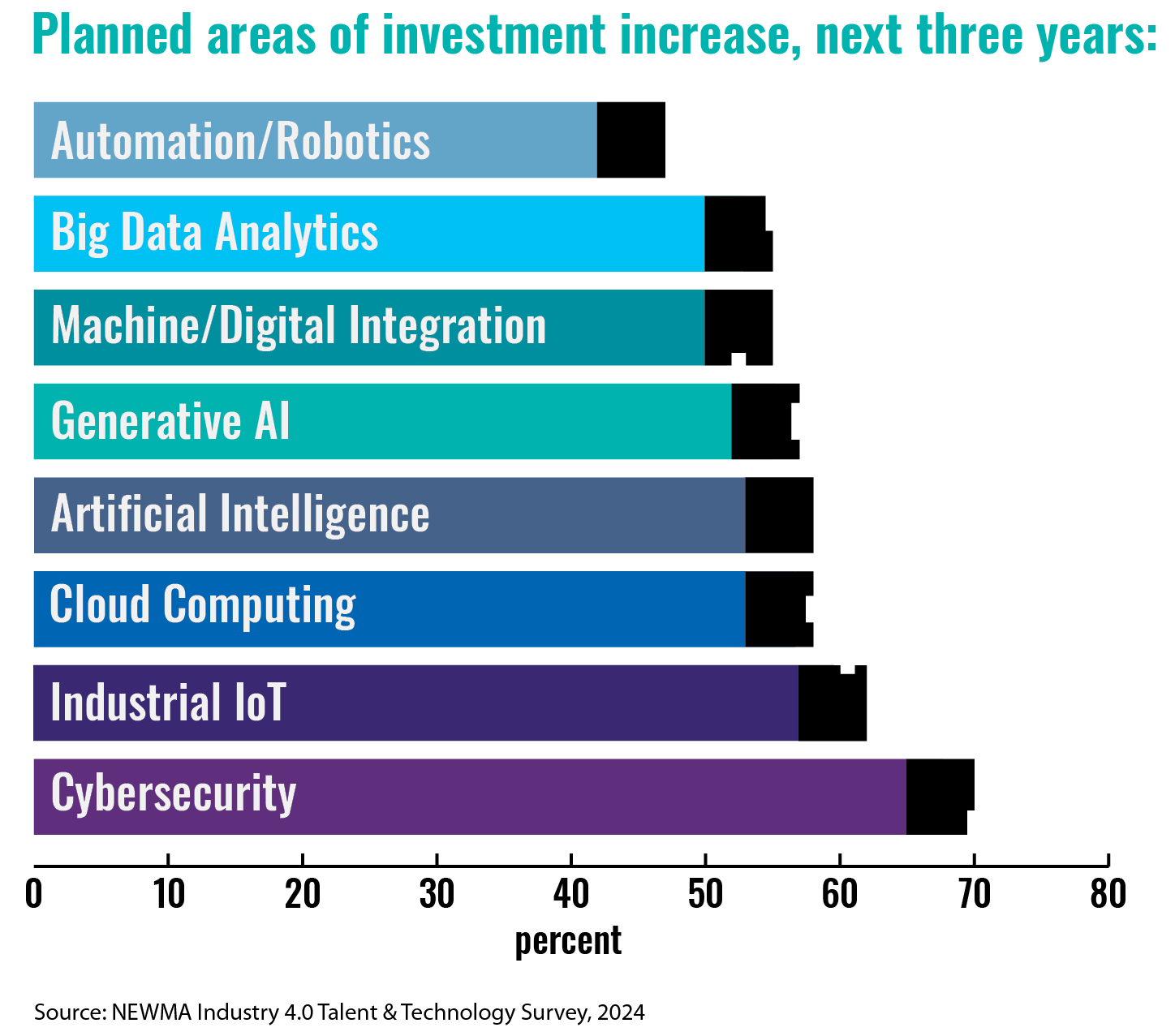
The NEWMA study asked respondents to identify their top areas of Industry 4.0 investment. Cybersecurity topped the list, with 70% of manufacturers saying they plan to increase their cybersecurity investments in the next three years. Second most cited for investment was industrial Internet of Things technology. Neither of these surprises Timmers, who says they point back to that need to securely leverage networked systems.
“Customers are at that point where, ‘OK, we know we need to start tying these things together,’” he says. “‘But how do we do that securely?’ And that’s the big question.”
Survey respondents were asked to identify the technologies they believe will have the greatest impact on their business in the near future. The survey revealed a lot of uncertainty, though 78% cited 5G wireless, bluetooth and mesh networks as high impact technologies for the next three years.
Investment in automation and robotics has declined somewhat since the last NEWMA Industry 4.0 survey (2021), points out Valerie Kretz, interim director of the Strategic Research Institute at St. Norbert College, which administered this year’s study.
To Timmers, that’s just a sign that manufacturers are not abandoning automation but rather taking it to the next level and concentrating on AI and next-gen automation equipment that can “make decisions for itself.”
Kretz says the survey clearly concluded that I4.0 technology adoption in our region is indeed widespread: “Very few are planning to decrease [investment] in any of these technologies.”
Much ado about AI
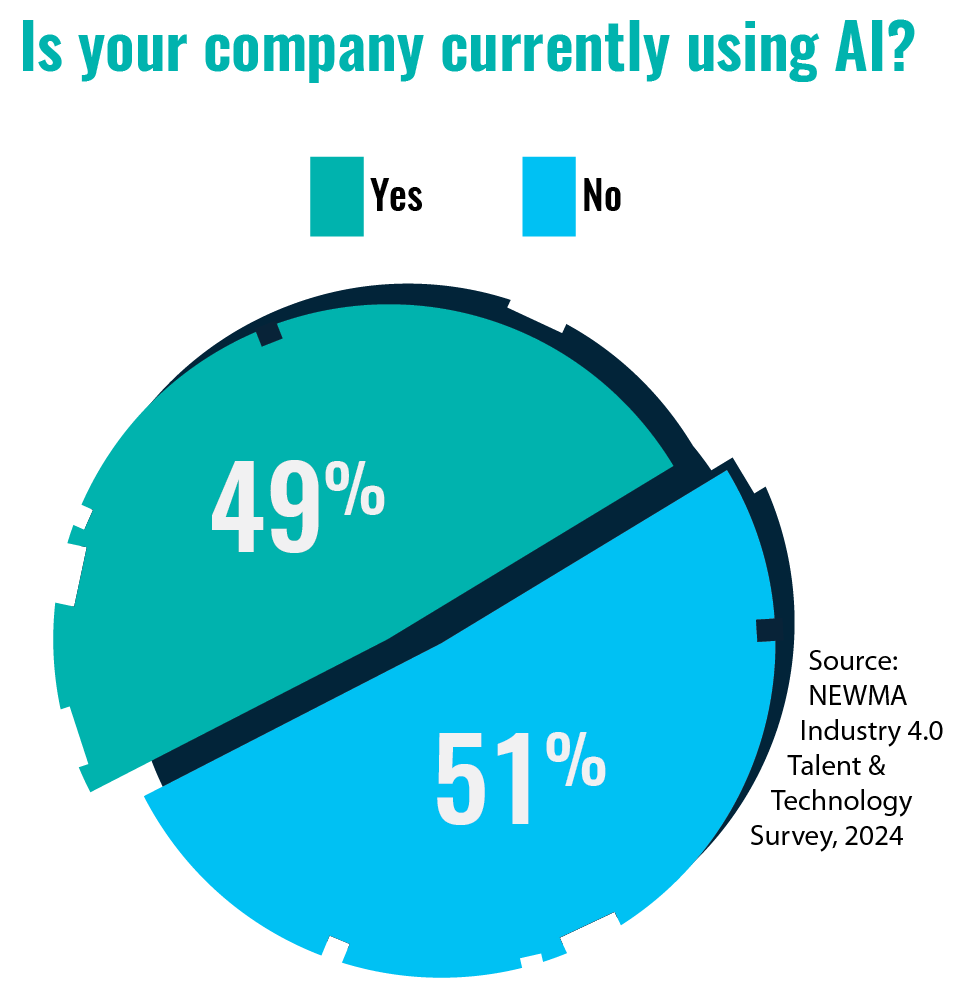
With half of the survey respondents saying their firms are not utilizing AI at all, Kretz says she felt it was important for the study to drill down as to why. The number one reason given was “lack of expertise,” followed by concerns about security and the complexity of integration.
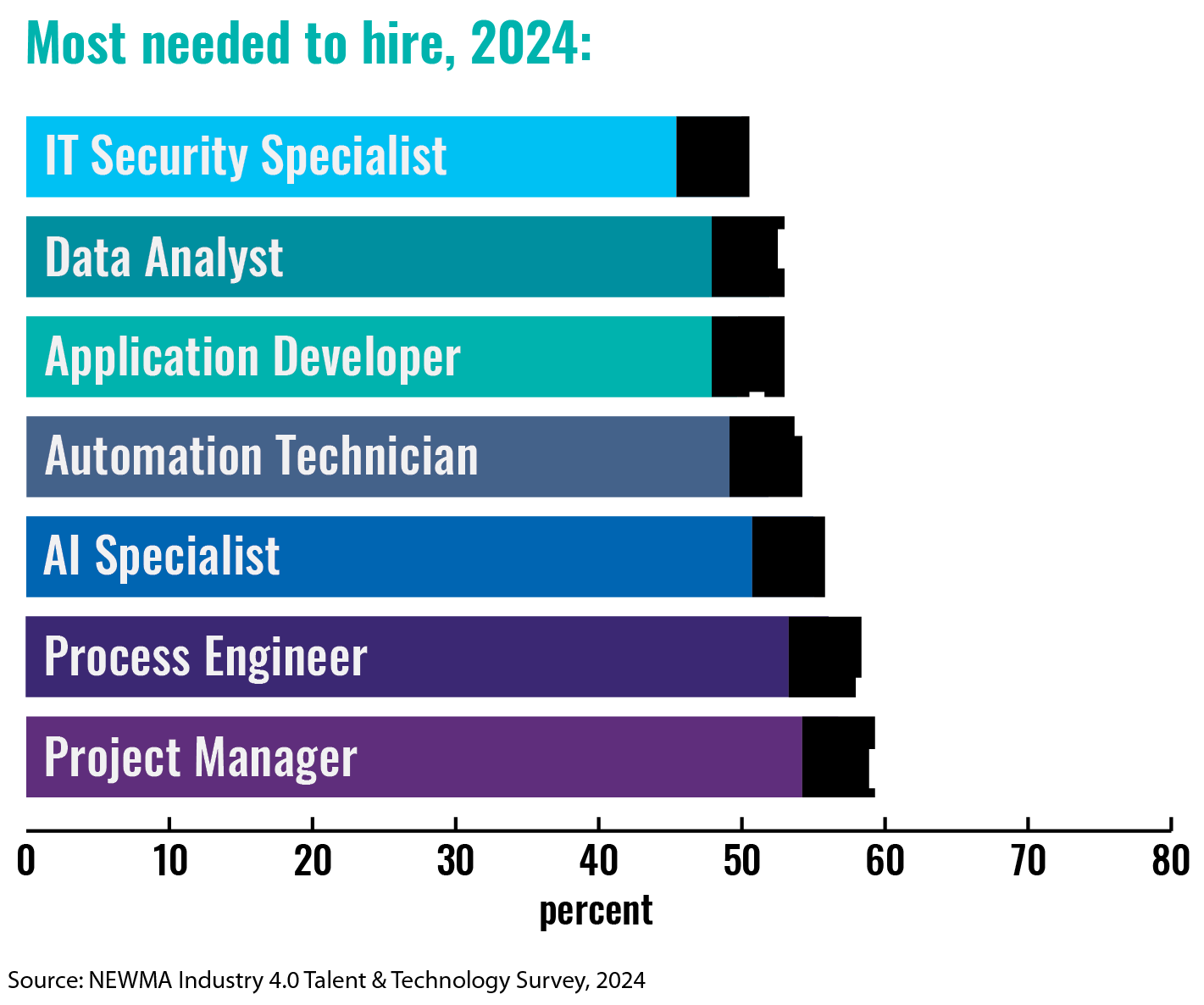
“One of the reasons folks aren’t adopting AI is because they don’t have expertise in that area,” Kretz says, noting that “AI specialist” ranked third on the study’s list of most-needed Industry 4.0 occupations.
Abuali says that, yes, hiring AI specialists is important. But it is also incumbent on workers in a wide variety of positions across manufacturing to learn about the transformational impact of AI. He says he’s watching five major trends right now: industrial machine learning, scheduling and forecasting, sustainability and ESG, connected worker applications and generative AI.
Abuali will join the NEW Manufacturing Insights podcast in July to talk more about these five trends.
“Depending on the digital maturity of a company, those five points need to be laid out in an Industry 4.0 roadmap with a clear cost benefit analysis of how to get it done,” Abuali says.
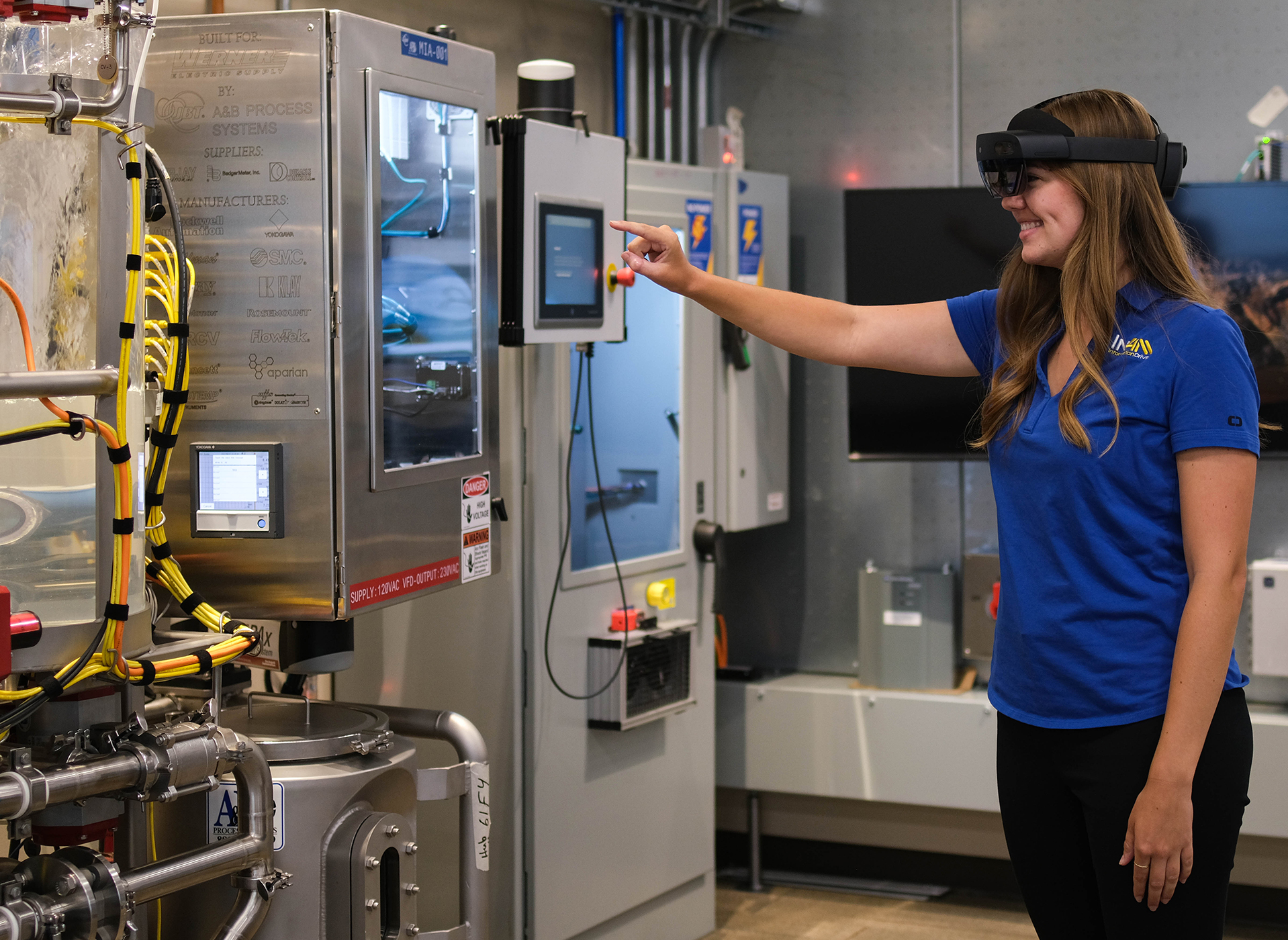
Werner Electric Supply, meanwhile, is gearing up to host its IN4M conference Aug. 20-21 at Lambeau Field. Timmers says the event will showcase Werner’s services in automation technology as well as connect manufacturers with about 50 key suppliers in a trade show format.
“We’re more than just an electrical supply company,” Timmers says. “Our name is misleading in that case, because we have a lot more to offer.”
Among the AI technologies Timmers is excited for customers to see in action at IN4M are Guardian AI, a predictive maintenance tool that alerts technicians as soon as something seems “off” in a piece of equipment, and Logics AI, which alerts manufacturers as soon as product quality gets out of spec due to issues like raw material variance.
“These are really cool AI tools,” Timmers says, “that we’ve never really had in the past.”
Help wanted
For manufacturers, the ongoing need for talent looms large, and the issue is magnified in the Industry 4.0 space. Among the most-needed positions within manufacturing companies are project managers, process engineers and AI specialists. Upskilling or reskilling employees is a top strategy manufacturers plan to utilize to fill those workforce gaps, according to the NEWMA survey.
But upskilling and reskilling is not like “flipping a switch,” cautions Merriman. Training and transitioning into new roles and processes takes time, she says, and change management is an important consideration. Furthermore, a variety of team members will often need to be involved to securely implement new technologies.
“I see the blending of OT and IT in things like vision systems, doing things with cameras to catch abnormalities, which is a really awesome technology,” Merriman says, for example. “But it’s not just one person that you would hire for that.”
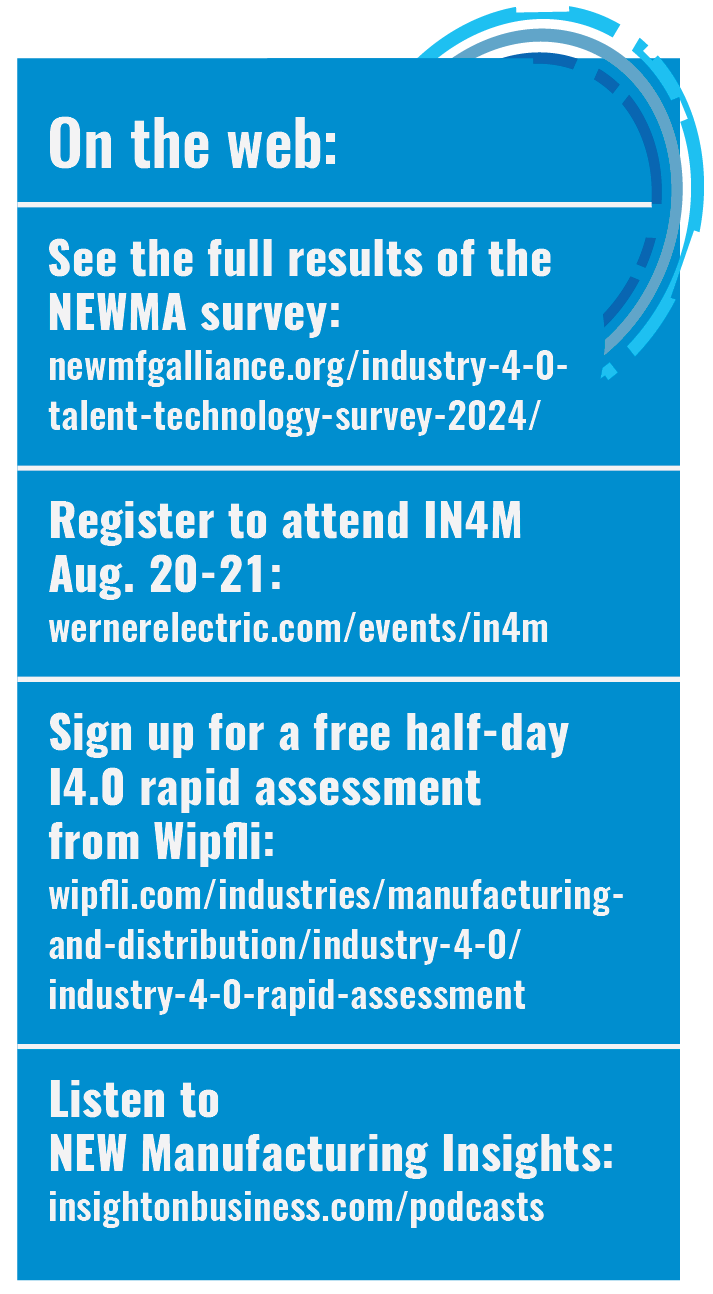
newmfgalliance.org/industry-4-0-talent-technology-survey-2024/
wernerelectric.com/events/in4m
wipfli.com/industries/manufacturing-and-distribution/industry-4-0/industry-4-0-rapid-assessment
insightonbusiness.com/podcasts
When it comes to preparing the next generation for Industry 4.0 careers, Abuali says our educational institutions have a long way to go. Exposing bright young minds to the practical business applications of cutting-edge technology as early as possible will help fill the talent pipeline and help manufacturers take the next step on their I4.0 journeys.
“How can we strengthen the collaboration between industry and academia? There’s got to be co-ops, interns, there’s got to be capstone projects, consortiums and certain events,” Abuali says, pointing to NEWMA’s work in this area as an asset to the region. “Waiting until the college level is late in some cases; starting in high school is a smart, smart idea.”