
With a projected five-year population growth rate of just 0.38 percent, Fond du Lac County is facing a demographic crisis and is taking steps now to increase that figure.
Not only is the county seeing a low growth rate, it’s also home to an aging demographic. When Moraine Park Technical College completed a demographics analysis of the region a couple of years ago, it found that within the next decade, nearly 30 percent of county residents will be retirement age. In a healthy community, that number is closer to 12 to 15 percent, says Sadie Parafiniuk, president and CEO of Envision Greater Fond du Lac.
“It’s not sustainable. We can’t find people now to fill jobs, and we’re seeing our neighbors increase population at more like 2 percent. We have got to get competitive and move forward and do something,” Parafiniuk says.

The economic development organization, which also functions as the county’s chamber of commerce, is making talent attraction and retention a priority. Its efforts include bringing on Elle Henne as director of business intelligence. With a background in industrial organizational psychology, Henne can help employers improve employee retention through assessing pre-employment and exit surveys and workplace culture.
Helping matters, Fond du Lac County weathered the pandemic’s economic fallout exceptionally well. The Fond du Lac metropolitan statistical area added 4,000 new jobs during the pandemic, making it the No. 1 MSA in the nation for job growth during that time period. It also saw the highest wage growth in the nation, which Parafiniuk says could help draw workers but also is difficult for employers to sustain.
“We’ve got great wage growth. We’ve got great career development opportunities for people. Also, that hits the bottom line for employers,” she says.
Envision is working to attract not only talent but also businesses. Its economic development team is working on eight attraction projects with the potential for 349 new jobs and eight expansion projects, bringing up to 211 new jobs.
The organization also is partnering with a developer group to build a 100,000-square-foot spec building for industrial use. Envision has created virtual spec buildings in the past, but this is the first physical space.
Fond du Lac County traditionally has been a risk-averse area, but Envision is partnering with some stakeholders to mitigate risk if the building sits vacant for a long period of time. But Parafiniuk says she’s confident that won’t be the case. “Our industrial vacancy rate is less than 1 percent, so we know there’s a need,” she says.
Fond du Lac also partnered with New North, Inc. to attain Gold Shovel Ready certification for the city’s aeronautical business park. The designation identifies the property to developers, site selectors and companies looking for suitable expansion locations. It provides upfront information that helps interested parties expedite their search, helping Gold Shovel sites stand out against the competition.
To provide more support for entrepreneurs, Envision brought startup support organization IGNITE under its umbrella. It provides services and programming to entrepreneurs, and Envision is offering a microloan program for those who are struggling to get traditional financing.
On the broadband front, Fond du Lac County was one of six communities in the state to become a part of a broadband pilot program. Envision is identifying the needs of residents and businesses, and the information gathered will better position municipalities in the county to apply for funding and grants.
Housing also is an issue throughout the county, especially affordable housing. Parafiniuk says in the future, communities could try to work with large employers to put forth solutions such as partnering to build multifamily units.
Marian, Ripon College explore partnership
Two of Fond du Lac County’s small higher education institutions are examining partnerships that could include administrative, academic and cocurricular activities.
“We’re two different schools with two distinct histories and cultures, but we’re not looking to merge — rather, find some ways to cooperate,” Zach Messitte, president of Ripon College, said when the schools announced the plan.
The schools created a task force this past spring that included faculty, staff, students and trustees from both schools. Marian University President Michelle Majewski says she hopes to see a plan come together by next spring.
Majewski says smaller colleges and universities are facing declining enrollment rates, a trend that’s expected to continue for the next several years, due in part to declining birth rates around the time of the Great Recession. In addition, education costs keep rising. Cost sharing and working collaboratively can offer a stronger and broader academic experience to students as well as more opportunities for cocurricular activities, she says.
“The days of higher education standing alone, especially smaller schools, are going away,” she says.
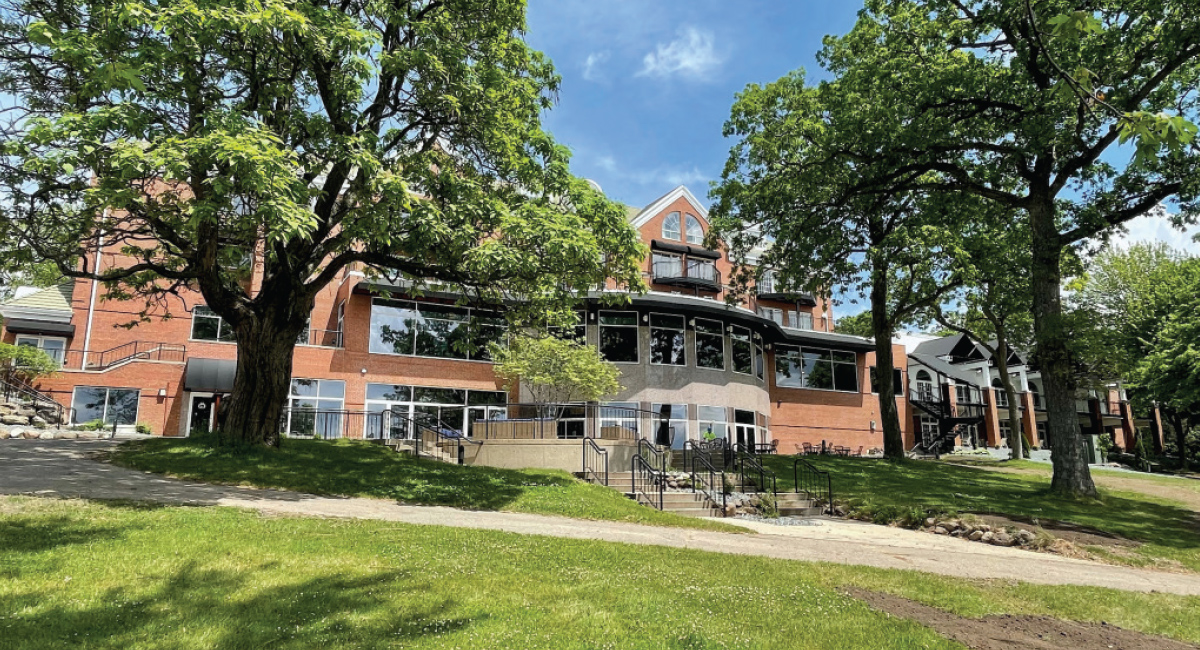
Heidel House reopens under new ownership
Green Lake’s Heidel House Resort and Hotel reopened under the ownership of Green Lake Hotel Group LLC, which purchased the 18-acre property in 2020. In April, Green Lake received a $250,000 Wisconsin Economic Development Corp. grant to help renovate and reopen the space.
The property includes two bars, two restaurants, an indoor pool, a fitness center, a game room, a gift shop, a business center and conference facilities. Guest rooms have new flooring, bathrooms, window treatments and furniture, and the restaurants have been renovated as well.
The reopening is welcome news for Green Lake, which saw its tourism dollars decrease from $42.8 million in 2018 to $36.2 million in 2019, a 15.4 percent drop, after the Heidel House closed its doors.
“I vow to make the Green Lake community proud to have the Heidel House Hotel and Conference Center back,” Heidel House General Manager Nicole Sevcik said.
In Berlin, also in Green Lake County, ThedaCare Medical Center-Berlin is adding a 9,000-square-foot emergency department that includes a larger trauma room, greater accessibility and improved access to telehealth technology.
Berlin also is creating a city wildlife area. The space will be open to the public for recreational use, and the project increases city-owned green space from 50 acres to 280 acres, says Berlin Community Development Director Lindsey Kemnitz.

