
Thirty years ago, Kerry Henning set a goal: to win a gold medal for cheddar, which his family has been making and perfecting for 111 years.
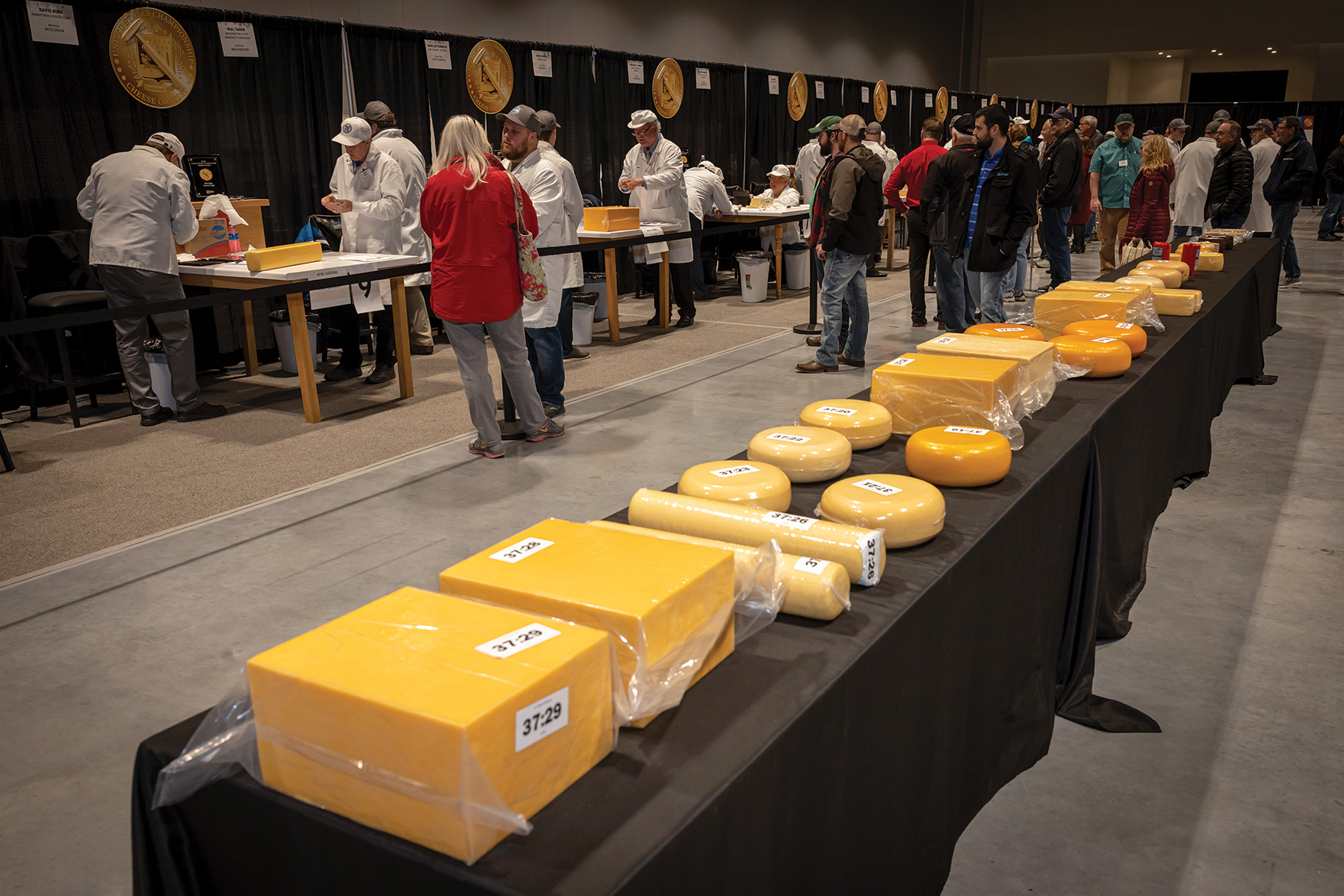
He achieved his goal, and now Henning’s Cheese is a perennial favorite in all manner of competitions. This March at the 2025 U.S. Championship Cheese Contest in Green Bay, Henning’s was a finalist for the grand prize and took home three gold medals.
“I lose track of which awards we have won, but I’m always happy,” Henning says from his blue-ribbon-lined office in Kiel. “It affirms to your customers that you’re doing a good job and are being seen as a leader of quality cheese.”
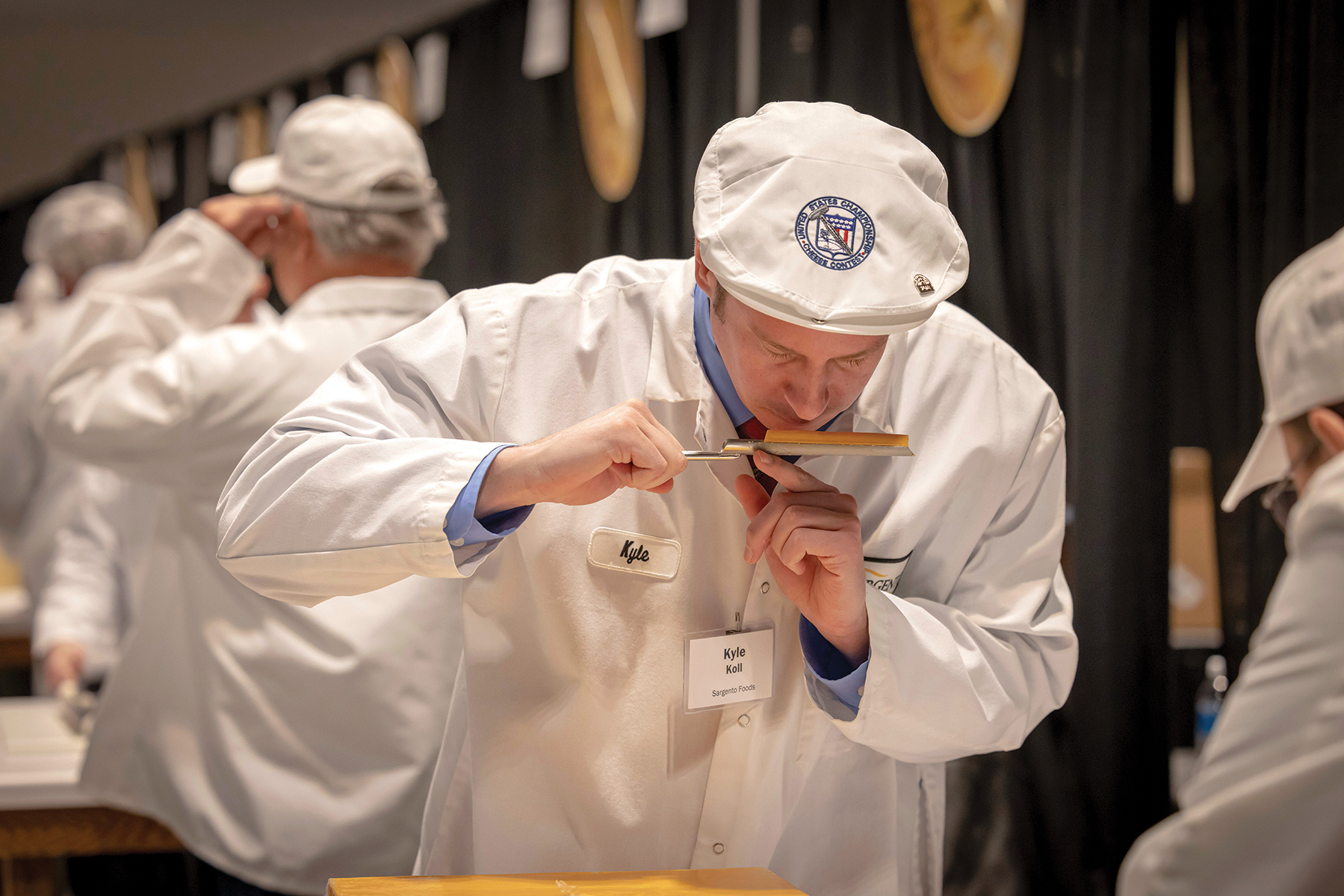
The U.S. championships and world championships are hosted by the Wisconsin Cheese Makers Association, but don’t let the organization’s name fool you — WCMA, which has members in 34 states, has been the arbiter of fine cheese for nearly 70 years. Its world championships started in 1957 and U.S. championships in 1981; the organization hosted contests dating back to the very first year it existed in 1893, says Executive Director John Umhoefer.
Why center global cheese championships in Wisconsin? Because it’s the center of the cheese universe. If Wisconsin was a country, it would rank fourth in the world for cheese production.
It’s a product that’s frequently on our minds and, well, our heads.
“We love it when people say ‘cheeseheads’ and wear cheese on their heads, because it just reinforces that this is a place that just eats, sleeps and dreams about cheese,” Umhoefer says. “If you want to buy good cheese, why not buy it from a state that’s obsessed with it?”
Birth of an obsession
America’s Dairyland was once America’s breadbasket.
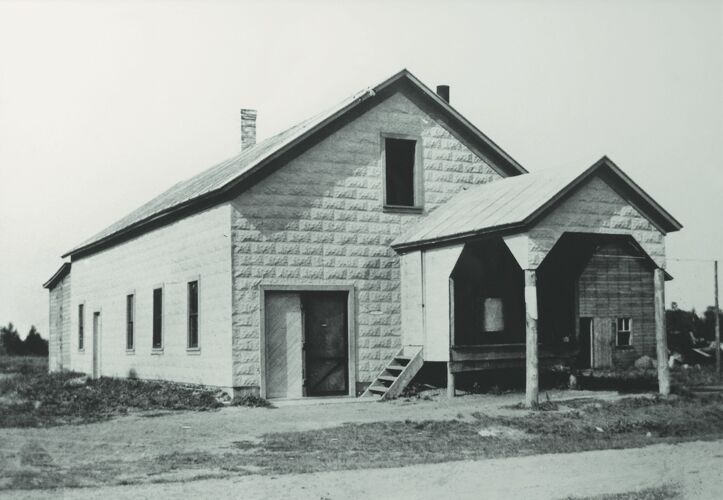
In its early days of statehood, Wisconsin’s rich soil led to the proliferation of wheat production. In fact, for a period in the 1800s, Milwaukee was the world’s busiest wheat shipping port.
In 1878, Wisconsin’s agricultural future was turned upside-down by a tiny black-and-white insect. Massive droughts of the 1860s and 1870s led to an outbreak of chinch bugs. The chinch bug, according to experts at the University of Wisconsin Insect Diagnostic Lab, on its own isn’t much to write home about — “humble, roughly an eighth of an inch long.”
But en masse, chinch bugs literally sucked the life out of Wisconsin’s wheat industry. That, says Wisconsin Center for Dairy Research Technologist Dean Sommer, left the state at a crossroads in the late 19th century. Ever eager to establish an agricultural tradition, European settlers identified the similarities between Wisconsin’s topography and soil with some of the great dairy regions from which they had migrated.
“They brought with them the traditions of dairying as well as cheesemaking, and that’s what got Wisconsin going down the road of being the cheese capital of the United States,” Sommer told attendees at a Badger Talks event in Appleton last year.
Wisconsin grabbed the U.S. title for cheese production away from New York in 1910 and hasn’t looked back. Wisconsin even imported cheese knowledge from New York; Stephen Babcock came to Madison in 1888 to chair the agricultural chemistry department at the UW-Madison Agricultural Experiment Station. Two years later, the industry was forever changed by his work when he developed the Babcock test for measuring butterfat content in milk, an innovation Babcock donated for the good of mankind.
“Talk about an idea that changed the world,” says Sommer. “Before this test farmers couldn’t tell if their feeding practices were producing more butterfat or less butterfat. Now you could pay the farmers equitably for how much butter or cheese their milk would make. This changed everything — feeding improvements came into play, genetics came into play, equity came into play.”
Sommer summarizes Wisconsin’s dairy heritage as a convergence of factors:
“We had the right soil, the right climate, the natural rainfall. We had a great mixture of immigrants coming from Europe; a passion for dairy farming and cheesemaking; outstanding farmers; and university training, research and support. We developed industry associations and infrastructure. The state of Wisconsin supported it. We had creativity and entrepreneurship, and that’s how Wisconsin became the cheese state.”
Uniquely Wisconsin
By 1922, the number of cheese factories in Wisconsin peaked at more than 2,000. In fact, Umhoefer says, there was “one every few miles” before the advent of trucking allowed for consolidation. Dairy farms also exploded throughout the 20th century. Just after the Civil War, the state was home to about 245,000 dairy cows; by the end of World War II, that number had grown to 2.5 million.
Wisconsin Dairy is more than just a brand — it’s big business, generating $45.6 billion in economic activity. To put that in perspective, Sommer points to the numbers for Florida Citrus and Idaho Potatoes: $7.2 billion and $2.7 billion, respectively.
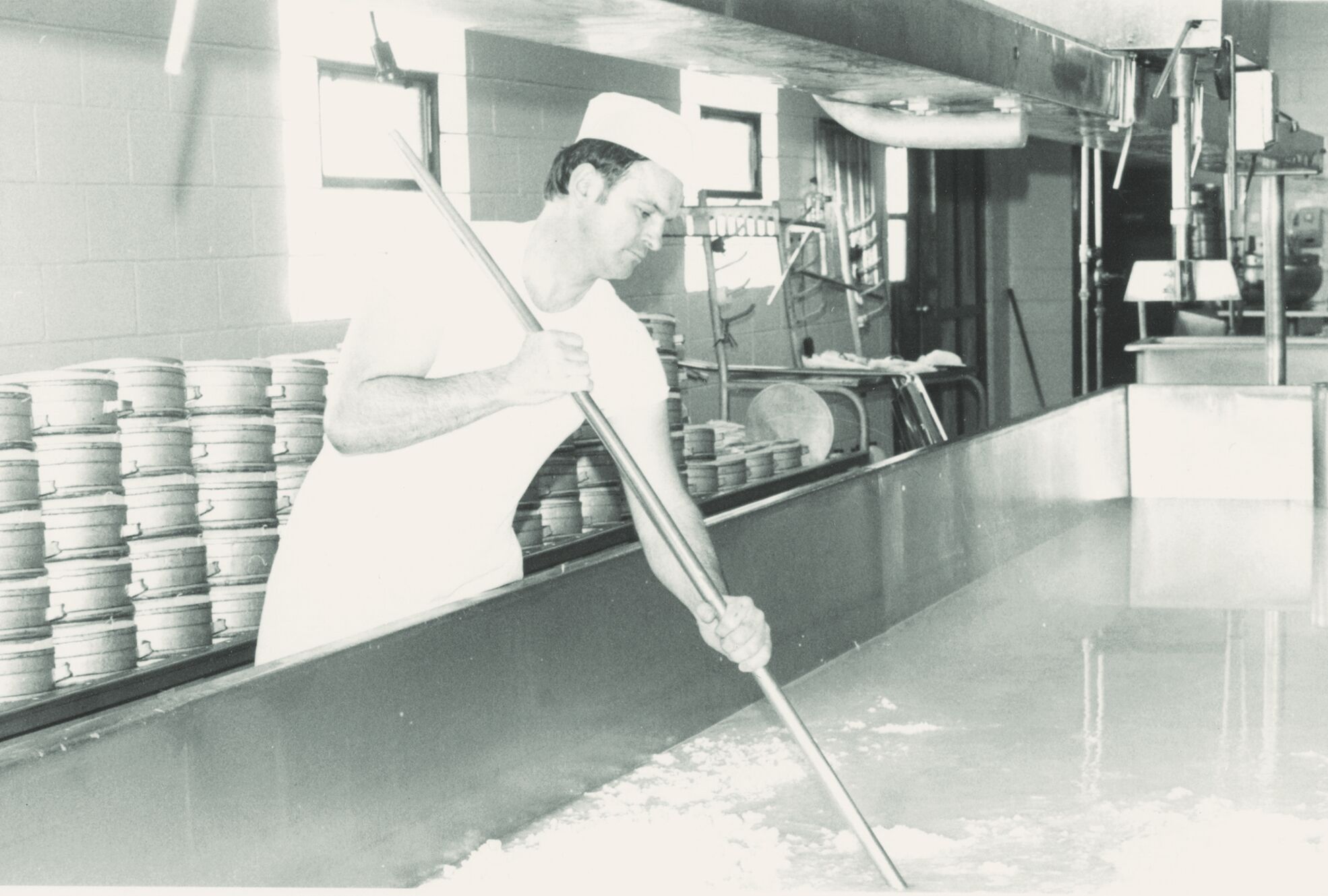
Today, says Umhoefer, there are about 120 cheese factories in Wisconsin ranging from tiny to mega. The state began licensing makers in 1916, and to this day Wisconsin is the only U.S. state that requires licensure and apprenticeship for cheesemaking. “Wisconsin originals” are cheeses that were developed in the state — these include brick in 1877, colby in 1885 and cojack in 1979.
Today Wisconsin is home to 1,200 licensed cheesemakers creating more than 600 varieties of cheese. In addition, Wisconsin also certifies Master Cheesemakers through the Center for Dairy Excellence, with only about 100 people having gone through the rigorous three-year program often referred to as a “Ph.D. in cheese.”
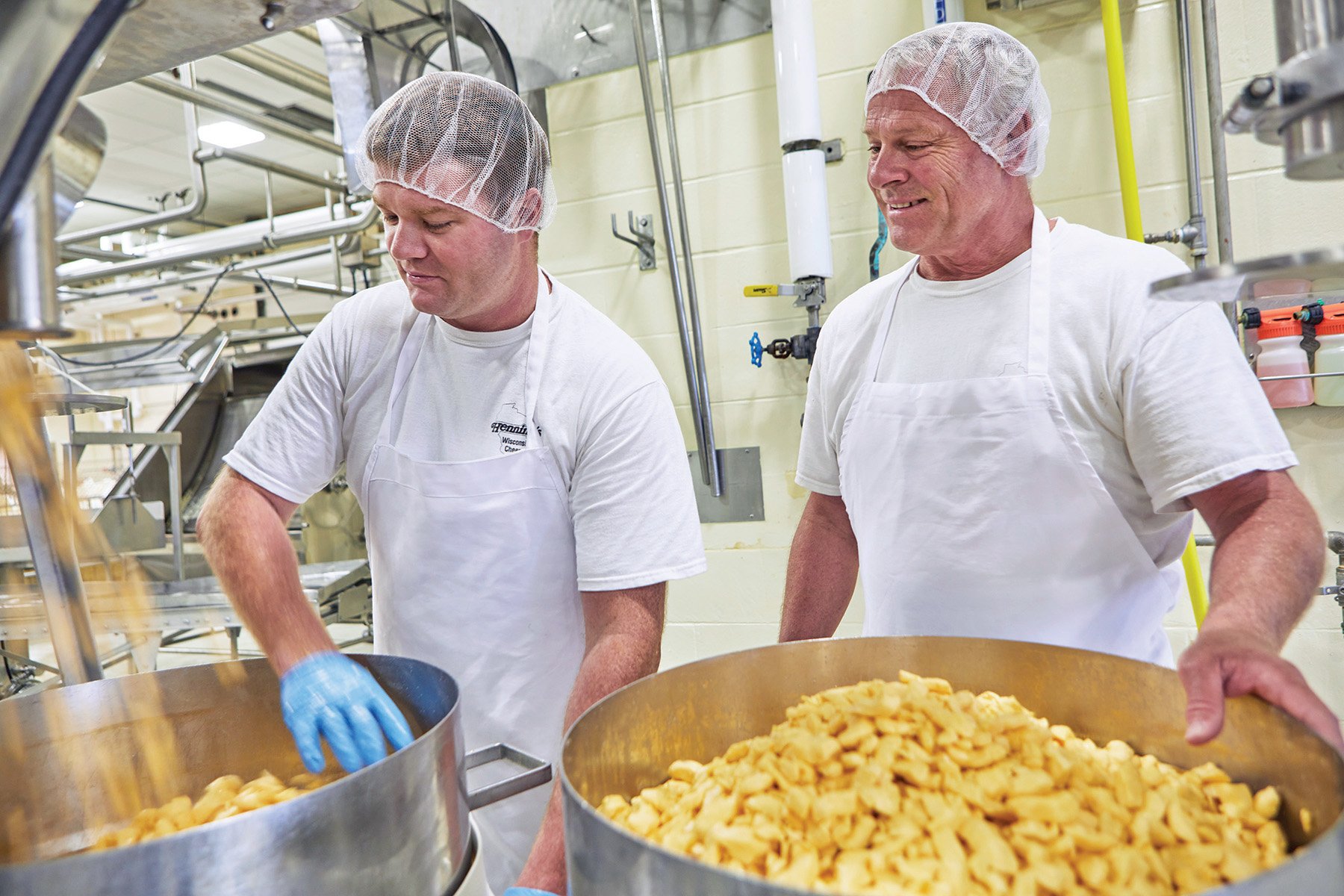
Henning is one of them. While he still makes his cheese “like my grandpa” did, he is constantly striving to get his cheddars just a little more flavorful. One of the least-appreciated aspects of cheesemaking is how much time it takes, he says.
Henning says he’s been asked by touring visitors if Henning’s is “making its 10-year cheddar today:” “No,” he says. “We made that 10 years ago.”
Henning says he hears from customers who believe the flavor of Wisconsin cheese is unparalleled and will go out of their way to source from the state. He credits Wisconsin’s focus on supporting specialty cheesemakers.
Sommer says leaning into table and specialty cheeses, like the ones Henning makes, has truly helped the state distinguish itself.
“I think what you saw happen was Wisconsin pivoted in the 1990s because there was a growth in dairy in the west and the south and more of a ranching style of dairy farming, which meant big farms served by big cheese factories. What you make in big factories is cheddar and mozzarella — those are the big cheeses in the United States,” he says. “So Wisconsin realized that if there were going to be big factories on the commodity side of the business, there also needed to be folks who could make the specialty cheeses, the value-added cheeses, and that was the niche Wisconsin really pursued. So while we do have big factories, and we still make the most cheese in the United States, it’s more diversified.”
Wisconsin’s specialty cheese industry has grown 600% since 1994, and today a full half of all U.S. specialty cheese comes from Wisconsin.
“The smaller companies can focus on unique flavors and recipes that the big players can’t,” says Henning, who counts among his best-sellers a blueberry cobbler cheese and in 2018 won world gold for his cheddar flavored with New Mexico hatch chili peppers. Customers are increasingly appreciating the joy of cheese boards and charcuterie plates, and like Wisconsin’s craft beer industry, its cheese industry has successfully implemented niche, bold flavor enhancements.
“A while back I saw a PBS show talking about Wisconsin … black garlic, and I thought ‘Wow, that might be interesting,’” Henning says. “Now we’re doing a black garlic peppercorn, and it’s just phenomenal. We’re sourcing Wisconsin garlic for that product.”
Finger on the pulse
As a lobbying and advocacy organization, WCMA prides itself on keeping abreast of industry issues, and the current global trade landscape is one of them. About 15% of the milk in the U.S. currently leaves the country in the form of cheese, whey or butter, Umhoefer says. Wisconsin cheese’s top global destinations are currently Mexico and Japan, followed by China and Canada.

“We as an industry favor free trade, because it’s been a great opportunity for dairy farmers to grow,” Umhoefer says. “Last year cheese exports surpassed 1 billion pounds for the first time ever, so we are definitely hoping for resolution of [tariff] issues so that we can keep selling cheese around the world.”
While Asian cuisine isn’t known for its use of cheese, Umhoefer says Japan and China rank high on the list because of the popularity of American culture, including pizzerias, as well as a push throughout the continent to boost calcium consumption.
“It’s new traditions people are adopting over there,” he says. “They’re trying to add that element of nutrition to their diets.”
The avian flu is another issue Wisconsin’s cheese industry is watching closely, Umhoefer says. But the news there is good: “It’s been proven time and again that pasteurization very effectively kills that pathogen,” he says. “We’re working with the government and consumers to understand that pasteurized dairy products are safe.”
There are also concerns about the rise of alternate milks and imitation cheeses, Umhoefer says, but more good news for the industry is that those markets are retracting. WCMA has increased its number of competition categories to 117 and now includes yogurt and whey classes to better reflect the breadth of dairy manufacturing. But adding a non‑dairy or vegan cheese category is not currently on the table.
“We don’t favor the idea that you can call something made from slurried elements a cheese,” Umhoefer says. “I think the message is, we’ve got a product that’s rich in calcium and protein and vitamins — a nutrient dense product. When you look at the nutrition panels, these cheese alternates [have] no protein. When they use our word, the word that’s been used for 2,000 years, and don’t deliver the same product, that’s confusing for the consumer.”
‘It’s a calling’
Henning describes Wisconsin’s cheesemaking community as tight‑knit and collaborative. He says continuing education opportunities and organizations like the Center for Dairy Excellence make it even more so.
The center was established in 1976 by the University of Wisconsin as the Walter Price Cheese Research Institute; it recently completed a $70 million addition to its facility in Madison. Sommer points out that two-thirds of the center’s budget comes from dairy farmers and processors — not taxpayers, reflecting the industry’s passion for excellence, continuous improvement and educational access.
And while today the center is a sparkling physical presence, “they make house calls,” Umhoefer says: “They will come into your plant and work with you on a cheese. They really are like doctors on the call in our industry.”
Among the cheesemakers the center has supported in the New North region are Appleton’s Red Barn Family Farms, a small-batch maker that ended up snagging first runner-up at the 2023 U.S. Championships for its vintage cupola, and Seymour Dairy, which produces gold‑medal blue cheese. Sommer says Seymour Dairy started in 2003 with two employees who wanted to learn how to make blue cheese and grew to more than 50 within seven years with the center’s support; it’s now the second-largest blue cheese factory in the U.S.
Umhoefer says cheesemaking is an art form, and attracting talent and new ideas to the industry is important in sustaining Wisconsin’s place at the top.
“Ours is an industry that takes work, takes skill, and you’ve got to find people that are willing to do the work,” Umhoefer says. “And I think there’s a great reward because you’re making food; you’re making something you can take from grass all the way to the consumer’s plate.”
Henning admits he could talk about cheese all day. This is the passion Umhoefer says has kept him in his role since 1992.
“If you’re hanging out with [cheesemakers], they do not think they have a job — it’s a calling. It’s amazing. They just eat and breathe cheese. People who create things are always interesting,” Umhoefer says. “You know, I’ve always said this industry has an opportunity to really explode in so many directions and go beyond the basic cheeses, and that has happened. It just keeps opening doors for people who want to do something interesting with their lives and jump into being creative.”