
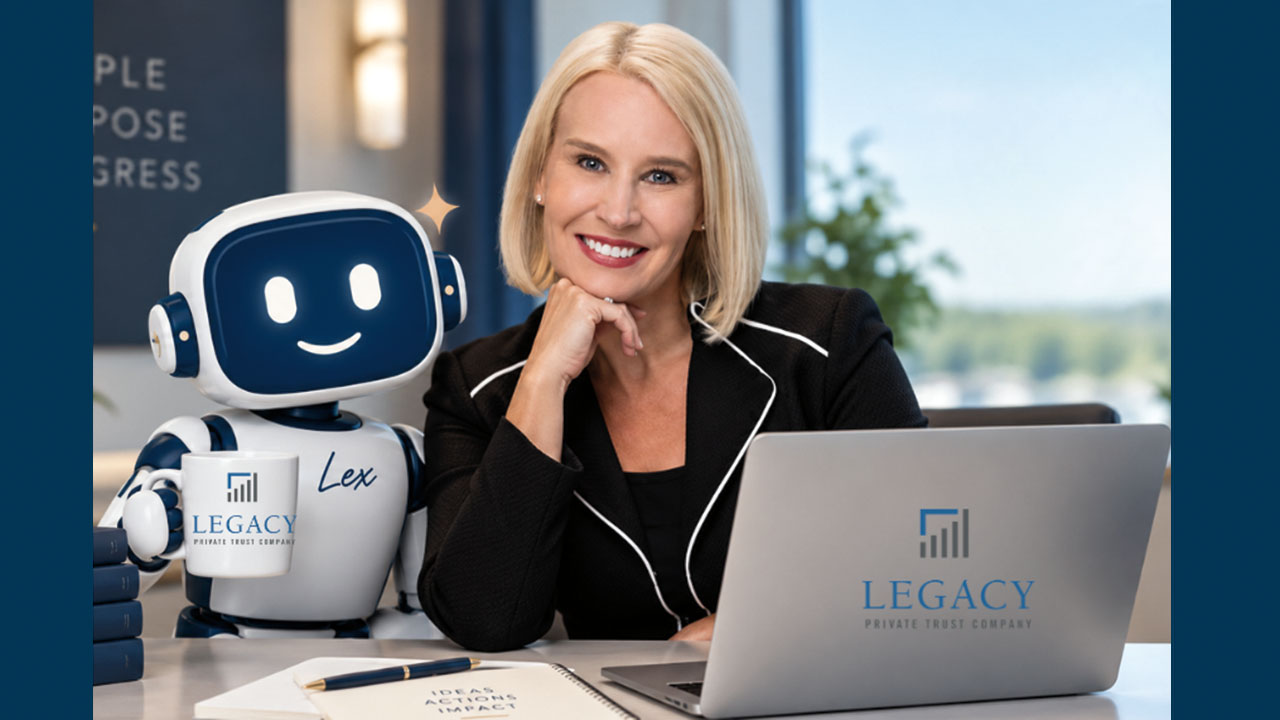
Artificial intelligence is reshaping how organizations think about work, information and productivity. I believe the more important question is not simply what AI can do, but what an organization chooses to do with the capacity it creates.
At Legacy Private Trust Company, our answer is clear: use technology to create more time for the relationships, judgment and stewardship our clients expect.
That philosophy began with leadership. Our president Michael Mahlik recognized early that AI could be more than another technology initiative. His vision challenged us to rethink how an independent trust company could operate — where technology could remove friction, make knowledge more accessible, and allow our people to devote more time to clients and complex decision‑making.
Our team took that challenge and ran with it.
We learned quickly that meaningful AI adoption does not begin with technology. It begins with the information behind it.
Three years ago, we launched LegacyConnect, our company intranet. That effort required us to examine how years of policies, procedures, reference materials and institutional knowledge were structured, stored and accessed. We reviewed, organized, cataloged and indexed that information while identifying redundancies and inconsistencies.
That foundation became critical when our team developed and deployed Lex, Legacy’s internal AI assistant.
Consider how to book an asset in our trust accounting system. Previously, an employee might search shared files, determine which procedure applied and work through the instructions.
Today, that employee can ask Lex. In seconds, Lex can provide step‑by‑step guidance and direct the employee to the underlying procedure.
The procedure still governs. Professional judgment still matters. What has changed is how quickly our people can get the right information.
The same applies to more technical work. Rather than beginning with pages of tax code or reference material, employees can use Lex to identify the relevant provision and move directly to the authoritative source. AI accelerates access; our professionals remain responsible for analysis, interpretation and judgment.
Our teams are also using AI‑assisted development tools to improve LegacyConnect, workflows and internal processes that might once have required outside development. The benefit is not simply cost savings. It is speed, ownership and adaptability — with the people who understand the work helping design the tools that support it.
None of this happens without discipline. Our AI Innovation Team evaluates new capabilities for security, confidentiality, compliance and fiduciary responsibility while driving education and adoption across the firm.
That is where independence becomes powerful. We can move quickly, but responsibly and thoughtfully. We can build internally, adapt rapidly and remain grounded in the standards expected of a fiduciary entrusted with complex and multigenerational wealth.
The organizations that lead in AI will not simply have the most technology. They will have the clearest purpose for using it.
At Legacy, that purpose is to create more capacity for the work that cannot be automated: judgment, perspective, trust and relationships.
That is where we believe the real advantage lies — not in replacing people, but in giving exceptional people more time to do exceptional work.
About the Guest Author

Candy Thurs, CTFA, CWS® — Senior Vice President, Legacy Private Trust Company