

Ubicept SNAPSHOT
| Industry |
Computer vision software |
| Venture capital investment |
>$1 million |
| Staff size |
10 full-time |
| Year of origin |
2021 |
| Headquarters |
Boston, MA |
| Revenue sources |
Computer vision software |
| Business classification |
C-Corp. |
While a grainy photograph can be nostalgic, people tend to expect more of images and video in the age of high-resolution cameras and AI enhancement — especially when it comes to security, road safety and other high-stakes applications.
In 2021, Sebastian Bauer started Ubicept, a University of Wisconsin-Madison spinout that has since established a headquarters in Boston but retains an office in Sun Prairie, with the goal of sharpening how computers process images.

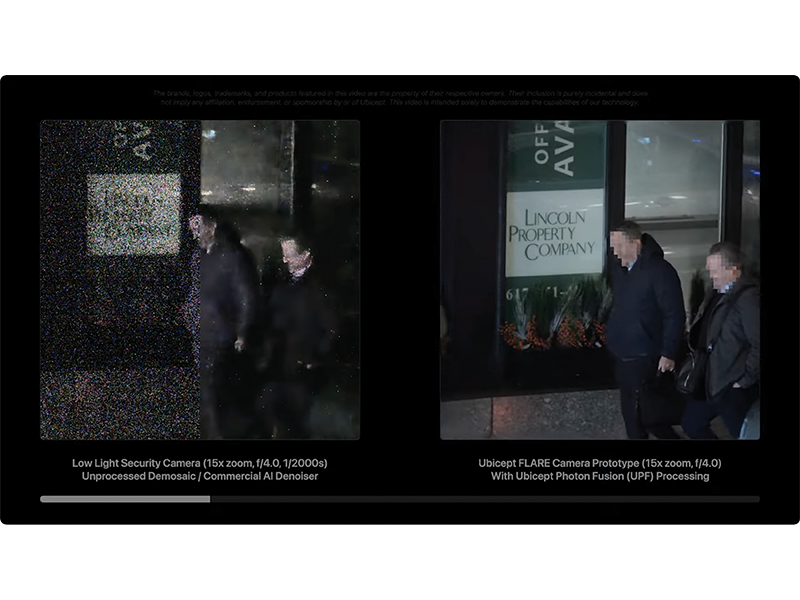
Bauer, the company’s CEO, and Tristan Swedish, its chief technology officer and other co-founder, developed a software to address what they call “the impossible triangle” faced by conventional imaging systems: the struggle to optimize low light, fast motion and high dynamic range.
The company’s physics-based computer vision technology aims to “revolutionize how machines perceive the world,” Bauer said, overcoming these obstacles and generating higher-quality images.
“Think of a car that has a camera on it for driver assistance systems, and that car is in a dim tunnel,” he said. “Then it’s going out into bright sunlight, and it’s blinded.
“These systems need to be able to work reliably in (dim) light but also in bright sunlight. The same holds for delivery robots, for drones and … robots on the shop floor. … At this point, image sensor quality output is not good enough.”
The company is looking to address this issue for machines used in areas like manufacturing and quality assurance.
“The cameras and vision algorithms we use today capture images in the form of pixels and frame exposures,” said Andreas Velton, an associate professor at the UW-Madison and Ubicept’s founding adviser. “Real light is made up of photons. We can now directly measure, digitize and process these photons, and that allows us to improve every aspect of a camera to make it faster, more light efficient, smaller and more energy efficient.
“In the transition from processing pixels to processing photons, every part of the vision pipeline from sensor to final pattern recognition will change.”
Last April, the company secured $1 million when it won the TitletownTech Startup Draft in Green Bay. Bauer said the milestone catalyzed additional fundraising, and he believes Ubicept is well-positioned to take its software to market and begin generating revenue.
Ubicept has 10 full-time employees, and like many young companies, it has faced challenges in establishing its customer base and refining its business model.
“There are three kinds of startups,” said Bauer. “That’s a gross oversimplification, of course, but on the one hand you can have startups that have a business idea, they are funded by somebody who works in the industry and thinks, ‘There are processes that I can do better.’ So they know immediately what their problem is (and) immediately what product to build. … They’re able to generate revenue really quickly.”
University spinouts, however, are another animal, he said, sometimes starting with the seed of an idea but an unclear direction or commercial application for it. These companies’ primary risks are typically technology- or market-related, he said.
In the first case, “there is no need to search for a customer because when you succeed (in building the technology), the customers are there already,” Bauer said. Whereas in Ubicept’s case, where the technology has been developed, “The difficulty is to find the customers … (and demonstrate) sufficient commercial attraction.”
One positive move was a collaboration with Continental Group Sector Automotive (now called Aumovio) last summer. Aumovio’s sensors are integrated with Ubicept’s software to improve autonomous vision in low-light or poor weather conditions — especially for object detection.
As Aumovio is among the largest automotive tier one suppliers, providing technology to automakers, this means “the market is taking us seriously, and we’re making good progress,” he said.
Just last month, Ubicept also released the Ubicept Toolkit, which makes its imaging technology available to virtually any modern vision system for a broad range of applications, from robotics to automotive to industrial sensing.
The software is compatible with sensors commonly used in digital cameras, and the kind currently used by Aumovio, as well as sensors used in robotics, security cameras, automotive LiDAR (Light Detection and Ranging) and more.
“This Toolkit is a general customer tool that we can roll out in a more automated way… to engage with customers quickly,” said Bauer.
While it sets up the company for short-term growth with its broad applicability, the company’s long-term plans are focused on single-photon image sensors. These sensors are very sensitive and produce highly precise images.
The idea to use such advanced sensors when the company first formed was a “super rough, vague guess back then,” Bauer said. “And there were lots of questions on the hardware side: Ubicept doesn’t make any sensor chips, any piece of silicon. … How big do these chips need to be? How expensive? How much electrical power would (they) consume?”
A breakthrough related to the technology occurred last spring, when Canon announced a single-photon sensitive image sensor for automotive applications. Bauer said this represents a win for Ubicept as well.
“That’s a really, really big deal because the industry also has realized our vision to some extent,” he said. “We know how these sensors can be used and provide extremely crisp imagery essentially in all environments. … Now we see that the hardware is getting ready, and it’s a huge move forward for the industry because Canon is putting a stake in the ground, (saying) we believe in the sensor technology, and we think that it’s commercially valuable to us.
Meanwhile, “the rest of the industry is using conventional sensors,” Bauer said.
Bauer hopes single photon sensors will become dominant in the years ahead. For now, he wants to have Ubicept’s software in the hands of as many people as possible.
“Ubicept is really at the heart of this transition … to a new way of basically doing vision where you process things in units of photons,” said Velton. “And that could change everything.
“I’m optimistic. I feel like a lot of the cameras we have today … could be replaced as a technology in the long run. Early on, it’s going to be a few high-demand applications, but it’s just a better way of processing light because light happens to be made up of photons and we have been ignoring that.”
For now, the company is prioritizing its Toolkit, its partnership with Aumovio and another collaboration Bauer said will be announced in the months ahead.
Bauer also noted growing traction in applications of the company’s software beyond the automotive sphere. Such areas include infrastructure inspection, where the technology could aid cameras that help detect cracks or buckling on roadways and reduce the manual labor needed for such efforts.
“With manual labor … it’s very expensive and tedious,” Bauer said. “If you have automated image classification, which kind of screens the asphalt and (says), ‘Here’s a crack, here’s some unevenness and this needs fixing,’ and automatically flags that and puts it into a database with a map, then that’s perfect.”
He said diverse near-term applications will allow Ubicept to gain revenue while forecasting higher numbers down the road with longer-term partners.
“We are preparing to roll out our product offering to the broader market,” he said, “and we really are about to get into repeatable and scalable sales.”
“I think (Ubicept’s technology) is going to be a game changer for many in the spaces that rely on vision in challenging conditions — low light, fast motion,” Velton said. “We’re actually at the point where what we can see on the camera is better than what you can see with the human eye.”
Ubicept

