


Wisconsin Manufacturers & Commerce asks two key questions in its biannual Wisconsin Employer Survey: “What is the one thing state government could do to help your business?” and “What is the one thing state government could do to improve Wisconsin’s business climate?”
In the most recent survey WMC saw a record 41% say their top priority on both fronts is to “make health care more affordable.”

“Typically reduce taxes or reduce regulation, or vice versa, [would be] the number one and two responses,” says Rachel Ver Velde, WMC’s associate vice president of government relations and senior political advisor. “Over the past couple of years we’ve seen ‘make health care more affordable’ rise up on the list, and now it’s by far the top issue for our membership.”
The rising cost of health care is a nationwide problem. Brian Meyer, director of analytics and underwriting and partner for the Madison-based insurance brokerage and risk management firm M3, says the price of health care is rising at a rate of about 7% per year, with no signs of slowing down. While reasons vary, Meyer says the biggest contributors to rising costs are currently orthopedic surgeries like joint replacements, cancer surgeries and medical channel specialty drugs.
“Some of it is an aging workforce; some of it, to a smaller degree, is surgeries that may have been delayed because of COVID,” Meyer says. “And then the cost of the actual procedures has continued to rise with health care inflation.”
The national picture is grim, but statistics bear out an especially stark level of rising concern within the state of Wisconsin. In the last year, nearly half (44%) of Wisconsin businesses told WMC they have seen their health care costs go up by double digits. More than half (54%) of businesses with locations in multiple states say their costs are higher in Wisconsin than other locations, according to the Wisconsin Employer Survey.
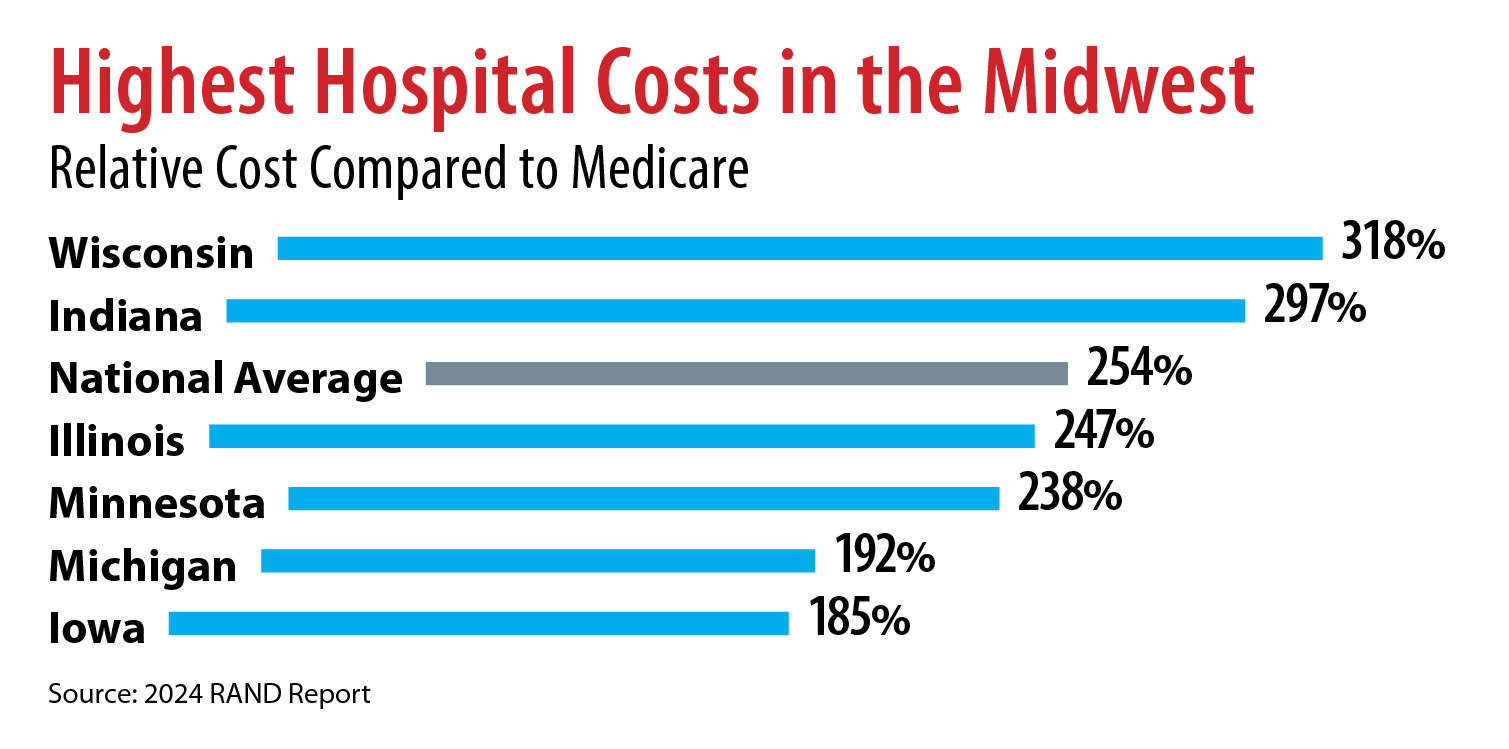
Hospitals play a significant role in the rising cost of health care among the privately insured population, and Wisconsin’s hospital costs are the nation’s fifth highest, clocking in at 318% of Medicare rates — 64 percentage points ahead of the national average.
The nonpartisan, nonprofit research organization RAND says hospital mergers are a key driver of rising hospital costs. Wisconsin has seen four major health system mergers (Gundersen and Bellin; Advocate Aurora and Atrium; Marshfield Clinic and Sanford Health; Froedtert and ThedaCare) in the last five years alone.
Also affecting employers’ pocketbooks are Wisconsin’s workers compensation medical payments, which are among the highest in the country. Among 36 states that were included in a study by the Workers Compensation Research Institute (WCRI), Wisconsin had the second-highest costs — with an average claim cost 39% above the median, driven in part by a higher proportion of hospital-affiliated versus nonhospital facilities or specialty clinics, according to WCRI’s study.
Another factor driving up the cost of workers compensation in Wisconsin is the fact that it is one of only five U.S. states that doesn’t operate on a fee schedule tied to Medicare reimbursement rates.
“The only effective way to contain costs is with a medical fee schedule,” Ver Velde says. “Forty-five other states around the country have [them], and when you look at the research you see that the states with the higher costs are the ones without the medical fee schedule.”
In February, Gov. Tony Evers outlined policy proposals aimed at tackling Wisconsin’s high health care costs, including making Wisconsin the first state in America to audit insurance companies that deny health care claims, cracking down on prescription drug price gouging and limiting insurers’ use of “prior authorization” requirements. In March, Wisconsin Assembly Bill 173 was introduced with the intention to regulate pharmacy benefit managers, or PBMs. Sponsors of the bill like Sen. Mary Felzkowski (R-Tomahawk) have said reining in PBMs will help contain costs.

But Renae Langel, vice president of human resources with the Kaukauna-based logistics company Midwest Carriers, is among the bill’s opponents. She says employers that developed innovative solutions to combat the rising cost of health care, including self‑funded plans, will be undermined by the regulation.
“Employers in both the public and private sectors are constantly seeking ways to control rising health care costs while maintaining quality care for their workers,” Langel wrote in a letter to legislators. “This bill ties their hands, increasing long-term costs and reducing flexibility.”
The flexibility of self-funding
The passage of the Affordable Care Act (ACA) 15 years ago gave rise to a trend in employer-based health insurance: the self-funded plan, which allows employers to use their own funds to cover employees’ medical claims rather than purchasing traditional insurance. According to a 2024 Kaiser Family Foundation analysis, 79% of workers in organizations with 200 or more employees are enrolled in such plans. For many, self-funding leads to greater flexibility, the avoidance of certain ACA‑related costs and regulations, and care that is actually better for employees.
For Langel, self-funded health care has become a passion.
“Before I came to Midwest [Carriers], I had been kind of blind to the way health care worked,” she says.
With the self-funded plan, the company has been able to eliminate deductibles and introduce free direct primary care clinics for employees. Midwest Carriers also incentivizes employees to shop around for specialty care, which in the case of one employee saved $30,000 on a knee replacement surgery, Langel says. Above all, the company is equipped with the information it needs to make informed decisions in the best interests of workers.
“We can see where people are needing additional education or resources,” Langel says. “We can really work with our insurance company on what we need to do to make a plan better. When you’re in a fully-insured plan you basically listen to your broker and they say … this is the best we can do. There’s so much more transparency on the self-insured side.”
Stevens Point-based manufacturer Gamber-Johnson, which has been ranked among the Top 100 Healthiest Workplaces in America, is included as a case study in the WMC Foundation’s December 2024 report, “An Arm and a Leg: Reforms and Best Practices to Make Health Care More Affordable.” In the report, the company is lauded for its use of data to lower health care costs while at the same time improving care.
“By utilizing data from its own claims and other information provided by partners, Gamber-Johnson has been able to review common procedures and find providers that offer quality care at more affordable rates,” the report states. “The team at Gamber-Johnson says disruption to the current health care system is necessary to improve care and bring down costs. That is why they have worked to educate their employees about how the system works. It has helped to encourage them to be proactive when it comes to care. By being more aware of costs and how it can impact them as individuals, the Gamber-Johnson team has been able to significantly lower its overall health care costs while ensuring employees are well taken care of.”

Phillip Blair, Gamber-Johnson’s vice president for human resources, says the company operates on a three-tiered medical plan.
“We have in-network and out‑of‑network, but we essentially have inserted a tier before in-network, which is our list of preferred providers,” Blair says. “These preferred providers meet our metrics for, first and foremost, quality — then they have to meet our metrics for transparency, price and access. If our employees use our list of preferred providers, which range from primary care to specialty care, they have [little to no] cost.”
Solstice Health, which lists surgery prices directly on its website, Anovia Health and M3 are key partners with Gamber-Johnson, Blair says.
“I think when employers have the right partners that are actually of like mind and helping to control the costs for health care, you can produce some phenomenal outcomes,” Blair says. “It’s a good testament that, within Gamber-Johnson, our number one favorite employee isn’t even an employee of Gamber-Johnson: It’s our on-site nurse, who works for Anovia Health.”

Meyer says predictive analytics, AI and machine learning have been “changing the game for employers to take back a little bit of control of their spend.” And those technologies are easier to access in a self-funded environment, he says.
“At M3 we try to strike the right balance, where our clients can utilize these tools themselves, but we help train and coach them on what to look at,” says Meyer, who admits calculating ROI on health care spend and identifying trends within an employee population can be a heavy lift. “It’s definitely something that’s increasing: employers wanting to align to a wiser health care consumer.”
Policy solutions
Ver Velde says one in 10 Wisconsin employers has considered relocating or expanding outside of the state because of high health care costs. Sixty‑four percent of Wisconsin Employer Survey respondents said they would be forced to increase employee contributions to health care in response to high costs, and 35% identified increased deductibles as a likely response.
“We had one employer tell us that … they had one employee who got diagnosed with a condition that [required] a million-dollar drug, and that diagnosis for that one employee wiped out all of their bonuses and all of their raises for all their staff,” Ver Velde says.
Prices are out of control, but price transparency is a key policy issue that can and should be addressed, Blair says.
“Health care is one of the few areas where you ask what the cost is and it’s said, ‘I can’t tell you; that’s proprietary information,’ or ‘You’ll find out when you get a bill in the mail,’” Blair says. “I think there are a lot of issues with how the system runs today, but transparency is vital to understanding how the current insurance complex is running.”
Federal price transparency rules were enacted in 2021, but studies show only 46% of hospitals nationwide are compliant — a mere 30% in Wisconsin. Due to this lack of compliance, states including Colorado and Texas have taken bipartisan action to codify price transparency requirements into state law.
“[Hospitals] are charging 18 different paying parties 18 different rates for the exact same procedure,” Colorado Gov. Jared Polis said at a July 2024 event hosted by the American Legislative Exchange Council. “Until now, that has all been in a lock box in the CFO’s office … We opened up that lock box to make sure that we have one of the first and one of the strongest hospital pricing transparency laws.”
President Donald Trump issued an executive order Feb. 25 urging health insurance providers and hospitals to come into compliance with the federal law. WMC and Ver Velde issued a statement of support for the action:
“We will never be able to lower prices unless we allow patients to make market‑based spending decisions based on cost and quality,” Ver Velde wrote. “But they cannot do so when prices remain hidden.”
Ver Velde says WMC is in favor of a statewide price transparency law, as well as Wisconsin implementing a medical fee schedule for workers compensation. The organization also opposes legislation like Assembly Bill 137 that she says “puts in place mandates on health plans and health insurance.”
Employer-based health care isn’t a perfect system, but Ver Velde says she still believes it’s the best option for Wisconsinites. But agreement on how to lower costs, even within political parties, has been hard to find.
For HR professionals like Blair, it’s frustrating.
“It’s interesting that something, in my opinion, as simple as knowing the cost of care can be such a controversial topic,” he says. “I think everybody agrees that something needs to be done, but [we] can’t get out of our own way to make some of that necessary work happen.”