
From the back seat of a Winnebago County Sheriff squad car, Jon Metzig forgave his brother.
It would be one of many remarkable decisions the sudden sole owner of Union Star Cheese would make in the wake of his parents’ murders.
Jon had just discovered his parents — Dave, 72, and Jan, 71 — shot to death in their bedroom at their Wolf River home. Their youngest son Erik was the only suspect.
Now Jon was sitting alone in the back of that squad car praying, repeating the Bible verses his parents had raised him on, when he felt called to forgive his younger brother for killing not only their parents, but the people who were his partners in the 122‑year‑old family business.
“I would say it was God’s spirit, but part of it was to protect myself,” Jon, 41, says. “We’ve all known people who refuse to forgive — I’ve heard it described as you taking poison hoping to hurt the other person. I forgave him as much for myself as other people.”
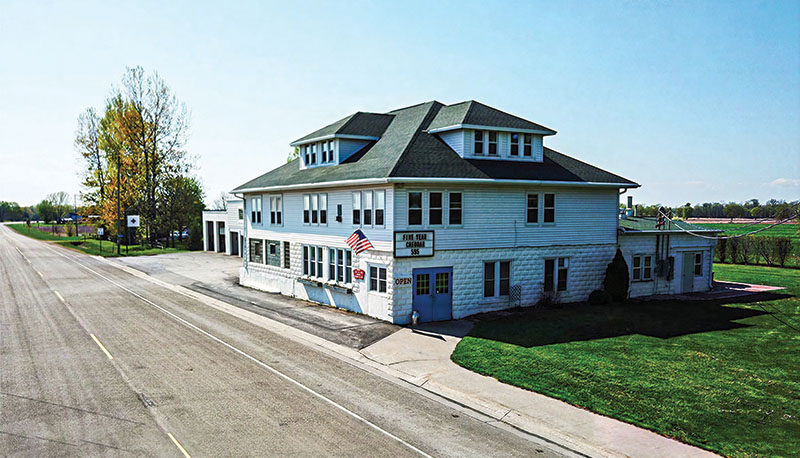
The murders rocked the unincorporated community of Zittau, located 30 minutes west of Appleton, where the Metzig family has been growing their iconic cheese business since the early 1900s.
Jon’s second remarkable decision came roughly 48 hours later when he returned to work, picking up milk to make Union Star’s dozens of cheese varieties.
“There’s no pause button in this industry. The milk is still coming,” he says. “We opened up Monday because the farmers needed to sell their milk. Fifteen families depend on the cash flow from this business. We’re gonna keep going.”
And while the challenges have been many, that’s exactly what the fourth-generation owner of Union Star Cheese has been doing since the 2023 death of his parents, an embodiment of the deep sense of responsibility and relentless work ethic Jon says they instilled in him.
“Definitely my dad was a hard-nosed German,” he says. “That’s probably what he would have told me — get back to work and figure it out.”
Made for this
Jon, the fourth of five Metzig boys, describes his parents as straightforward and steady — not overly affectionate, but unwavering in their support, he says, deeply rooted in their community and their faith.
The couple met while attending Valparaiso University in Indiana. Dave, who was born in Oshkosh, was studying accounting; Jan, a New York native, biology. Like his great‑grand uncle, Union Star founder Henry Metzig, Dave aspired to run his own business.
In 1980, he and Jan moved to Zittau and bought Union Star from Henry’s daughter Edna, a pioneering female cheesemaker who took over Union Star alongside her husband Eugene Lehman.
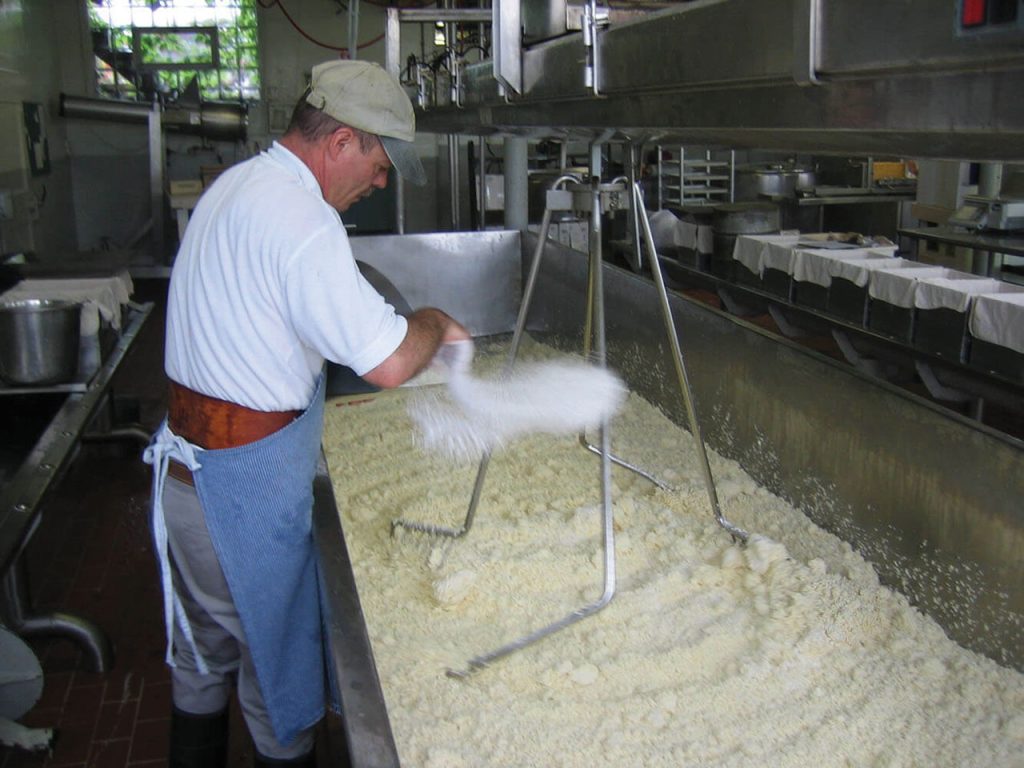
Dave and Jan raised their five sons in the home above the Union Star Cheese factory. Jon remembers customers and employees always coming and going, but it made it easy for Dave to join family breakfasts and dinners, which were a daily occurrence. It also made it easy for him and his brothers to help with the family business. Jon was just 6 when he started bagging Union Star’s famous cheese curds on Saturday mornings.
Jon worked on dairy farms in high school and attended the University of Wisconsin-River Falls with intentions of enrolling in its dairy program. But a freshman year food science class, along with some travels around Europe, ignited his interest in artisan cheesemaking.
“It was why I came back [to Union Star]. I saw the opportunity,” Jon says. “Large scale cheesemaking was not for me.”
At age 18, Jon became one of the state’s youngest licensed cheesemakers (his older brother Matt also earned his cheesemaking license in 2001).
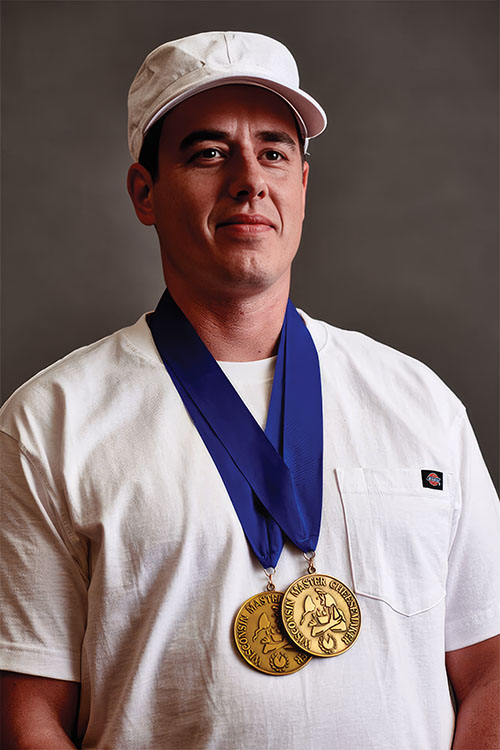
Jon became a certified Wisconsin Master Cheesemaker through the Center for Dairy Research and Dairy Farmers of Wisconsin — he and Dave were only the second father‑son master cheesemakers in Wisconsin. The rigorous three-year certification program is described as a “Ph.D. in cheese.” As of 2025, there are only 63 active Master Cheesemakers in Wisconsin, which is the only state in the U.S. with the level of certification.
That expertise shows up in the cheese. Red Willow, a specialty cheese Jon developed, earned a bronze medal at the 2025 U.S. Championship Cheese Contest. Each wheel of Red Willow is aged 20-25 days and washed in a beer and salt mix to give the rind its signature pink hue.
“People will come in and say, ‘I didn’t even know some of these cheeses existed,’” Jon says. “I want people to experience what dairy can be.”
Things fall apart
The plan had been for Jon to eventually take ownership of Union Star, the only one of the five brothers interested in doing so. In 2018, the family began that process with Jon and his wife Kelsey buying 50% of the company’s stock and formalizing a buy-sell agreement.
“The original plan was we would buy half the stock, and then when I pay that off, buy the second half of the stock,” Jon says. “I think we paid it off faster than [my dad] thought. I don’t think he wanted to retire, but he didn’t want to admit that.”
So instead of buying the second half of the company’s stock immediately, Jon and Kelsey bought the Union Star property, continuing to take strategic, thoughtful steps toward full ownership.
But on March 18, 2023, everything changed in an instant.
That morning a dropped 911 call came into Winnebago County just after 5 a.m.
Deputies arrived at the home on Metzig Road where Dave, Jan and Erik lived, but no one answered the door. So they called Jon, who had already been at work for hours. It was a Saturday, one of four days each week when cheese curds are made starting at 4 a.m.
“It was 5:54 a.m.,” Jon recalls. “The time is just stuck in my head.”
In an instant, Jon went from president to sole owner, now splitting his time between his regular day-to-day cheesemaking responsibilities while picking up the administrative work Dave had managed.
Jon’s workload doubled while his heart was breaking.
“I remember sitting at my desk looking at [my dad’s] desk. He’s never going to be there again,” Jon says. “Like, how am I going to do this?”
‘Baptism by fire’
Cathy Silverthorn emerges from her flat barn milking parlor wearing bright pink Udder Tech bibbed overalls. On Fridays, her day off from babysitting grandkids, she does chores on the 450-acre dairy farm in Omro she owns with her husband Allen and son Josh.
The Silverthorns started Silver-Shea Holsteins in 1981, renting their grandma’s barn and milking 35 cows. Today, the farm milks 165 cows twice a day; about half the milk produced is supplied to Union Star (Agropur co-op takes the rest). Silverthorn dreams of a day when they produce just enough to supply Union Star, which doesn’t charge hauling fees and pays premiums for their product.
“We love them and how they take care of us, and they love our milk. Dave always told us that they have the best cheese because they have the best milk,” says Silverthorn, who has been supplying Union Star since the early 2000s.
The working relationship between farmer and cheesemaker is so enmeshed that one of Jon’s first calls the morning of his parents’ deaths was to Cathy and Allen, who were on vacation in Arizona. They cut their trip short to get back in time for the funeral.
“I’d never seen such a massive funeral visitation in my entire life,” Cathy says. “It was overwhelmingly big.”
Cathy says there was a lot of fear and uncertainty in those early days, as their operation depends so heavily on Union Star. Their success — or failure — is mutual.
“We didn’t know what was going to happen, and I’m sure Jon didn’t know what was going to happen either,” Cathy says. “It was scary for both of us. We both were trying to piece together the same things — what are we going to do if Jon doesn’t do it? And what’s Jon going to do if he can’t handle all this?”
Jon had three goals in the aftermath of the murders: Number one, make payroll. Number two, don’t bounce a check. Number three, make a profit that year.
“One of the first things we did was give all the staff, my full-time staff, part-time staff that have been here for a while, pay raises and then just keep making that goal, watch the cash flow, and just build off that,” Jon says.
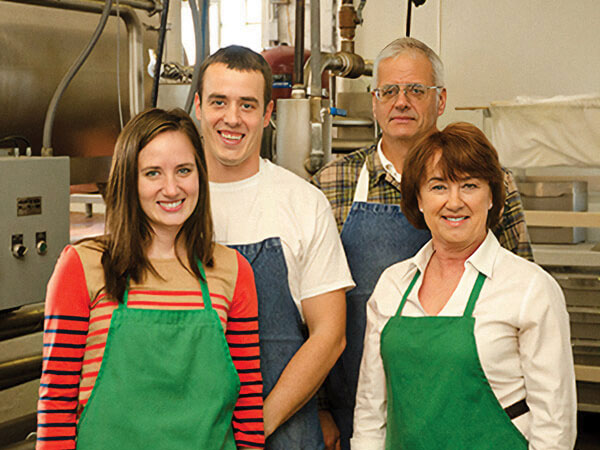
Today Union Star has 15 employees — most of them are part time, including a couple of high school students, Jon says.
A meticulous accountant, Dave handled the day-to-day bookkeeping himself. Stephanie Geurts, partner at Suttner Accounting in Oshkosh, had been helping Dave with year-end corporate tax work the last handful of years, but she didn’t meet Jon until Dave and Jan’s funeral.
A month later, Geurts made her first trip to Zittau to meet with Jon.
“My main concern on my first visit was just seeing how he was doing mentally and, instead, I met a guy [who] had gone through his dad’s records and was continuing to work,” she says. “Halfway through my time there he was quoting scripture. I was so caught off guard in a good way.”
“I would rather have tried and failed than not tried. I think that would haunt me more — just the regret of giving up.”
– Jon Metzig, owner, Union Star Cheese
Geurts went through Dave’s records systematically, helping Jon build a financial roadmap from what his father had left behind — everything from how overhead was calculated to how inventory was valued. She helped Jon take over the monthly bookkeeping, and modernized some manual processes along the way, like moving the checking account reconciliation from paper to software.
“[Jon] was really able to keep his long-term vision in mind of what he wanted to do with the business,” Geurts says. “It accelerated some decision making and pulled a few more items into focus. It’s a baptism by fire.”
While not every business owner faces such a significant tragedy, Geurts says she works with clients every day who have unexpectedly lost a partner, co-owner or controller. Jon’s experience holds lessons for every business, she says.
“This really is a story of finding strength through faith — the ability to accept circumstances that you’re not going to understand or make sense of but being able to work through them even when you’re not going to have the answers that you want or the closure that you feel you deserve,” Geurts says. “That’s really what I’ve witnessed happen here and it’s been remarkable to watch, quite frankly.”
Geurts says Jon’s persistence has paid off as he continues to find new opportunities for growth.
“Three years ago, it was really just trying to sort through and figure things out,” she says. “Now it’s being able to focus on running the business again.”
Jon says the support he received from partners like the Silverthorns and Geurts was imperative to the survival of Union Star.
“I would rather have tried and failed than not tried,” he says. “I think that would haunt me more — just the regret of giving up.”
Setting the table
Union Star Cheese was a business born out of frustration.
In the early 1900s, the introduction of the Babcock Test — a method for measuring the butterfat content of milk — meant Wisconsin cheese factories would only pay top dollar for high-fat milk. But most local farmers raised Holstein cattle that naturally produce milk lower in butterfat, Jon says. In response, 13 local farmers, including Henry Metzig, started their own cheese factory as a co-op in Zittau.
Henry eventually bought out the others in 1911 and created Union Star Cheese, beginning a century-long family legacy in Wisconsin’s world-renowned cheesemaking industry.
At its peak, there were upwards of 45 cheesemakers in Winnebago County. “There used to be a cheese factory every 15 miles, they would say, because that’s how far a farmer could transport their milk [before it spoiled],” Jon says.
Today, Union Star is the only one left, a reality Jon attributes in part to the business’ longstanding retail strategy that started when second-generation owners Eugene and Edna opened a small retail storefront, which was unusual at the time.
“From what I’ve been told over the years, it was frowned upon because it was kind of like you were a peddler,” Jon says.
Technology advancements in the ’70s and ’80s drove a lot of consolidation, Jon says, which put pressure on the remaining cheesemakers to scale to the needs of larger wholesale customers.
“Either you get bigger and more efficient or you find a different market,” Jon says.
The increasingly complex regulatory burden of wholesale, which requires dedicated staff to manage, also makes retail more attractive from a cost efficiency standpoint and with higher margins, Jon says.
“Instead of covering that overhead for someone to do paperwork just for wholesale, why don’t you use that person to sell cheese at a shop?” Jon says.
Today retail makes up 75% of Union Star’s sales, the majority of which come from the Zittau location. The other 25% is wholesale to local vendors. Production takes place six days a week across both Union Star in Zittau and Willow Creek in Berlin, which Dave and Jan opened in 2002, and results daily in about 1,200 pounds of cheese from 11,000 pounds of milk.
Prioritizing retail was a philosophy Dave adopted early in his tenure and on which Jon has doubled down, most recently with the opening of a new retail store in downtown Neenah last October.
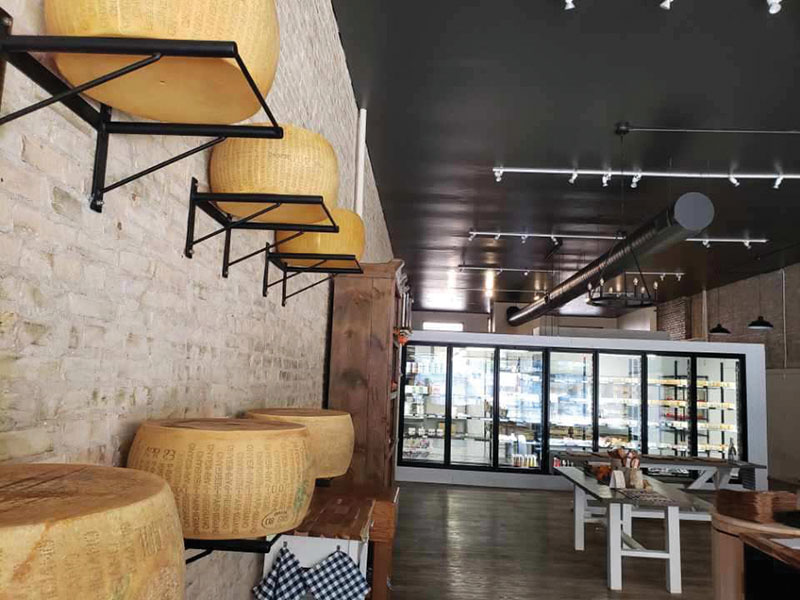
The Cheese Table in Neenah targets a different customer than the Zittau drive-up curd buyer, offering an elevated experience — tasting classes, charcuterie to-go and wine by the bottle — that expands the brand upmarket while staying true to Union Star’s roots.
“He had a vision,” Cathy Silverthorn says. “He wanted to [open a third retail store] since before his mom and dad passed away, and by gosh, he dug in and he did it. And that says a lot about somebody.”
Soon after opening, Jon received comments from people happily surprised to see him growing the business despite the loss of his parents.
His matter-of-fact response was on brand: “Well, isn’t the point of having a business to grow it?”

Making their way
Last October, Erik Metzig was sentenced to two consecutive life sentences without parole after pleading no contest to two counts of first-degree intentional homicide.
While the conclusion of the trial brings some relief, the family Jon knew was irrevocably shattered.
“I lost a brother in this thing, too,” Jon says.
And there are still many loose ends to be tied. Dave and Jan’s estate is yet to be closed, a result of the complex legal proceedings.
“The estate in theory has five beneficiaries, but if one is found guilty of murder, then the estate has four beneficiaries,” Geurts says. “And with the trial taking as long as it did, more than two years, it makes it difficult for the estate to get closed out.”
Jon believes the estate will finally be closed this summer.
But earlier this year, a ray of light: Jon and Kelsey welcomed their first child, a daughter named Olivia. She makes the eighth grandchild of Dave and Jan.
Becoming a father himself has clarified certain things for Jon, and deepened the confusion over others — namely accepting how a child could commit such a violent act against his own parents.
“It makes you look at life differently. You see the love and devotion you put into your kid,” he says. “That’s been one of the hardest things being on the other side.”
Before Olivia was born, Jon assumed he would eventually sell the business, ideally to someone who would care for it like his family has for more than 100 years. Part of him still thinks he will. But now, he and Kelsey also wonder if Union Star will pass to a fifth generation of Metzigs.
It’s a question that’s raised one spring afternoon, sitting in the office above the Union Star Cheese factory that used to be the Metzig family dining room — a china cabinet filled with framed photos depicts generations past and present.
“What about you, Olivia? Will you be a cheesemaker?” Kelsey asks, bouncing the baby in her arms as she poses the question.
As if on cue, Olivia squints her eyes and purses her lips, making a sour face at the suggestion, much to the delight of her parents.
Jon says his commitment to the family business is his responsibility, but ultimately it is his choice. He would never pressure his child to choose it, the same as his parents didn’t pressure him.
Over the last three years, Jon has heartbreakingly learned that some choices aren’t ours to make. How you respond, is.
“I guess that was the one thing that gave me hope through the whole process — this happened to me, but it doesn’t have to be who I am,” Jon says, looking at his baby daughter. “There’s a future. You can write it yourself.”