
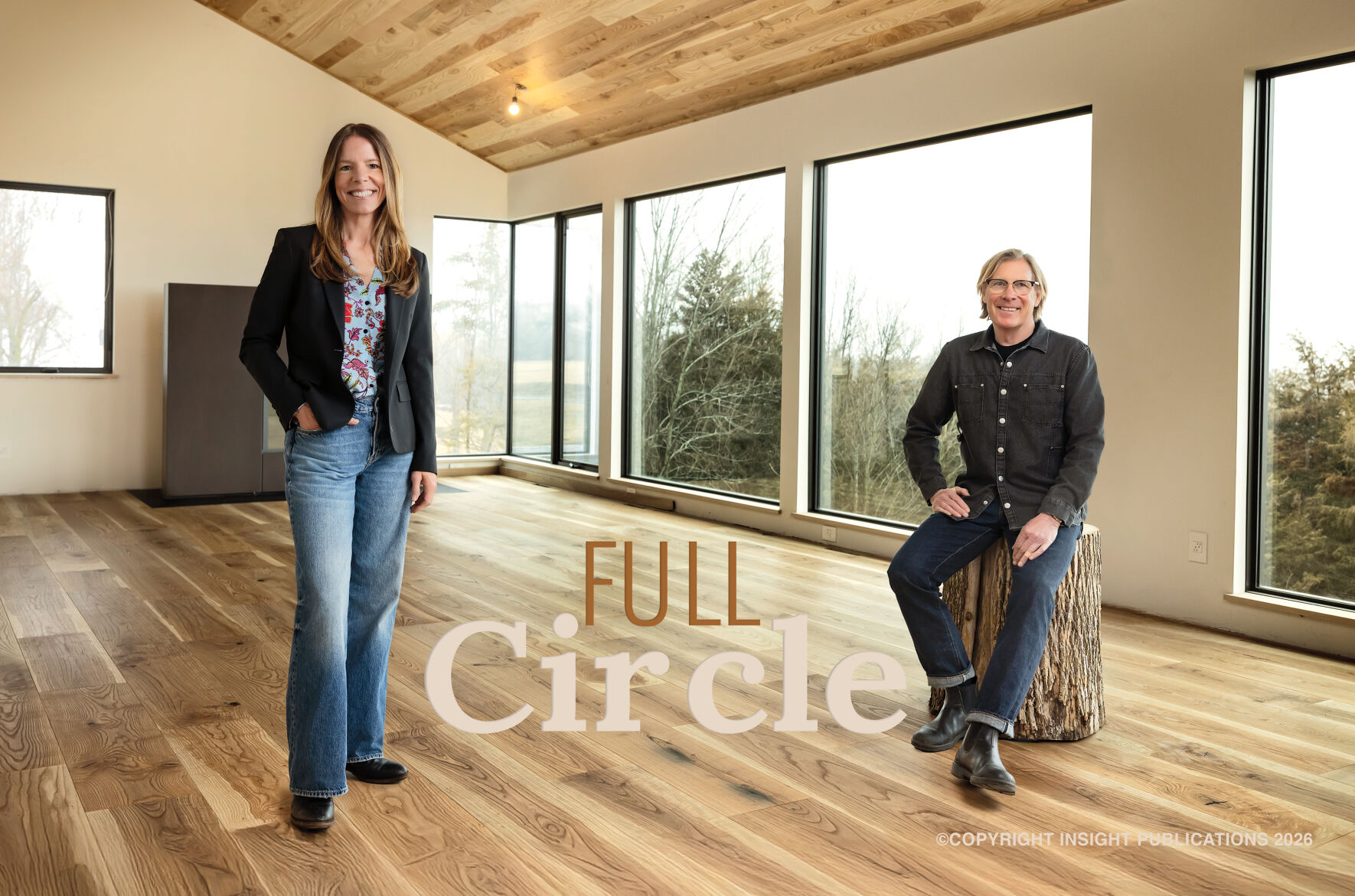

Robin and Jeff Janson, co-founders of Urban Evolutions, partnered with DeLeers Construction on this Green Bay home featuring reclaimed ash sourced from trees felled on the property by emerald ash borer — a living example of circular design. (Photography by Shane Van Boxtel, Image Studios / Styling by Mary Collette)
When Jeff Janson drives by a barn, he’s eagerly eyeing the trees around it.
That’s because the trees often tell the story of these 19th century structures.
“Farmers lived off the land 100%,” says Jeff, who co-founded Appleton-based Urban Evolutions with his wife, Robin. “Old farms were built from the lumber that was on the property in proximity to the barn.”
“Historically that’s how people built things,” Robin says. “More and more we have this disposable mindset and the sense that we can get [materials] from anywhere delivered to our doorstep. There’s a beautiful connection to how things were done before we got a little disconnected from our materials and our planet.”
For nearly 30 years, Urban Evolutions has been working to reestablish that connection by transforming reclaimed and sustainably sourced Midwestern wood into building materials for architects, builders and designers across the country.
When Urban Evolutions was founded in 1997, reclaimed barn wood was the hero of the story. Today, the company has become a national leader in circular design and draws from a diversified web of underutilized and sustainable wood sources — from traditional reclaimed to fallen municipal trees to timbers from Menominee Tribal Enterprises’ sustainable forest — which have found their way into homes and the corporate offices of OpenAI, LinkedIn and Levi’s, among others.
Jim DeLeers, president of DeLeers Construction in Green Bay, has been partnering with Urban Evolutions on commercial and residential projects for nearly two decades. He remembers one of their early projects where Urban Evolutions sourced reclaimed tobacco barn boards and hand-hewn timbers for a cigar room.
“Great architecture tells a story,” DeLeers says. “Urban Evolutions adds narrative to that story.”
From the ashes
Urban Evolutions was born from a practical need: In the early ’90s a fire destroyed the Jansons’ 1890s Appleton farmhouse. It was a total loss and had to be completely gutted, Jeff says.
He started salvaging the necessary materials for their home’s remodel, and that experience turned into a business idea.
“We love old things. We wanted old flooring, old baseboards, old doors. And we couldn’t find them anywhere,” Robin says. “Also, we didn’t have a lot of money so we started with the leave-behinds, things we could get for cheap … that [caused] us to take old materials seriously.”
The couple had met at a conference while working for the same national youth organization. As the remodel took shape, Jeff stepped back from the organization to focus on reclamation work full time. Robin, who had a degree in social work and was working as a family counselor, eventually joined him.
“We were as green as green can be,” Robin says of their business chops at the time. “It forced us to surround ourselves with good people right away, and that has been our saving grace. We really leaned heavily on our staff and consultants.”
Today Urban Evolutions has a staff of 26 — many of whom have been with the business for more than 20 years — and its current operation spans five acres on West College Avenue.
Inside Urban Evolutions’ showroom is an eclectic array of furniture, home goods and gifts — from whimsical children’s décor to candles and greeting cards. The showroom is an easy entry point for customers, but it accounts for less than 10% of the business’ sales.
“Most of our work is back here,” Robin says, pushing open the door to Urban’s 40,000-square-foot heated warehouse.
What began as a scrappy reclamation business has evolved into a sophisticated $8 million material design company — one that has turned sustainable wood sourcing into commercially viable, high-performance product lines for some of the country’s most recognizable brands. That evolution required a fundamental rethinking of the business. In its early days, Urban Evolutions produced wholesale furniture, competing in a market increasingly undercut by manufacturers in China and India.
“The biggest change has been moving away from furniture products to material products, in parallel with moving away from wholesale to selling directly,” Robin says. “We really struggled in the early days to make good money for our effort on wholesale furniture. Now we sell direct to big brands — we provide tables to Morgan Stanley — and actually make good money for domestic manufacturing.”
Most of Urban Evolutions’ business today is in flooring, paneling, millwork and beams for markets including retail, hospitality, corporate office, institutional and residential.
While the business has changed, its ethos has stayed the same. At its crux is the concept that the world doesn’t need “more things,” Robin says. Rather, it needs quality products that can be reused and repaired.
“That’s what drives us,” she says. “Making things better, not just more.”
Urban solutions
The raw material for some of Urban’s most recent and ambitious work has been lining the streets of Northeast Wisconsin neighborhoods.
For the last several years, an invasive beetle — the emerald ash borer (EAB) — has been destroying one of the region’s most abundant urban tree species, creating both an ecological crisis and an unexpected opportunity.
“It’s decimated the ash population in the state since about 2009,” says Scott Lyon, forest products team leader with Wisconsin DNR’s forestry division.
Between 2016 and 2023, there were roughly 20,000 to 30,000 municipally managed ash trees — the kind lining neighborhood streets and shading city parks — in just five Northeast Wisconsin counties (Fond du Lac, Winnebago, Calumet, Outagamie and Brown). The Wisconsin DNR estimates today at least half — 10,000 to 15,000 — are gone because of EAB.
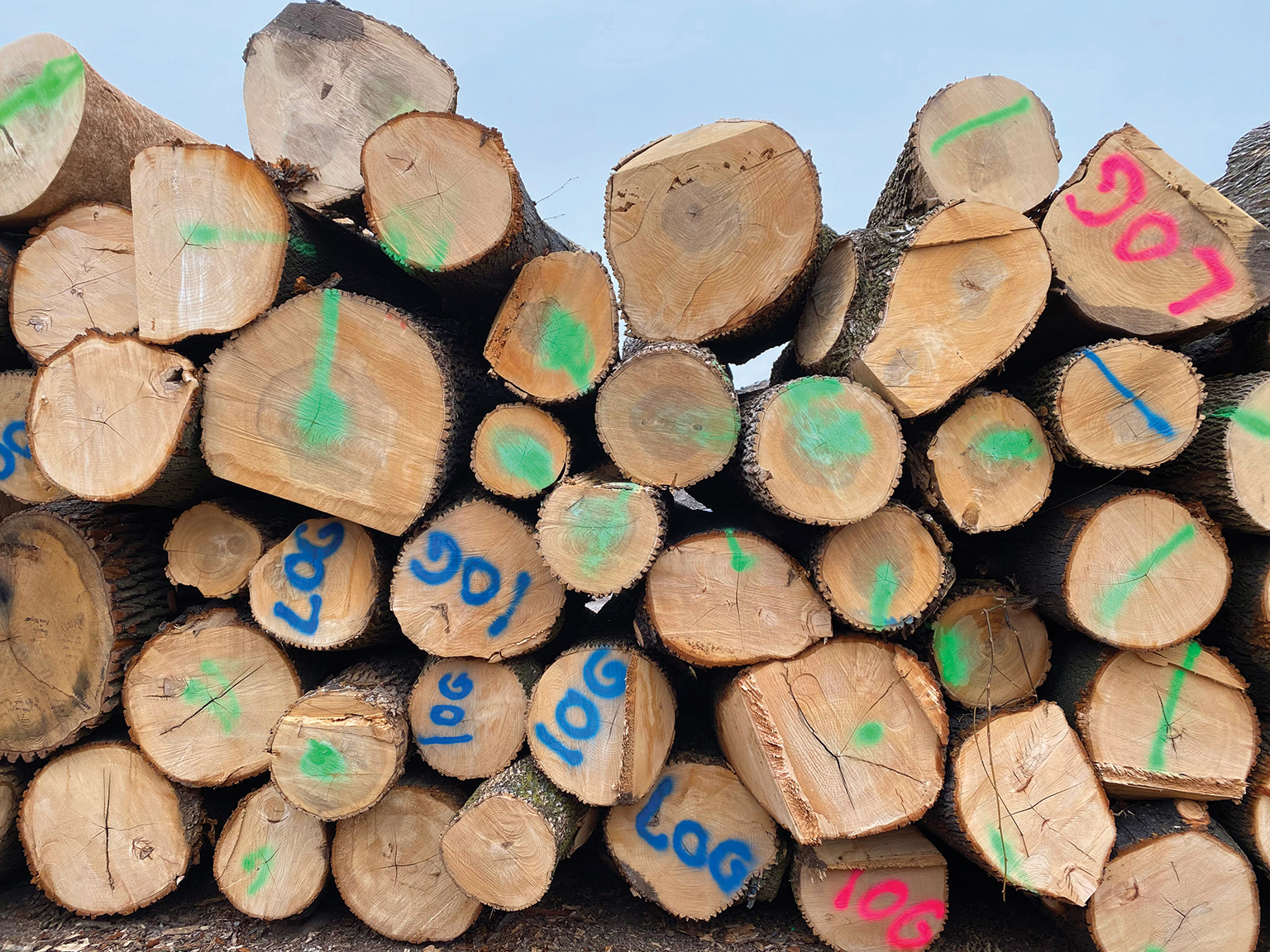
Robin saw opportunity in urban wood, which refers to trees removed as a result of disease, storm damage, hazard mitigation or development.
Simultaneously, design trends began favoring a cleaner, modern aesthetic over the rustic, character-rich barnwood that got Urban its start.
“We wanted something a little cleaner, a little fresher, and it drew us into this urban wood sourcing because it actually looks a lot like new wood,” Robin says.
Lyon has helped connect Urban Evolutions with municipalities being affected by EAB, including Green Bay, Appleton, Wausau, Franklin and Wauwatosa. Urban Evolutions works with them to salvage and process the trees into usable lumber.
Lyon says it’s a win for municipalities, whom Urban pays for the wood it accepts.
“It helps them buy equipment for their city and it helps them by getting rid of material that would be a struggle for them to get rid of,” Lyon says.
Since 2021, Urban Evolutions has saved 912 tons of urban wood from the waste stream — that’s the carbon offset equivalent of burning 63,000 gallons of gasoline or driving 1.1 million miles.
As the diseased ash supply winds down, the business is preparing to adapt, says Emma Kiel, Urban’s material and sustainability coordinator.
“Right now we’re still taking plenty of ash trees, [but] we’re aware that eventually we’ll need to shift away from ash. We’ve got some alternative species to take its place,” she says. “Also we do select harvest, which is sourcing new wood harvested by a hyper-local producer who is practicing really good forestry.”
What makes Urban Evolutions’ diverse sourcing strategy worth the effort goes beyond aesthetics or market trends. It comes down to what’s inside every tree it salvages, Lyon says.
Trees draw carbon dioxide from the atmosphere through photosynthesis, storing it in its trunk, branches, leaves and roots. According to the USDA, dried tree material is about 50% carbon. When a tree is mulched, burned or decomposes in a landfill — the fate of many felled urban trees — that carbon is released back to the atmosphere.
“But that carbon can be stored for another lifetime in a product,” Lyon says. “It could be either flooring, cabinets, furniture — this adds another opportunity to recycle that material. [Urban Evolutions] is giving it continued life in a different product.”
Circularity, at scale
Urban’s product strategy hinges on scaling niche or first-to-market products. Robin credits the approach for how the small Midwestern business is able to stand out from national brands.
“We do things that aren’t readily available on the market, [like] taking reclaimed wood but elevating it to be a high-performance, beautiful product,” she says. “We are a bit of a unicorn in that world.”
An example of this is Urban’s reclaimed and salvaged wood plywood, which is one of the company’s most significant product innovations to date. By partnering with Marion-based Great Lakes Veneer, a 100-year-old family-owned plywood manufacturer, Urban is filling a gap in the market that previously had no viable solution at commercial scale. For architects and designers working on projects that require plywood substrates, there was no way to source reclaimed material until now.
“There was no way to get plywood from salvaged materials — we are one of the first,” Robin says. “We kind of hold the market in that area for the nation.”
The breakthrough has opened doors with commercial clients on the West Coast in particular, where demand for sustainable building materials is high as well as with innovative architects like EUA in Wisconsin. For Urban, it also means the ability to supply every wood application in a project so the design tells a cohesive story.
“We can do all the products, all wood applications from a single source,” Robin says. “Architects really love that. They can tell one story.”
Lyon says Urban’s scale sets it apart.
“Urban is unique in that they work with bigger scale projects. A lot of companies in the state that use urban wood are mostly making furniture; they’re not doing the bigger, larger scale [projects] like they are,” he says.
Urban has scaled significantly, surpassing 16 million square feet of reclaimed wood deliveries. It completed its largest urban ash flooring install to date — 19,000 square feet at Levi’s San Francisco headquarters.
Through a partnership with Gensler Architecture, Urban completed its fourth project for LinkedIn. Its flagship project featuring urban wood was in 2022 which included 40,000 square feet of city-salvaged veneered ash paneling for walls and ceiling baffles at its Omaha campus. The project is part of a broader carbon reduction commitment by Microsoft, LinkedIn’s parent company, which has pledged to become carbon negative by 2030. Urban’s salvaged ash paneling is one way that pledge takes shape.
Perhaps no project captures the reach of Urban’s sourcing philosophy more unexpectedly than its first install of Menominee Tribal Enterprises veneered red oak paneling — sourced from one of the oldest sustainably managed tribal forests in the United States — at OpenAI’s San Francisco headquarters.
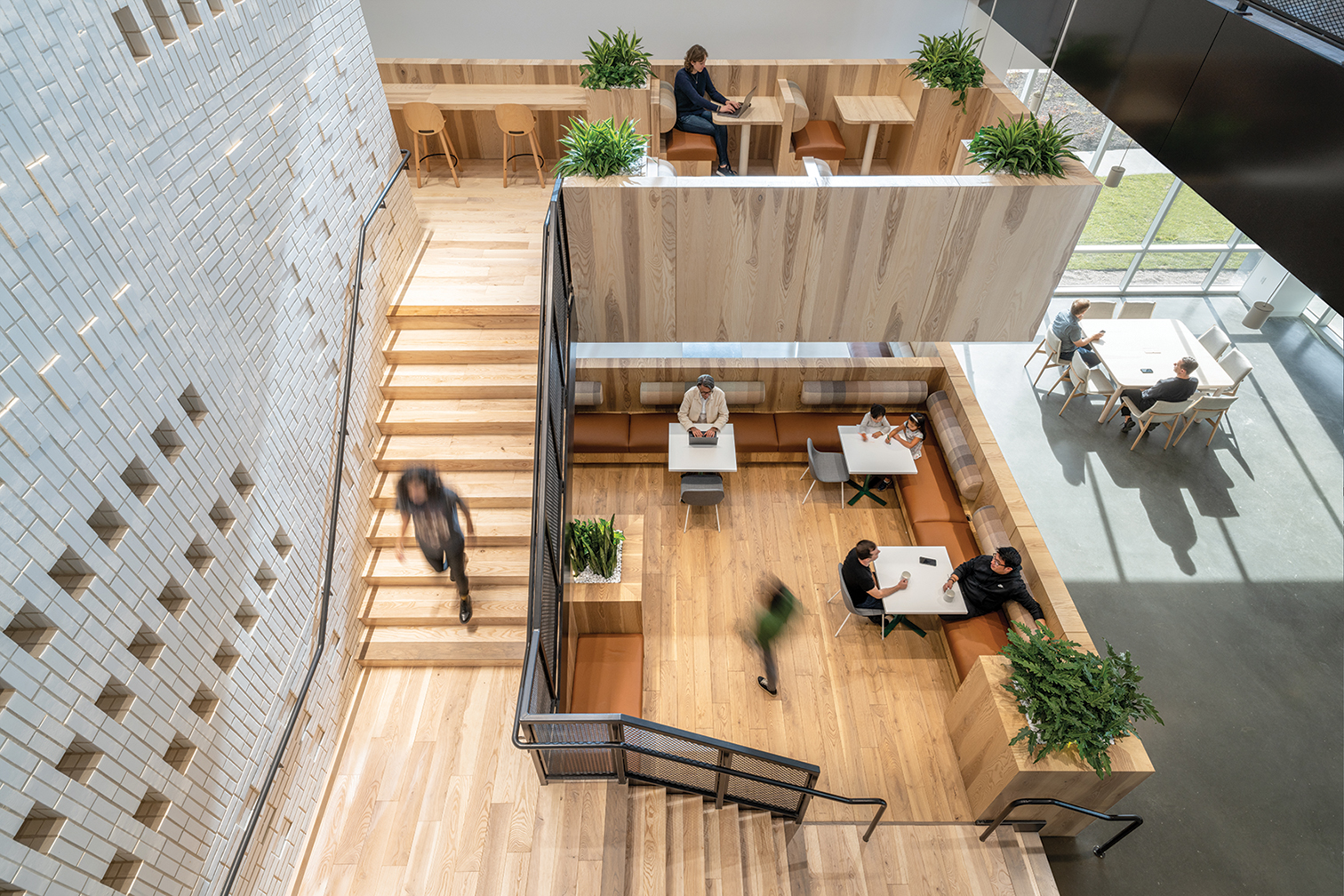
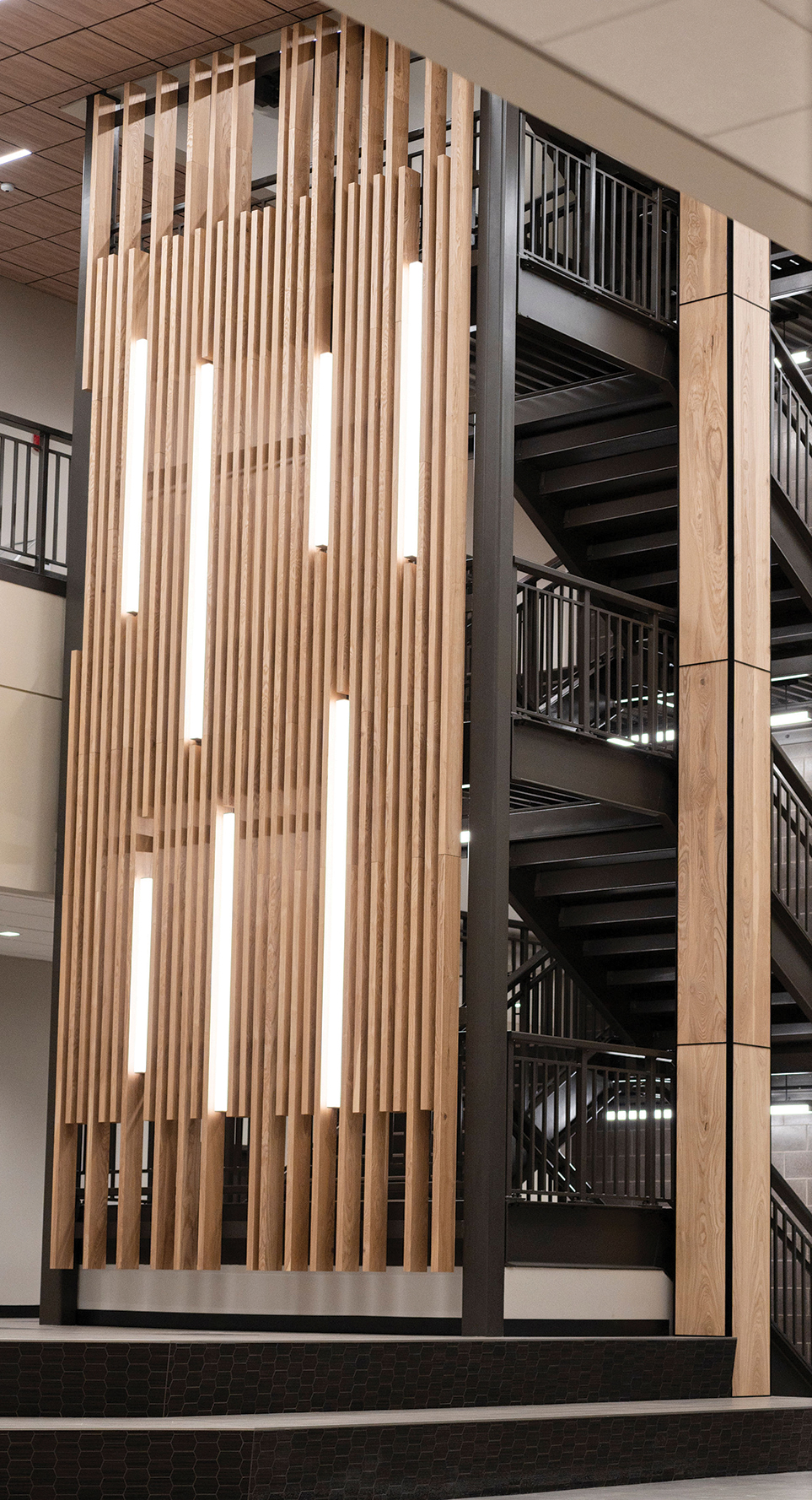
But Urban’s influence can be seen in Northeast Wisconsin as well. The company contributed ash veneer, beams, trim and casework sourced from 20 locally salvaged trees to Fox Commons, a 180,000-square-foot, mixed-use space in the former City Center Plaza on College Avenue in Appleton.
Cole Alsbach, vice president of operations for Dark Horse Development, which co-developed Fox Commons with Boldt, says Urban Evolutions led the vision for the wood design element that turned the atrium’s staircase into a highlight of the space.
“Most of the time designers, architects and even developers are pressing the easy button and using material that is cheaper or in most cases plastic. Urban is taking that extra step to see what’s the most economic product, financially and sustainably,” Alsbach says. “They were so passionate about doing something like this in the space that they really went the extra mile to help us see it was feasible and doable.”
Fox Commons was the first time Dark Horse has used reclaimed materials in a project, but it won’t be the last, Alsbach says.
“It opened our eyes to what possibilities are out there,” Alsbach says. “Usually you pay quite a bit to get that wood look and most of the time it’s not real. I think it goes to prove if you put a little bit of effort and creative thought to it, you can come up with something even nicer than what you would originally get.”
Second life
The U.S. Environmental Protection Agency estimates that 600 million tons of construction and demolition waste was generated in the United States in 2018. That’s more than twice the amount generated by municipal solid waste.
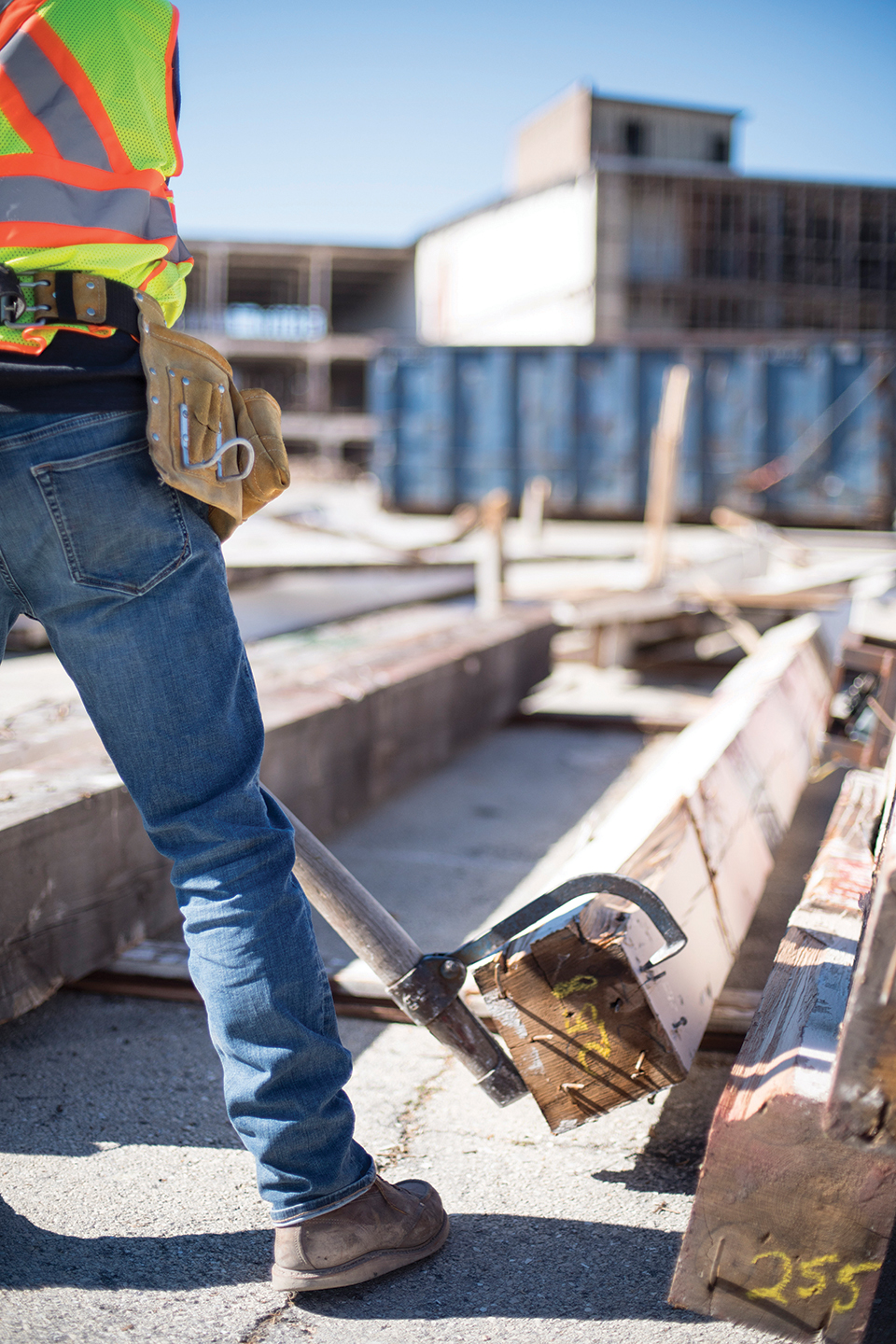
To counteract this, Urban Evolutions sources materials through deconstruction, a systematic process of dismantling homes and buildings that preserves materials for reuse rather than simply demolishing them.
Urban Evolutions connects clients with deconstruction partners, like DeLeers Construction.
“You’re doing the reverse in terms of protocol because you’re taking [a structure] apart piece by piece,” DeLeers says. “The benefit is it’s not going to the landfill. And in many cases, the materials are unique and … it’s getting donated to a not-for-profit to live on in the future.”
Robin has spent the last year and a half working with a large California biotech firm that is anticipating 20 of its wood-roofed buildings will need to come down over the next decade. Urban is working with the firm to regrade the wood so it can be deconstructed, stored and reused in its new building.
“It’s like rolling a boulder up a hill for everybody involved, including the company that wants to do it. It’s so anti how things get built,” she says. “When you think about how complicated building is, and now we’re disrupting the way things have been done since the ’50s. It’s very disruptive at every part of the process.”
Despite the disruption, more and more companies are seeing the benefits of deconstruction, which extend beyond environmental impact. Unlike traditional demolition, deconstruction can offer tax benefits and resale opportunities that help offset salvage costs.
And also, it just feels good, DeLeers says.
“It comes back to just the golden rule — let’s do the right thing,” DeLeers says. “If you can have a little less impact and get a unique product and tell a great story, it’s a win for both sides.”
DeLeers says deconstruction and a sharper focus on sustainability are concepts gaining traction in the industry.
“Urban is really helping shift the mindset,” he says.
Their latest collaboration illustrates exactly why. At a residential project north of Green Bay, dead ash trees from the property — victims of EAB — were salvaged and transformed into nearly every surface of the home: exterior cladding, floors, ceiling, trim, doors and cabinets. The trees that once stood on the land now define the space built to replace them.
The exterior is roasted ash, a thermally modified finish that will silver and patina naturally over time. For DeLeers, it’s a statement about what endures.
“My hair is graying; my beard is graying. This home is going to age just like me,” he says. “Good architecture does that. That home should age just like the folks in it, in a way that is graceful.”
“Great architecture tells a story. Urban Evolutions adds narrative to that story.”
– Jim DeLeers, president, DeLeers Construction