
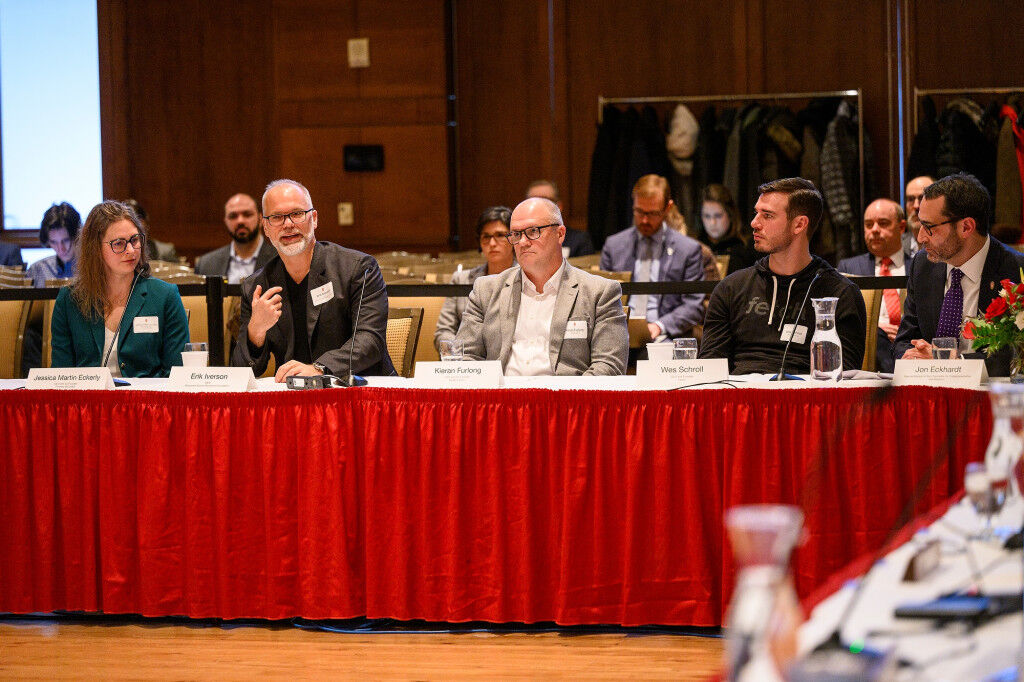

The Universities of Wisconsin will focus on the individuals who create and build companies acording to Professor Jon Eckhardt, special advisor to the chancellor for entrepreneurship.
Eckhardt talked about the shift at the Board of Regents meeting Feb. 7.
“We need to lean into entrepreneurship so our faculty, students, alumni and state can learn to leverage technologies and shape the future economy of the state and the world instead of being shaped by it,” said Eckhardt.
Eckhardt is leading the Wisconsin Entrepreneurship Initiative, which draws on the findings and recommendations of a study commissioned by Chancellor Jennifer Mnookin last year.
The university’s multifaceted entrepreneurship plan includes establishing leadership and structure, creating a culture that celebrates and promotes entrepreneurship, expanding access to capital, and committing to excellence in entrepreneurship with a focus on founders.
The Entrepreneurship Initiative also seeks to understand and uplift strengths that already exist.
Jessica Martin Eckerly, CEO and co-founder of Forward BIOLABS, a Midwest co-working life science lab for early-stage startup companies, said one of the concepts highlighted in UW–Madison’s entrepreneurship report was expanding programming around entrepreneurship for students, building on UW–Madison’s strengths in education and talent.
Another strength UW–Madison plans to build on is the relationship between the university and the Wisconsin Alumni Research Foundation, as well as using the existing tools the partnership makes available to innovators and researchers on campus.
Kieran Furlong, CEO and co-founder of Realta Fusion, an early-stage company developing fusion energy for applications in industrial process heat and power, pointed to his own company as an example of the strengths that the university and WARF bring to entrepreneurs.
“It’s no exaggeration to say that without the University of Wisconsin–Madison, and without WARF, Realta Fusion would not exist,” said Furlong. “The jobs we’re creating would not exist, and the millions of dollars that we’re bringing to the state and to the university as an investment would not exist either.”
Erik Iverson, CEO of WARF, said WARF receives about 400 new inventions from across campus annually. He emphasized WARF’s role in supporting and cultivating technology transfer, noting that while entrepreneurship is complimentary to WARF’s role, it is not their focus.
Eckerly noted that entrepreneurs who get their start in the state often stay.

