

Bob Arndt still remembers the session of The Boldt Company’s weekly “Toolbox Talk” that kept about 40 employees talking afterward. It was a May discussion recognizing Mental Health Awareness Month, and the topic had struck a heavy chord.
“Out of those 40 guys, there were like seven guys who knew someone who had committed suicide that they had worked with at some point,” remembers Arndt, an Appleton-based superintendent whose life has been very personally affected by the subject.
Arndt’s fiancee’s father was a tradesman who committed suicide, and Arndt says he sees the devastating toll it has taken on the family every day — especially the grandchildren left behind.

“He was one of those guys who would give you the shirt off his back. You never saw a picture of him where he wasn’t smiling,” Arndt says. “But inside, he was struggling. He was older and tougher and didn’t want to bother anybody. If only someone had just said, ‘Hey, what’s going on?’”
Today, Arndt hopes he can be that someone for his colleagues as part of Boldt’s “Gatekeepers” program. The company launched Gatekeepers last year because suicide in construction is four times the national average, as well as the leading cause of death in the industry.
Through the program, Boldt is challenging the long-held idea of tough-minded, stiff-lipped construction workers pulling up their bootstraps and checking their personal problems at the door. Instead, program participants are trained through the QPR Institute — a national program that helps people identify the warning signs of suicide and then “question, persuade, and refer” — and encouraged to have those conversations at work. Special purple “It’s OK to ask me for help” stickers adorn hard hats and office doors throughout the company, sending a powerful message: There’s always someone to talk to.
Let’s talk about mental health
Talking, says mental health professional Rosangela Berbert, is an essential component of de-stigmatizing and improving mental health in the workplace.

“Companies like Boldt are starting to bring this to light, and I am a firm believer that they are going to start seeing great benefit from that,” says Berbert, executive director of Menasha-based counseling and mental health provider Samaritan. “We have got to be prepared to talk more about this and be equipped to ask questions properly. I think long gone is the time when people would just say ‘pull it together and keep going.’”
And that doesn’t mean employers need to be trained in counseling or diagnosing health problems, Berbert says. But employers do have an obligation to listen, make resources available, communicate about those resources and flex their emotional intelligence muscles.
Bill Marklein, founder of the Plymouth-based leadership development training firm Employ Humanity and an expert on emotional intelligence in the workplace, agrees.
“The reality is, if you’re a servant leader you’re in health care whether you call it health care or not,” Marklein says. “Empathy is the critical ingredient to leadership.”
Meeting needs

Barbara Rau is dean of the University of Wisconsin-Oshkosh College of Business whose research interests range from HR recruitment and compensation to what she says is now called “work-life satisfaction.” To best support workers’ mental health, she says, organizations need to offer comprehensive health care plans that include mental health coverage, provide immediate resources for people in crisis, and create clear plans for addressing and accommodating mental health concerns in the workplace.
“An employer doesn’t have to continue to employ someone if they can’t perform their essential functions, but they do have an expectation of reasonable accommodation. And I think right now the bar for reasonable accommodation for mental health is getting higher and higher,” Rau says. “It’s no longer acceptable to say, ‘This person seems to have a mental health issue, so they’re not appropriate for the job.’”
“If someone comes to work with a brace on their arm, we are required to provide some accommodations for them,” says Berbert, adding that accommodating mental health needs is no different. “You can’t say ‘I’m not going to ask if my employee needs accommodation because then I’d have to do it.’”
A ready resource
Both Berbert and Dawn Gohlke, CEO of the nonprofit organization CASA of the Fox Cities, say that they have seen tremendous benefit from offering certified employee assistance programs for their staffs — both working in fields that leave them highly susceptible to stress and burnout. An EAP is a workplace service that helps employees cope with crises or stressful situations through access to trained professionals. According to the U.S. Bureau of Labor Statistics, 54% of U.S. workers have EAP coverage. When considering only large companies (with 500 or more employees), that figure jumps to 85%.
CASA of the Fox Cities, however, employs a team of just nine.
“I was skeptical in the beginning because I had heard that employee utilization rates were only like 10% and I was [worried we’d] spend money and no one was going to use it,” Gohlke says. “But it’s probably the best thing we could have done for our employees.”
Berbert says that, regardless of the utilization rates, offering an EAP is the right thing to do.
“We purchase car insurance and hope we are never going to use it,” she says. “It’s the kind of investment you should not expect to use but should be very happy that you have. It’s a great benefit for staff and supervisors. You don’t have to tell me anything that’s going on with you; give the EAP folks a call.”
Gohlke says her organization’s EAP is provided locally through Aurora and offers both responsive services and proactive communications like topical newsletters and training sessions. Most recently, her team was inspired by a presentation on the topic of adapting to change.
“I would strongly recommend an EAP for any employer because these are skilled people who can help you in areas where you wouldn’t be able to help yourself,” she says.
Culture of care
Menasha-based Faith Technologies Incorporated has long offered an EAP and other mental health benefits to its 2,500 employees, but the company’s wellness program manager Alyssa Kwasny says the last few years have spurred the electrical planning and engineering firm to take its dedication to the next level.
Like Boldt, FTI has taken the alarming statistics about mental health in the construction industry very seriously.
“Over the last two years we’ve really taken a deep dive into mental health,” Kwasny says. “We do an annual workplace survey, and [in] 2020 the survey indicated that about 60% of our respondents were looking for more mental health resources and support from the organization. That’s when what we call our ‘Culture of Care’ was born.”
With strong support from the company’s leadership — President David Jahner sits on an internal culture task force — FTI began promoting the Culture of Care through communications and new programs, including an employee pledge and a “Culture of Care Champions” program that, like Boldt’s Gatekeepers, facilitates peer-to-peer conversations about mental wellness.
The company has also implemented daily check-ins branded under the Culture of Care, as well as a “time to recharge” benefit — two hours of paid time off every month for self-care. Since August 2021, Kwasny says FTI employees have logged more than 30,000 hours of “time to recharge,” doing things like spending time with kids, visiting a doctor or even time in the barber shop.
And not only has the Culture of Care program grabbed the attention of the FTI workforce, it has garnered national recognition. In May the company received the 2022 Platinum Bell Seal for Workplace Mental Health from Mental Health America. It has also received multiple safety awards related to its wellness and mental health programs, including the 2020 Associated General Contractors “grand” award for a series on mental health and the unity of mind, body and soul.
Kwasny says Culture of Care has helped elevate mental wellbeing to a priority of FTI’s safety department, taken as seriously as physical safety concerns.
“Our vice president of safety Rocky Rowlett talks a lot about psychological safety. You can’t do your job safely if you’re not in a good mental health space,” Kwasny says. “There’s a lot of work to be done still with that, but we’re trying to really make sure we’re weaving [psychological and physical health] together and that it’s really clear to people that those two go hand in hand.”
Mind, body, spirit
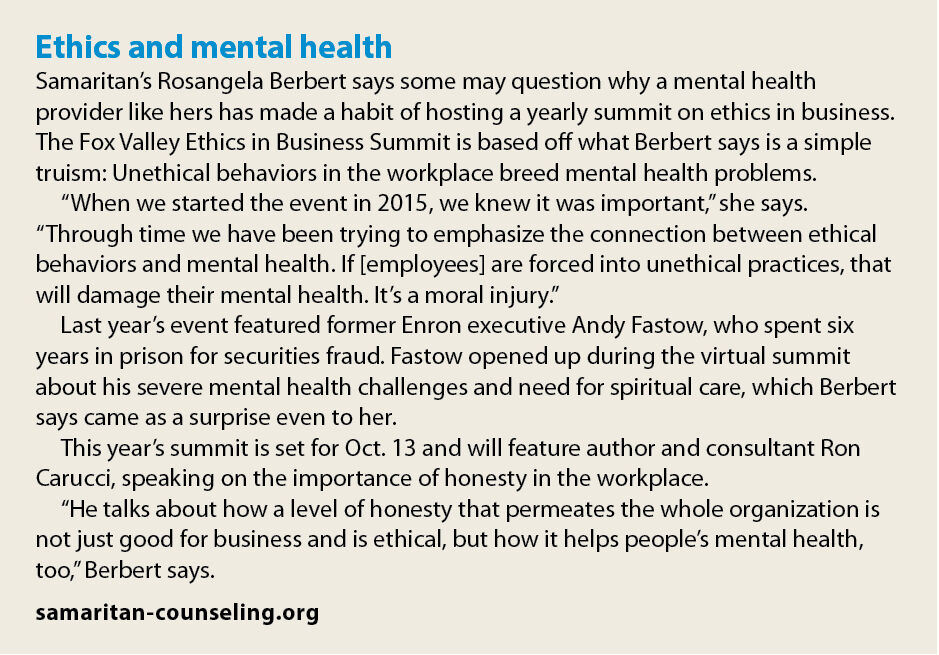
At Samaritan, Berbert says her organization also examines and emphasizes the importance of spiritual health when it comes to workplace wellness.
“Spiritual care is sometimes the best resource a person can have to keep their mental wellness in check,” Berbert says, adding that spiritual care doesn’t necessarily mean religion. “It can be yoga, meditation, as simple as ensuring staff and team members take their breaks throughout the day. It’s helping people stay well in a holistic way. It’s helping folks lean into what’s important to them and what gives them a sense of purpose.”
“What we’re trying to accomplish in the workplace when it comes to employee satisfaction is with their whole life, as opposed to just balancing work against everything else,” Rau says. “There are seven or eight areas people need to attend to.” One of those areas, Rau says, is spiritual growth and development.
New normal
So is the uptick in mental health concerns a function of decreased health or increased willingness to speak out? Berbert says this is a question she receives often, and the answer is yes to both. The world has become a more dangerous place, she says, and technology and social media magnify fears.
“We are living in times that are very different,” Berbert says. “The 9/11 terrorist attacks in Washington, New York, everyone felt the aftershock of that. So many lives were lost. But now how many lives have been lost in the pandemic? It came inside our houses, inside every single workplace.”
Berbert says fear has reached new levels that are clearly affecting mental health. She says Samaritan’s school-based screening program saw a 133% increase in mental health needs from 2020 to 2022.
Speaking on the topic of workplace mental health at the NEW Manufacturing Alliance’s quarterly meeting in June, Lisa Tutskey, a licensed marriage and family therapist with Prevea Health, said the pandemic has brought with it increases in anxiety, depression, substance abuse, suicide, overdose deaths and domestic violence. Prevea’s referral numbers, she says, are up almost 25%.
Tutskey points to the loss of connection, support, relationships and security COVID brought. Work, she points out, is for many people tied closely to security.
“When our needs aren’t met, we feel unsafe,” she says. “If people don’t feel safe, we have mental health issues that can arise. We can’t underestimate the long-term impact this could have on people because what was once a very safe world became a very unsafe and scary world.”
Tutskey recommends getting back into the “routine of connection” at work, including eating lunch with coworkers or even just making a point to stop by someone’s desk and say hi.
“Everyone talks about wanting to go back to normal,” Tutskey says. “We can’t go back. We can create a new normal, but it’s going to be important for all of us to understand how we feel about what happened.”