


Should we still export?
Wisconsin business leaders recently converged in Pewaukee on a stormy morning, the one‑year anniversary of President Donald Trump’s April 2 “Liberation Day,” to take the pulse of manufacturing exports in Wisconsin following a wild year of tariff activity.
Conservative‑leaning The Tax Foundation estimates that U.S. tariff policy has changed more than 50 times under Trump, and a recent Pew Research Center study found that 6 in 10 U.S. adults are not confident in the president’s decisions about trade policy.
Confusion and frustration with the administration’s tariffs, many of which were struck down by the Supreme Court in February, loomed large over the event — but the easy answer to the event’s defining question is an emphatic yes from keynote speaker Roxanne Baumann, architect of the Wisconsin ExporTech program who now serves as an independent exporting consultant with her firm, Baumann Global.
“The middle class in United States is basically retiring. We’re getting rid of our stuff. We’re not buying a lot of things. We didn’t have a lot of kids. There’s not a huge group of folks coming up behind us. So the world’s purchasing power is now outside of the United States,” Baumann explained. “Ninety‑five percent of the people you could sell to are outside of the United States. So the answer is, yes, we definitely want to, you know, find those people, get to them and build business with them.”
Baumann, who has been advising manufacturers for more than three decades, has long said one of the keys to success in exporting is being intentional about identifying a list of 10 countries to which your goods can be traded. In the age of tariffs, adding “pivot” countries to the list can be a lifeline.
“From an export side, there’s 197 countries on the globe,” she told attendees at the Brookfield Chamber‑sponsored forum. “We’re always planning ahead for the next one.”
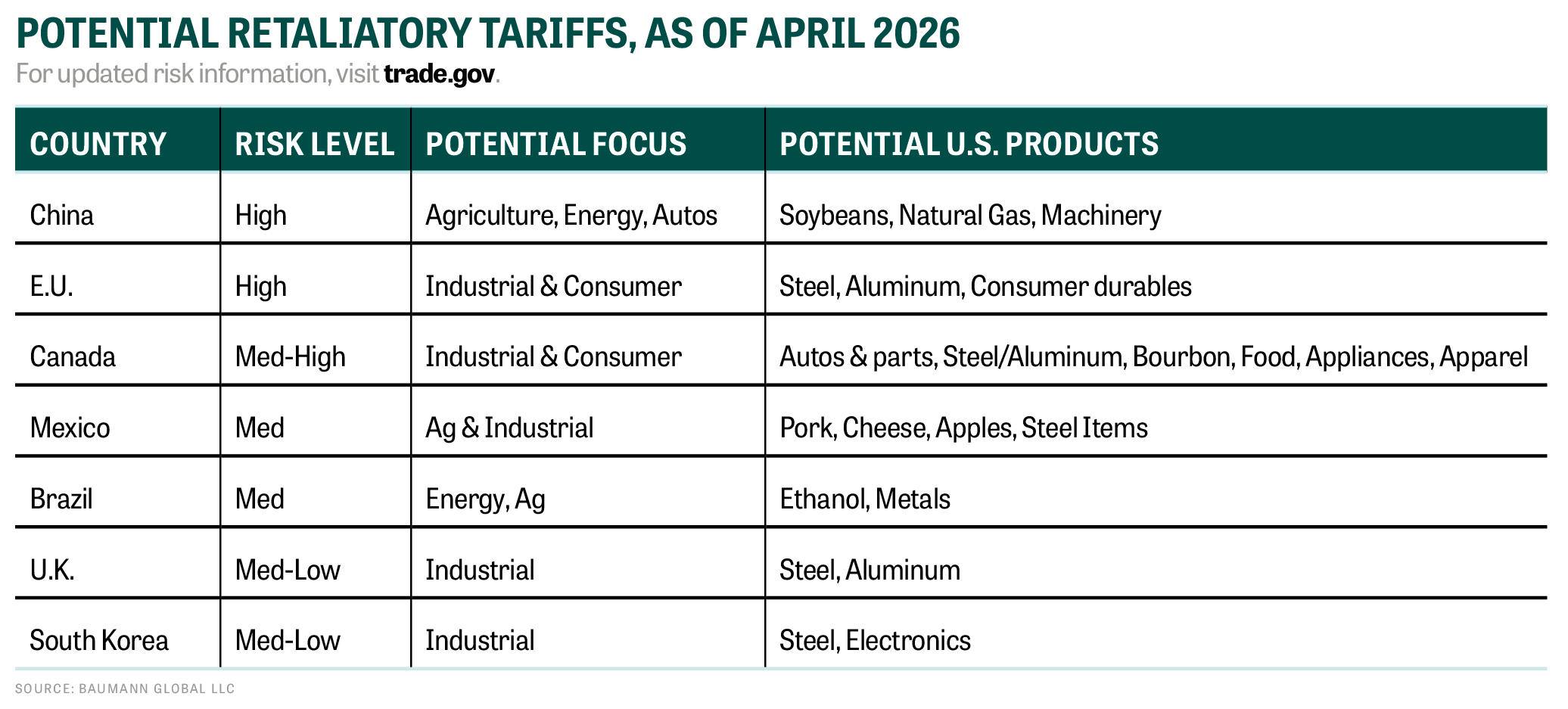
Retaliatory tariffs are among the ever‑changing issues manufacturers must eye as they navigate the exporting landscape. Baumann encourages manufacturers to visit trade.gov and search for the Foreign Retaliations Database, where companies can enter their harmonized code (available through their shipping departments) and get the latest information on what retaliations may currently be in place for a given nation.
Baumann outlined a series of short‑term measures manufacturers can take in the event the U.S. is slapped with a given retaliatory tariff, but “none of them are really great choices,” she said. Diversified markets will always prove more effective than short‑term fixes, and having critical conversations can strengthen relationships.
“You can proactively communicate to your customers, you know: ‘We’re in this together. No one wanted this.’ It’s a geopolitical risk, but we’ve got to deal with it,” she said, adding that most business leaders have been trained not to discuss politics with customers but may need to come to meetings prepared to share their views in a politically correct way.
“They will ask you what you think about politics that are going on in the U.S.,” Baumann said. “When you go overseas, what the U.S. does affects everything in other countries, because we’re a big player, you know, and so they want to know what are your thoughts.”
Communication and compromise are critical: A lot of exporters have agreed to split tariff costs 50/50 with their customers, Baumann added.
After all, for many companies, pivoting the supply chain on a dime isn’t possible and shouldering the burden of tariffs together is truly the only viable solution. This is true at TLX Technologies in Pewaukee, where a large part of the firm’s business is making vehicle parts. Speaking on the April 2 panel, CEO Neil Karolek said some customers have “sucked it up” as the “cost of doing business” because the alternative of not making the vehicle at all is much bleaker.

“We found that most of the customers, no matter where they are worldwide for our products, end up accepting the tariff and putting [it] on as a separate line item,” Karolek said. “They’re always waiting for the tariff to be killed and get reparations back to them again. So that’s still something that’s in the works. Our uniqueness of our products [is] that they’re custom designed for these customers. It’s very difficult for Ford to suddenly say, well, we’re not going to put that brake system on the F‑150 anymore. We’ll go to somebody else. It takes years to get a system on a car.”
Of course, tariffs are just one cost burden affecting U.S. exporters as of April 2026. The conflict in Iran has sent fuel prices surging. Empirical estimates from the U.S. Department of Commerce suggest a 10% rise in energy costs typically reduces U.S. manufacturing exports by roughly 1‑5%, with larger effects in energy‑intensive sectors. Insurance costs, labor costs and health care costs — Wisconsin’s rank in the top 5 nationally — are also on the rise, creating a multiplier effect for exporters.
While much uncertainty remains about how long certain tariffs will endure and what the specific impact of the Supreme Court’s February ruling will be, Baumann said companies must remain limber and continue to export high‑value products from Wisconsin, even in the face of financial challenges.
“We’ve done it for years … Our state has supported it. We’ve got great infrastructure,” Baumann said. “Are you really going to bet your business on the 5% of customers that are left here in the United States going forward, or are you going to figure this out?”

