

Community leaders in Wisconsin had a chance to learn the latest on Wisconsin’s Broadband Equity Access and Deployment (BEAD) grant program, which was disrupted by federal policy changes earlier this year.
The University of Wisconsin-Madison Extension and the PSC’s Wisconsin broadband office hosted the webinar “BEAD 2025: What Changed, What’s Next, and What Communities Can Do,” offering an action plan to government and community officials.
The bipartisan BEAD program, implemented as a part of the 2021 Infrastructure Investment and Jobs Act, allocated about $42.5 billion to deploy broadband infrastructure nationwide with the goal of affordable and reliable internet for all, says Mark Leonard, PSC, broadband Planning and Policy coordinator.
Wisconsin was allocated just under $1.1 billion. “There was a tremendous amount of preparation work for BEAD over the past three to four years,” Leonard says. That included the “Badger the FCC” public campaign, the Internet for All Wisconsin Listening Tour, BEAD Local Planning Grants for county, tribal and regional economic development organizations, broadband planning toolkits, and BEAD five-year action plans that involved two volumes, public comments and commission approval, he says.
On June 6, the National Telecommunications and Information Administration (NTIA), the federal agency responsible for administering BEAD, implemented changes to the policy, directing states to rebid all their projects and to rescind all preliminary awards.
The new policy eliminated requirements related to fair labor practices, workforce development, middle-class affordability, climate change resilience and open network access. Instead, states were required to complete a Benefit of the Bargain (BOB) round with new scoring criteria that favored the lowest cost bidder and a technology-neutral approach, whereas previously the BEAD process had implemented a fiber-first approach.
States had until Sept. 4 to complete the BOB subgranting process and submit the final proposal to NTIA.
Round One of BEAD was already into preliminary awards and Round Two was about to close when the updated NTIA guidance came out, says Brittany Byers, UW Extension community economic development specialist.
The prior two BEAD rounds would have deployed fiber optics to 99.3%, or 185,163, locations at an average cost of $5,004 per location, Byers says.
The updated preliminary awards average about $4,000 a location, says Rory Tikalsky, manager of the Wisconsin Broadband Office. The decrease is attributed to the new policy changes prioritizing lowest cost, as well as that “the mix of technologies is significantly different than the original round.”
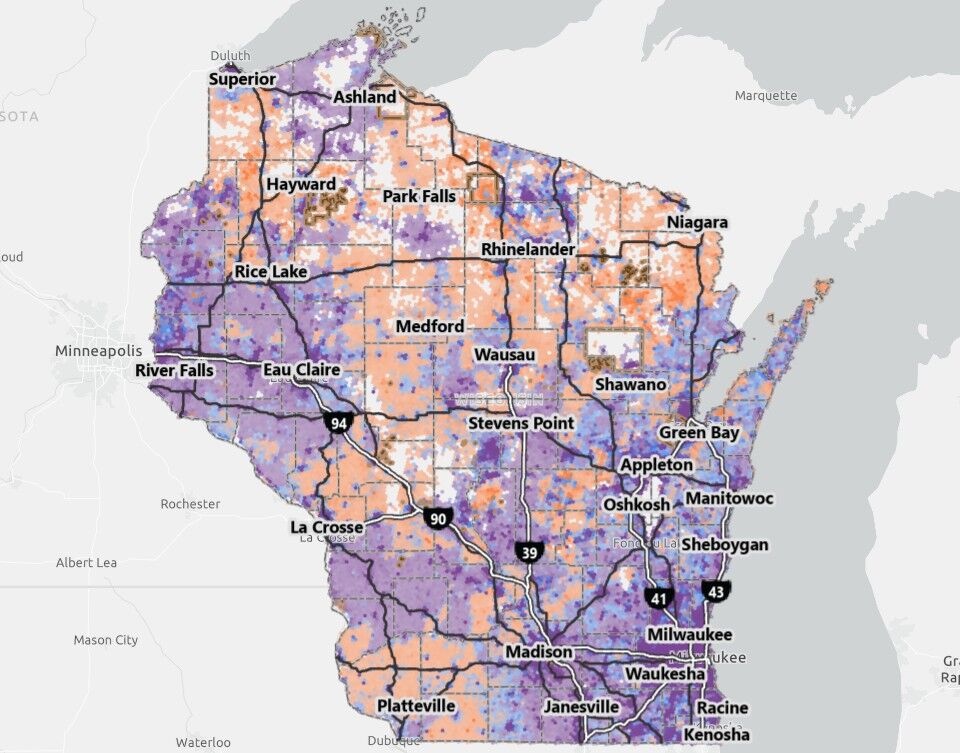
As of Oct. 14, Wisconsin has updated preliminary awards to 174,337 locations with just more than $690 million awarded. That includes:
- 76.1% fiber optics to 132,620 locations
- 9.9% fixed wireless to 17,204 locations
- 14% LEO satellite to 24,321 locations
- 0.1% mixed technologies to 192 locations
On Tuesday, the NTIA announced the approval of BEAD Final Proposals in 18 states and territories, not including Wisconsin. The NTIA is still working on approval of final proposals, and the state expects to hear from NTIA by Dec. 4.
Communities are encouraged to review their broadband plans and check the BEAD preliminary awards by location, technology and awardee on this PSC map: (https://maps.psc.wi.gov/portal/apps/experiencebuilder/experience/?id=a09ed2f175184454a3c8785a3490f545). Those needing assistance can email pscbeadgrants@wisconsin.gov.
Community leaders also should review endorsement language and consult with Corporate Counsel if there was a financial commitment to projects. “Was it based solely on getting the BEAD grant, or do you have projects that you’ve committed funds to locally, and how are those going to move forward?” says Gail Huycke, community development broadband outreach specialist with UW Extension. “If they’re going to move forward, speak with your provider if you were partnering on BEAD. Remember, no one’s in this alone.”
Leaders also should speak with preliminary awardees if they have no prior relationship, she says. “That’s really important that you introduce yourself, open that conversation and let them know this is who they would be working with, as far as permitting and other types of things,” Huycke says.
Communities also should stay engaged with their broadband committees to keep on top of changes and continue to follow Wisconsin Broadband Office and UW Extension broadband newsletters.
“If we’re going to make BEAD work, we need to partner, and it’s going to take communities and ISPs all working together to make sure that these projects are going to be successful,” Huycke says.
Leaders also should “continue to speak with your elected officials about your community’s broadband access, adoption and affordability needs,” Huycke says. “We know that it’s a three-legged stool, and all those components are going to be important if we’re going to be successful.”
The state hopes to complete BEAD projects by 2030.